Thank you for visiting SNEWPapers!
Sign up free
Literary
July 11, 1807
Virginia Argus
Richmond, Virginia
What is this article about?
Oration by William Radford delivered in the Capitol on July 4, 1807, celebrating the American Revolution's triumphs over British tyranny, recounting key battles like Lexington, Bunker Hill, Saratoga, and Yorktown, praising the Constitution, warning against corruption, and urging resistance to renewed British aggressions including the Chesapeake incident.
Clipping
OCR Quality
98%
Excellent
Full Text
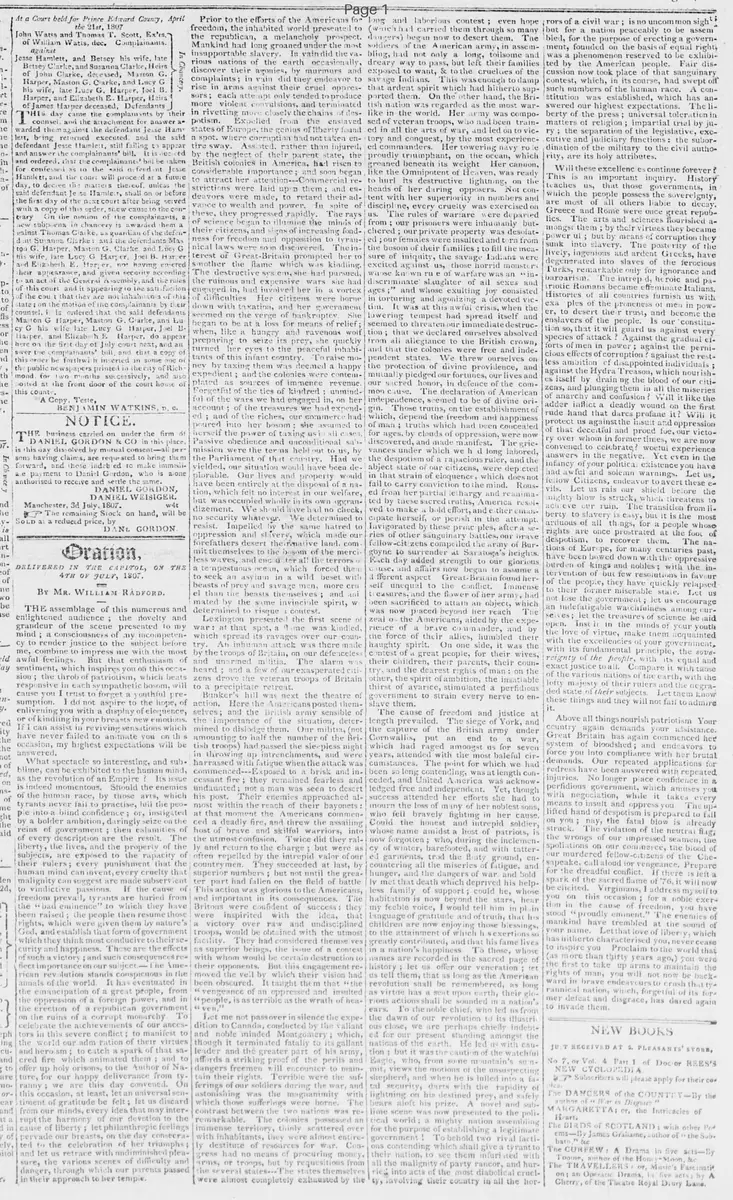
ORATION,
DELIVERED IN THE CAPITOL ON THE
4TH OF JULY, 1807.
By Mr. WILLIAM RADFORD.
The assemblage of this numerous and enlightened audience: the novelty and grandeur of the scene presented to my mind; a consciousness of my incompetency to render justice to the subject before me, combine to impress me with the most awful feelings. But that enthusiasm of sentiment, which inspires you on this occasion; the throb of patriotism, which beats responsive in each sympathetic bosom, will cause you I trust to forget a youthful presumption. I do not aspire to the hope, of enlivening you with a display of eloquence, or of kindling in your breasts new emotions. If I can assist in reviving sensations which have never failed to animate you on this occasion, my highest expectations will be answered.
What spectacle so interesting, and sublime, can be exhibited to the human mind, as the revolution of an Empire? Its issue is indeed momentous. Should the enemies of the human race, by those arts, which tyrants never fail to practise, lull the people into a blind confidence; or, instigated by a bolder ambition, daringly seize on the reins of government; then calamities of every description are the result. The liberty, the lives, and the property of the subjects, are exposed to the rapacity of their rulers; every punishment that the human mind can invent, every cruelty that malignity can suggest are made subservient to vindictive passions. If the cause of freedom prevail, tyrants are hurled from the bad eminence to which they have been raised; the people then resume those rights, which were given them by nature's God, and establish that form of government which they think most conducive to their security and happiness. These are the effects of such a victory; and such consequences reflect importance on our subject. The American revolution stands conspicuous in the annals of the world. It has eventuated in the emancipation of a great people, from the oppression of a foreign power, and in the erection of a republican government on the ruins of a corrupt monarchy. To celebrate the achievements of our ancestors in this severe conflict; to manifest to the world our admiration of their virtues and heroism; to catch a spark of that sacred fire which animated them; and to offer up holy orisons, to the Author of Nature, for our happy deliverance from tyranny; we are this day convened. On this occasion, at least, let an universal sentiment of gratitude be felt: let us discard from our minds, every idea that may interrupt the harmony of our devotion to the cause of liberty; let philanthropic feelings pervade our breasts, on the day consecrated to the celebration of her triumphs; and let us retrace with undiminished pleasure, the various scenes of difficulty and danger, through which our parents passed in their approach to her temple.
Prior to the efforts of the Americans for freedom, the inhabited world presented to the republican, a melancholy prospect. Mankind had long groaned under the most insupportable slavery. In vain did the various nations of the earth occasionally, discover their agonies, by murmurs and complaints: in vain did they endeavor to rise in arms against their cruel oppressors; each attempt only tended to produce more violent convulsions, and terminated in rivetting more closely the chains of despotism. Exiled from the enslaved states of Europe, the genius of liberty found a spot, where corruption had not taken entire sway. Assisted, rather than injured, by the neglect of their parent state, the British colonies in America, had risen to considerable importance; and soon began to attract her attention. Commercial restrictions were laid upon them: and endeavors were made, to retard their advance to wealth and power. In spite of these, they progressed rapidly. The rays of science began to illuminate the minds of their citizens, and signs of increasing fondness for freedom and opposition to tyrannical laws were soon discovered. The interest of Great-Britain prompted her to smother the flame which was kindling. The destructive system, she had pursued, the ruinous and expensive wars she had engaged in, had involved her in a vortex of difficulties. Her citizens were borne down with taxation, and her government seemed on the verge of bankruptcy. She began to be at a loss for means of relief: when, like a hungry and ravenous wolf preparing to seize its prey, she quickly turned her eyes to the peaceful inhabitants of this infant country. To raise money by taxing them was deemed a happy expedient; and the colonies were contemplated as sources of immense revenue. Forgetful of the ties of kindred: unmindful of the wars we had engaged in, on her account; of the treasures we had expended; and of the riches, our commerce had poured into her bosom; she assumed to herself the power of taxing us in all cases. Passive obedience and unconditional submission were the terms held out to us, by the Parliament of that country. Had we yielded, our situation would have been deplorable. Our lives and property would have been entirely at the disposal of a nation, which felt no interest in our welfare, but was occupied wholly in its own aggrandizement. We should have had no check, no security whatever. We determined to resist. Impelled by the same hatred to oppression and slavery, which made our forefathers desert their native land, commit themselves to the bosom of the merciless waves, and encounter all the terrors of a tempestuous ocean, which forced them to seek an asylum in a wild beset with beasts of prey and savage men, more cruel than the beasts themselves; and stimulated by the same invincible spirit, we determined to risk a contest.
Lexington presented the first scene of war: at that spot, a flame was kindled, which spread its ravages over our country. An inhuman attack was there made by the troops of Britain, on our defenceless and unarmed militia. The alarm was heard; and a few of our exasperated citizens drove the veteran troops of Britain to a precipitate retreat.
Bunker's Hill was next the theatre of action. Here the Americans posted themselves; and the British army sensible of the importance of the situation, determined to dislodge them. Our militia, (not amounting to half the number of the British troops) had passed the sleepless night in throwing up intrenchments, and were harrassed with fatigue when the attack was commenced. Exposed to a brisk and incessant fire; they remained fearless and undaunted; not a man was seen to desert his post. Their enemies approached almost within the reach of their bayonets: at that moment the Americans commenced a deadly fire, and threw the assailing host of brave and skilful warriors, into the utmost confusion. Twice did they rally and return to the charge; but were as often repelled by the intrepid valor of our Countrymen. They succeeded at last, by superior numbers; but not until the greater part had fallen on the field of battle. This action was glorious to the Americans, and important in its consequences. The Britons were confident of success: they were inspired with the idea, that a victory over raw and undisciplined troops, would be obtained with the utmost facility. They had considered themselves as superior beings, the issue of a contest with whom would be certain destruction to their opponents. But this engagement removed the veil by which their vision had been obscured. It taught them that "the vengeance of an oppressed and insulted people, is as terrible as the wrath of heaven."
Let me not pass over in silence the expedition to Canada, conducted by the valiant and noble minded Montgomery; which, though it terminated fatally to its gallant leader and the greater part of his army, affords a striking proof of the perils and dangers freemen will encounter to maintain their rights. Terrible were the sufferings of our soldiers during the war, and astonishing was the magnanimity with which those sufferings were borne. The contrast between the two nations was remarkable. The colonies possessed an immense territory, thinly scattered over with inhabitants, they were almost entirely destitute of resources for war. Congress had no means of procuring money, arms, or troops, but by requisitions from the several states. The states themselves were almost completely exhausted by the long and laborious contest; even hope (which had carried them through so many dangers) began now to desert them. The soldiers of the American army, in assembling, had not only a long, toilsome and dreary way to pass, but left their families exposed to want, & to the cruelties of the savage Indians. This was enough to damp that ardent spirit which had hitherto supported them. On the other hand, the British nation was regarded as the most warlike in the world. Her army was composed of veteran troops, who had been trained in all the arts of war, and led on to victory and conquest, by the most experienced commanders. Her towering navy rode proudly triumphant, on the ocean, which groaned beneath its weight. Her cannon, like the Omnipotent of Heaven, was ready to hurl its destructive lightning, on the heads of her daring opposers. Not content with her superiority in numbers and discipline, every cruelty was exercised on us. The rules of warfare were departed from; our prisoners were inhumanly butchered: our private property was desolated; our females were insulted and torn from the bosom of their families: to fill the measure of iniquity, the savage Indians were excited against us, those horrid monsters whose known rule of warfare was an "indiscriminate" slaughter of all sexes and ages;" and whose exulting joy consisted in torturing and agonizing a devoted victim. It was at this awful crisis, when the lowering tempest had spread itself and seemed to threaten our immediate destruction; that we declared ourselves absolved from all allegiance to the British crown, and that the colonies were free and independent states. We threw ourselves on the protection of divine providence, and mutually pledged our fortunes, our lives and our sacred honor, in defence of the common cause. The declaration of American independence, seemed to be of divine origin. "Those truths, on the establishment of which, depend the freedom and happiness of man; truths which had been concealed for ages, by clouds of oppression, were now discovered, and made manifest. The grievances under which we had long labored, the despotism of a rapacious ruler, and the abject state of our citizens, were depicted in that strain of eloquence, which does not fail to carry conviction to the mind. Roused from her partial lethargy and reanimated by these sacred truths, America resolved to make a bold effort, and either emancipate herself, or perish in the attempt. Invigorated by these principles, after a series of other Sanguinary battles, our brave fellow-citizens compelled the army of Burgoyne to surrender at Saratoga's heights. Each day added strength to our glorious cause, and affairs now began to assume a different aspect. Great-Britain found herself unequal to the conflict. Immense treasures, and the flower of her army, had been sacrificed to attain an object, which was now placed beyond her reach. The zeal of the Americans, aided by the experience of a brave commander, and by the force of their allies, humbled their haughty spirit. On one side, it was the contest of a great people, for their wives, their children, their parents, their country, and the dearest rights of man: on the other, the spirit of ambition, the insatiable thirst of avarice, stimulated a perfidious government to strain every nerve to enslave them.
The cause of freedom and justice at length prevailed. The siege of York, and the capture of the British army under Cornwallis, put an end to a war, which had raged amongst us for seven years, attended with the most baleful circumstances. The point for which we had been so long contending, was at length conceded, and United America was acknowledged free and independent. Yet, though success attended her efforts she had to mourn the loss of many of her noblest sons, who fell bravely fighting in her cause. Could the honest and intrepid soldier, whose name amidst a host of patriots, is now forgotten; who, during the inclemency of winter, barefooted, and with tattered garments, trod the frozen ground, encountering all the miseries of fatigue, and hunger, and the dangers of war and boldly met that death which deprived his helpless family of support; could he, whose habitation is now beyond the stars, hear my feeble voice, I would tell him in plain language of gratitude and of truth, that his children are now enjoying those blessings, to the attainment of which his exertions so greatly contributed, and that his fame lives in a nation's happiness. To those, whose names are recorded in the sacred page of history; let us offer our veneration; let us tell them, that as long as the American revolution shall be remembered, as long as virtue has a seat upon earth, their glorious actions shall be sounded in a nation's ears. To the noble chief, who led us from the dawn of our revolution to its illustrious close, we are perhaps chiefly indebted for our present standing amongst the nations of the earth. He led on with caution; but it was the caution of the watchful Eagle, who, from some mountain's summit, views the motions of the unsuspecting shepherd, and when he is lulled into a fatal security, darts with the rapidity of lightning on his destined prey, and safely bears aloft his prize. A novel and sublime scene was now presented to the political world; a mighty nation assembling for the purpose of establishing a legitimate government! To behold two rival factions contending which shall give a tyrant to their nation, to see them infuriated with all the malignity of party rancor, and hurrying into acts of the most diabolical cruelty, involving their country in all the horrors of a civil war: is no uncommon sight; but for a nation peaceably to be assembled, for the purpose of erecting a government, founded on the basis of equal rights was a phenomenon reserved to be exhibited by the American people. Fair discussion now took place of that sanguinary contest, which, in its course, had swept off such numbers of the human race. A constitution was established, which has answered our highest expectations. The liberty of the press; universal toleration in matters of religion; impartial trial by jury; the separation of the legislative, executive and judiciary functions: the subordination of the military to the civil authority, are its holy attributes.
Will these excellences continue forever? This is an important inquiry. History teaches us, that those governments, in which the people possess the Sovereignty, are most of all others liable to decay. Greece and Rome were once great republics. The arts and sciences flourished amongst them; by their virtues they became powerful; but by means of corruption they sunk into slavery. The posterity of the lively, ingenious and ardent Greeks, have degenerated into slaves of the ferocious Turks, remarkable only for ignorance and barbarism. The intrepid, heroic and patriotic Romans became effeminate Italians. Histories of all countries furnish us with examples of the proneness of men in power, to desert their trust, and become the enslavers of the people. Is our constitution so, that it will guard us against every species of attack? Against the gradual efforts of men in power; against the pernicious effects of corruption? against the restless ambition of disappointed individuals; against the Hydra Treason, which nourishes itself by draining the blood of our citizens, and plunging them in all the miseries of anarchy and confusion? Will it like the adder inflict a deadly wound on the first rude hand that dares profane it? Will it protect us against the insult and oppression of that deceitful and proud foe, our victory over whom in former times, we are now convened to celebrate? Woeful experience answers in the negative. Yet even in the infancy of your political existence you have had awful and solemn warnings. Let us, fellow Citizens, endeavor to avert these evils. Let us raise our shield before the mighty blow is struck, which threatens to achieve our ruin. The transition from liberty to slavery is easy, but it is the most arduous of all things, for a people whose rights are once prostrated at the foot of despotism, to recover them. The nations of Europe, for many centuries past, have been bowed down with the oppressive burden of kings and nobles; with the intervention of but few revolutions in favour of the people, they have quickly relapsed to their former miserable state. Let us not lose the government; let us encourage an indefatigable watchfulness among ourselves; let the treasures of science be laid open. Instil in the minds of your youth the love of virtue, make them acquainted with the excellencies of your government, with its fundamental principle, the sovereignty of the people, with its equal and exact justice to all. Compare it with those of the various nations of the earth, with the lofty majesty of their rulers and the degraded state of their subjects. Let them know these things and they will not fail to admire it.
Above all things nourish patriotism. Your country again demands your assistance. Great Britain has again commenced her system of bloodshed; and endeavors to force you into compliance with her brutal demands. Our repeated applications for redress have been answered with repeated injuries. No longer place confidence in a perfidious government, which amuses you with negociation, while it takes every means to insult and oppress you. The uplifted hand of despotism is prepared to fall on you; nay, the fatal blow is already struck. The violation of the neutral flag, the wrongs of our impressed seamen, the spoliations on our commerce, the blood of our murdered fellow-citizens of the Chesapeake, call aloud for vengeance. Prepare for the dreadful conflict. If there is left a spark of the sacred flame of '76, it will now be elicited. Virginians, I address myself to you on this occasion; for a noble exertion in the cause of freedom, you have stood "proudly eminent." The enemies of mankind have trembled at the sound of your name. Let that love of liberty, which has hitherto characterised you, never cease to inspire you. Proclaim to the world that (as more than thirty years ago,) you were the first to take up arms to maintain the rights of man, you will not now be backward in brave endeavours to crush that tyrannical nation, which, forgetful of its former defeat and disgrace, has dared again to invade them.
DELIVERED IN THE CAPITOL ON THE
4TH OF JULY, 1807.
By Mr. WILLIAM RADFORD.
The assemblage of this numerous and enlightened audience: the novelty and grandeur of the scene presented to my mind; a consciousness of my incompetency to render justice to the subject before me, combine to impress me with the most awful feelings. But that enthusiasm of sentiment, which inspires you on this occasion; the throb of patriotism, which beats responsive in each sympathetic bosom, will cause you I trust to forget a youthful presumption. I do not aspire to the hope, of enlivening you with a display of eloquence, or of kindling in your breasts new emotions. If I can assist in reviving sensations which have never failed to animate you on this occasion, my highest expectations will be answered.
What spectacle so interesting, and sublime, can be exhibited to the human mind, as the revolution of an Empire? Its issue is indeed momentous. Should the enemies of the human race, by those arts, which tyrants never fail to practise, lull the people into a blind confidence; or, instigated by a bolder ambition, daringly seize on the reins of government; then calamities of every description are the result. The liberty, the lives, and the property of the subjects, are exposed to the rapacity of their rulers; every punishment that the human mind can invent, every cruelty that malignity can suggest are made subservient to vindictive passions. If the cause of freedom prevail, tyrants are hurled from the bad eminence to which they have been raised; the people then resume those rights, which were given them by nature's God, and establish that form of government which they think most conducive to their security and happiness. These are the effects of such a victory; and such consequences reflect importance on our subject. The American revolution stands conspicuous in the annals of the world. It has eventuated in the emancipation of a great people, from the oppression of a foreign power, and in the erection of a republican government on the ruins of a corrupt monarchy. To celebrate the achievements of our ancestors in this severe conflict; to manifest to the world our admiration of their virtues and heroism; to catch a spark of that sacred fire which animated them; and to offer up holy orisons, to the Author of Nature, for our happy deliverance from tyranny; we are this day convened. On this occasion, at least, let an universal sentiment of gratitude be felt: let us discard from our minds, every idea that may interrupt the harmony of our devotion to the cause of liberty; let philanthropic feelings pervade our breasts, on the day consecrated to the celebration of her triumphs; and let us retrace with undiminished pleasure, the various scenes of difficulty and danger, through which our parents passed in their approach to her temple.
Prior to the efforts of the Americans for freedom, the inhabited world presented to the republican, a melancholy prospect. Mankind had long groaned under the most insupportable slavery. In vain did the various nations of the earth occasionally, discover their agonies, by murmurs and complaints: in vain did they endeavor to rise in arms against their cruel oppressors; each attempt only tended to produce more violent convulsions, and terminated in rivetting more closely the chains of despotism. Exiled from the enslaved states of Europe, the genius of liberty found a spot, where corruption had not taken entire sway. Assisted, rather than injured, by the neglect of their parent state, the British colonies in America, had risen to considerable importance; and soon began to attract her attention. Commercial restrictions were laid upon them: and endeavors were made, to retard their advance to wealth and power. In spite of these, they progressed rapidly. The rays of science began to illuminate the minds of their citizens, and signs of increasing fondness for freedom and opposition to tyrannical laws were soon discovered. The interest of Great-Britain prompted her to smother the flame which was kindling. The destructive system, she had pursued, the ruinous and expensive wars she had engaged in, had involved her in a vortex of difficulties. Her citizens were borne down with taxation, and her government seemed on the verge of bankruptcy. She began to be at a loss for means of relief: when, like a hungry and ravenous wolf preparing to seize its prey, she quickly turned her eyes to the peaceful inhabitants of this infant country. To raise money by taxing them was deemed a happy expedient; and the colonies were contemplated as sources of immense revenue. Forgetful of the ties of kindred: unmindful of the wars we had engaged in, on her account; of the treasures we had expended; and of the riches, our commerce had poured into her bosom; she assumed to herself the power of taxing us in all cases. Passive obedience and unconditional submission were the terms held out to us, by the Parliament of that country. Had we yielded, our situation would have been deplorable. Our lives and property would have been entirely at the disposal of a nation, which felt no interest in our welfare, but was occupied wholly in its own aggrandizement. We should have had no check, no security whatever. We determined to resist. Impelled by the same hatred to oppression and slavery, which made our forefathers desert their native land, commit themselves to the bosom of the merciless waves, and encounter all the terrors of a tempestuous ocean, which forced them to seek an asylum in a wild beset with beasts of prey and savage men, more cruel than the beasts themselves; and stimulated by the same invincible spirit, we determined to risk a contest.
Lexington presented the first scene of war: at that spot, a flame was kindled, which spread its ravages over our country. An inhuman attack was there made by the troops of Britain, on our defenceless and unarmed militia. The alarm was heard; and a few of our exasperated citizens drove the veteran troops of Britain to a precipitate retreat.
Bunker's Hill was next the theatre of action. Here the Americans posted themselves; and the British army sensible of the importance of the situation, determined to dislodge them. Our militia, (not amounting to half the number of the British troops) had passed the sleepless night in throwing up intrenchments, and were harrassed with fatigue when the attack was commenced. Exposed to a brisk and incessant fire; they remained fearless and undaunted; not a man was seen to desert his post. Their enemies approached almost within the reach of their bayonets: at that moment the Americans commenced a deadly fire, and threw the assailing host of brave and skilful warriors, into the utmost confusion. Twice did they rally and return to the charge; but were as often repelled by the intrepid valor of our Countrymen. They succeeded at last, by superior numbers; but not until the greater part had fallen on the field of battle. This action was glorious to the Americans, and important in its consequences. The Britons were confident of success: they were inspired with the idea, that a victory over raw and undisciplined troops, would be obtained with the utmost facility. They had considered themselves as superior beings, the issue of a contest with whom would be certain destruction to their opponents. But this engagement removed the veil by which their vision had been obscured. It taught them that "the vengeance of an oppressed and insulted people, is as terrible as the wrath of heaven."
Let me not pass over in silence the expedition to Canada, conducted by the valiant and noble minded Montgomery; which, though it terminated fatally to its gallant leader and the greater part of his army, affords a striking proof of the perils and dangers freemen will encounter to maintain their rights. Terrible were the sufferings of our soldiers during the war, and astonishing was the magnanimity with which those sufferings were borne. The contrast between the two nations was remarkable. The colonies possessed an immense territory, thinly scattered over with inhabitants, they were almost entirely destitute of resources for war. Congress had no means of procuring money, arms, or troops, but by requisitions from the several states. The states themselves were almost completely exhausted by the long and laborious contest; even hope (which had carried them through so many dangers) began now to desert them. The soldiers of the American army, in assembling, had not only a long, toilsome and dreary way to pass, but left their families exposed to want, & to the cruelties of the savage Indians. This was enough to damp that ardent spirit which had hitherto supported them. On the other hand, the British nation was regarded as the most warlike in the world. Her army was composed of veteran troops, who had been trained in all the arts of war, and led on to victory and conquest, by the most experienced commanders. Her towering navy rode proudly triumphant, on the ocean, which groaned beneath its weight. Her cannon, like the Omnipotent of Heaven, was ready to hurl its destructive lightning, on the heads of her daring opposers. Not content with her superiority in numbers and discipline, every cruelty was exercised on us. The rules of warfare were departed from; our prisoners were inhumanly butchered: our private property was desolated; our females were insulted and torn from the bosom of their families: to fill the measure of iniquity, the savage Indians were excited against us, those horrid monsters whose known rule of warfare was an "indiscriminate" slaughter of all sexes and ages;" and whose exulting joy consisted in torturing and agonizing a devoted victim. It was at this awful crisis, when the lowering tempest had spread itself and seemed to threaten our immediate destruction; that we declared ourselves absolved from all allegiance to the British crown, and that the colonies were free and independent states. We threw ourselves on the protection of divine providence, and mutually pledged our fortunes, our lives and our sacred honor, in defence of the common cause. The declaration of American independence, seemed to be of divine origin. "Those truths, on the establishment of which, depend the freedom and happiness of man; truths which had been concealed for ages, by clouds of oppression, were now discovered, and made manifest. The grievances under which we had long labored, the despotism of a rapacious ruler, and the abject state of our citizens, were depicted in that strain of eloquence, which does not fail to carry conviction to the mind. Roused from her partial lethargy and reanimated by these sacred truths, America resolved to make a bold effort, and either emancipate herself, or perish in the attempt. Invigorated by these principles, after a series of other Sanguinary battles, our brave fellow-citizens compelled the army of Burgoyne to surrender at Saratoga's heights. Each day added strength to our glorious cause, and affairs now began to assume a different aspect. Great-Britain found herself unequal to the conflict. Immense treasures, and the flower of her army, had been sacrificed to attain an object, which was now placed beyond her reach. The zeal of the Americans, aided by the experience of a brave commander, and by the force of their allies, humbled their haughty spirit. On one side, it was the contest of a great people, for their wives, their children, their parents, their country, and the dearest rights of man: on the other, the spirit of ambition, the insatiable thirst of avarice, stimulated a perfidious government to strain every nerve to enslave them.
The cause of freedom and justice at length prevailed. The siege of York, and the capture of the British army under Cornwallis, put an end to a war, which had raged amongst us for seven years, attended with the most baleful circumstances. The point for which we had been so long contending, was at length conceded, and United America was acknowledged free and independent. Yet, though success attended her efforts she had to mourn the loss of many of her noblest sons, who fell bravely fighting in her cause. Could the honest and intrepid soldier, whose name amidst a host of patriots, is now forgotten; who, during the inclemency of winter, barefooted, and with tattered garments, trod the frozen ground, encountering all the miseries of fatigue, and hunger, and the dangers of war and boldly met that death which deprived his helpless family of support; could he, whose habitation is now beyond the stars, hear my feeble voice, I would tell him in plain language of gratitude and of truth, that his children are now enjoying those blessings, to the attainment of which his exertions so greatly contributed, and that his fame lives in a nation's happiness. To those, whose names are recorded in the sacred page of history; let us offer our veneration; let us tell them, that as long as the American revolution shall be remembered, as long as virtue has a seat upon earth, their glorious actions shall be sounded in a nation's ears. To the noble chief, who led us from the dawn of our revolution to its illustrious close, we are perhaps chiefly indebted for our present standing amongst the nations of the earth. He led on with caution; but it was the caution of the watchful Eagle, who, from some mountain's summit, views the motions of the unsuspecting shepherd, and when he is lulled into a fatal security, darts with the rapidity of lightning on his destined prey, and safely bears aloft his prize. A novel and sublime scene was now presented to the political world; a mighty nation assembling for the purpose of establishing a legitimate government! To behold two rival factions contending which shall give a tyrant to their nation, to see them infuriated with all the malignity of party rancor, and hurrying into acts of the most diabolical cruelty, involving their country in all the horrors of a civil war: is no uncommon sight; but for a nation peaceably to be assembled, for the purpose of erecting a government, founded on the basis of equal rights was a phenomenon reserved to be exhibited by the American people. Fair discussion now took place of that sanguinary contest, which, in its course, had swept off such numbers of the human race. A constitution was established, which has answered our highest expectations. The liberty of the press; universal toleration in matters of religion; impartial trial by jury; the separation of the legislative, executive and judiciary functions: the subordination of the military to the civil authority, are its holy attributes.
Will these excellences continue forever? This is an important inquiry. History teaches us, that those governments, in which the people possess the Sovereignty, are most of all others liable to decay. Greece and Rome were once great republics. The arts and sciences flourished amongst them; by their virtues they became powerful; but by means of corruption they sunk into slavery. The posterity of the lively, ingenious and ardent Greeks, have degenerated into slaves of the ferocious Turks, remarkable only for ignorance and barbarism. The intrepid, heroic and patriotic Romans became effeminate Italians. Histories of all countries furnish us with examples of the proneness of men in power, to desert their trust, and become the enslavers of the people. Is our constitution so, that it will guard us against every species of attack? Against the gradual efforts of men in power; against the pernicious effects of corruption? against the restless ambition of disappointed individuals; against the Hydra Treason, which nourishes itself by draining the blood of our citizens, and plunging them in all the miseries of anarchy and confusion? Will it like the adder inflict a deadly wound on the first rude hand that dares profane it? Will it protect us against the insult and oppression of that deceitful and proud foe, our victory over whom in former times, we are now convened to celebrate? Woeful experience answers in the negative. Yet even in the infancy of your political existence you have had awful and solemn warnings. Let us, fellow Citizens, endeavor to avert these evils. Let us raise our shield before the mighty blow is struck, which threatens to achieve our ruin. The transition from liberty to slavery is easy, but it is the most arduous of all things, for a people whose rights are once prostrated at the foot of despotism, to recover them. The nations of Europe, for many centuries past, have been bowed down with the oppressive burden of kings and nobles; with the intervention of but few revolutions in favour of the people, they have quickly relapsed to their former miserable state. Let us not lose the government; let us encourage an indefatigable watchfulness among ourselves; let the treasures of science be laid open. Instil in the minds of your youth the love of virtue, make them acquainted with the excellencies of your government, with its fundamental principle, the sovereignty of the people, with its equal and exact justice to all. Compare it with those of the various nations of the earth, with the lofty majesty of their rulers and the degraded state of their subjects. Let them know these things and they will not fail to admire it.
Above all things nourish patriotism. Your country again demands your assistance. Great Britain has again commenced her system of bloodshed; and endeavors to force you into compliance with her brutal demands. Our repeated applications for redress have been answered with repeated injuries. No longer place confidence in a perfidious government, which amuses you with negociation, while it takes every means to insult and oppress you. The uplifted hand of despotism is prepared to fall on you; nay, the fatal blow is already struck. The violation of the neutral flag, the wrongs of our impressed seamen, the spoliations on our commerce, the blood of our murdered fellow-citizens of the Chesapeake, call aloud for vengeance. Prepare for the dreadful conflict. If there is left a spark of the sacred flame of '76, it will now be elicited. Virginians, I address myself to you on this occasion; for a noble exertion in the cause of freedom, you have stood "proudly eminent." The enemies of mankind have trembled at the sound of your name. Let that love of liberty, which has hitherto characterised you, never cease to inspire you. Proclaim to the world that (as more than thirty years ago,) you were the first to take up arms to maintain the rights of man, you will not now be backward in brave endeavours to crush that tyrannical nation, which, forgetful of its former defeat and disgrace, has dared again to invade them.
What sub-type of article is it?
Essay
What themes does it cover?
Liberty Freedom
Patriotism
Political
What keywords are associated?
American Revolution
Independence Day
British Tyranny
Patriotism
Liberty
Bunker Hill
Saratoga
Yorktown
Chesapeake Incident
What entities or persons were involved?
By Mr. William Radford.
Literary Details
Title
Oration, Delivered In The Capitol On The 4th Of July, 1807.
Author
By Mr. William Radford.
Subject
Celebration Of American Independence And Warning Against British Aggression
Form / Style
Patriotic Oration In Prose
Key Lines
What Spectacle So Interesting, And Sublime, Can Be Exhibited To The Human Mind, As The Revolution Of An Empire?
The American Revolution Stands Conspicuous In The Annals Of The World.
It Taught Them That "The Vengeance Of An Oppressed And Insulted People, Is As Terrible As The Wrath Of Heaven."
We Threw Ourselves On The Protection Of Divine Providence, And Mutually Pledged Our Fortunes, Our Lives And Our Sacred Honor, In Defence Of The Common Cause.
The Violation Of The Neutral Flag, The Wrongs Of Our Impressed Seamen, The Spoliations On Our Commerce, The Blood Of Our Murdered Fellow Citizens Of The Chesapeake, Call Aloud For Vengeance.