Thank you for visiting SNEWPapers!
Sign up free
The Savannah Tribune
Savannah, Chatham County, Georgia
What is this article about?
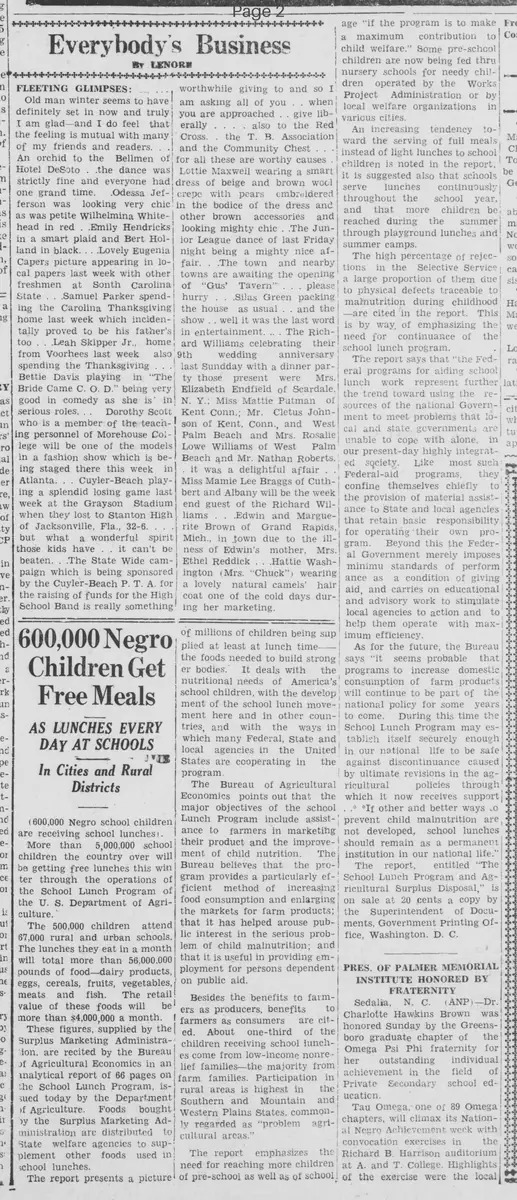
The U.S. Department of Agriculture's School Lunch Program will provide free lunches this winter to over 5 million school children nationwide, including 600,000 Negro children in 67,000 rural and urban schools, using agricultural surplus to improve child nutrition and support farmers.
Clipping
OCR Quality
Full Text
Children Get
Free Meals
AS LUNCHES EVERY
DAY AT SCHOOLS
JVIS
In Cities and Rural
Districts
(600,000 Negro school children
are receiving school lunches).
More than
5,000,000 school
children the country over will
be getting free lunches this winter
through the operations of
the School Lunch Program of
the U. S. Department of Agri-
culture.
The 600,000 children attend
67,000 rural and urban schools.
The lunches they eat in a month
will total more than 56,000,000
pounds of food—dairy products,
eggs, cereals, fruits, vegetables,
meats and fish. The retail
value of these foods will
be
more than $4,000,000 a month.
These figures, supplied by the
Surplus Marketing Administra-
tion, are recited by the Bureau
of Agricultural Economics in an
analytical report of 66 pages on
the School Lunch Program, is-
sued today by the Department
of Agriculture. Foods bought
by the Surplus Marketing Ad-
ministration are distributed to
State welfare agencies to sup-
plement other foods used in
school lunches.
The report presents a picture
of millions of children being sup-
plied at least at lunch time
with the foods needed to build strong-
er bodies.
It deals with
the
nutritional needs of America's
school children, with the develop-
ment of the school lunch move-
ment here and in other coun-
tries, and with
the ways in
which many Federal, State and
local agencies in the United
States are cooperating in
the
program.
The Bureau of Agricultural
Economics points out that the
major objectives of the school
Lunch Program include assist-
ance to farmers in marketing
their product and the improve-
ment of child nutrition. The
Bureau believes that the pro-
gram provides a particularly ef-
ficient method of increasing
food consumption and enlarging
the markets for farm products;
that it has helped arouse pub-
lic interest in the serious prob-
lem of child malnutrition; and
that it is useful in providing em-
ployment for persons dependent
on public aid.
Besides the benefits to farm-
ers as producers, benefits
to
farmers as consumers
are cit-
ed. About one-third of the
children receiving school lunch-
es come from low-income nonre-
lie f families—the majority from
farm families. Participation in
rural areas is highest in
the
Southern and Mountain
and
Western Plains States, common-
ly regarded as "problem agri-
cultural areas."
The report
emphasizes the
need for reaching more children
of pre-school as well as of school
age "if the program is to make
a maximum
contribution to
child welfare." Some pre-school
children are now being fed thru
nursery schools for needy chil-
dren operated by the Works
Project Administration or by
local welfare organizations in
various cities.
An increasing
tendency
to-
ward the serving of full meals
instead of light lunches to school
children is noted in the report.
It is suggested also that schools
serve
lunches
continuously
throughout the
school year,
and
that
more
children be
reached during
the
summer
through playground lunches and
summer camps.
The high percentage of rejec-
tions in the Selective Service—
a large proportion of them due
to physical defects traceable to
malnutrition during childhood
—are cited in the report. This
is by way of emphasizing the
need for continuance of the
school lunch program.
The report says that "the Fed-
eral programs for aiding school
lunch work represent further
the trend toward using the re-
sources of the national Govern-
ment to meet problems that lo-
cal and state governments are
unable to cope with alone, in
our present-day highly integrat-
ed society.
Like most such
Federal-aid
programs,
they
confine themselves chiefly
to
the provision of material assist-
anee to State and local agencies
that retain basic responsibility
for operating their own pro-
gram.
Beyond this the Feder-
al Government merely imposes
minimum standards of perform-
ance as a condition of giving
aid, and carries on educational
and advisory work to stimulate
local agencies to action and to
help them operate with max-
imum efficiency.
As for the future, the Bureau
says "it seems probable that
programs to increase domestic
consumption of farm products
will continue to be part of the
national policy for some years
to come. During this time the
School Lunch Program may es-
tablish itself securely enough
in our national life to be safe
against discontinuance caused
by ultimate revisions in the ag-
ricultural
policies through
which it now receives support.
If other and better ways to
prevent child malnutrition are
not developed, school lunches
should remain as a permanent
institution in our national life."
The report,
entitled "The
School Lunch Program and Ag-
ricultural Surplus Disposal," is
on sale at 20 cents a copy by
the Superintendent of Docu-
ments, Government Printing Of-
fice, Washington, D. C.
What sub-type of article is it?
What keywords are associated?
Where did it happen?
Domestic News Details
Primary Location
United States
Event Date
This Winter
Outcome
free lunches provided to over 5,000,000 school children monthly, utilizing 56,000,000 pounds of food valued at $4,000,000; improves child nutrition, supports farmers, and addresses malnutrition issues highlighted by selective service rejections.
Event Details
The U.S. Department of Agriculture's School Lunch Program distributes surplus foods to schools nationwide, providing free lunches to 5,000,000 children including 600,000 Negro children in 67,000 schools. A 66-page report by the Bureau of Agricultural Economics details the program's objectives, nutritional benefits, agency cooperation, and recommendations for expansion to pre-school and summer programs.