Thank you for visiting SNEWPapers!
Sign up free
Editorial
January 22, 1849
Republican Vindicator
Staunton, Virginia
What is this article about?
This editorial, titled 'LAOCOON NO. VII,' chronicles Virginia's legislative history from 1800 onward supporting the colonization of free people of color to Africa, highlights the formation of the American Colonization Society in 1816, and urges the 1849 legislature to fund emigration to Liberia to remove Virginia's 60,000 free colored population.
Clipping
OCR Quality
98%
Excellent
Full Text
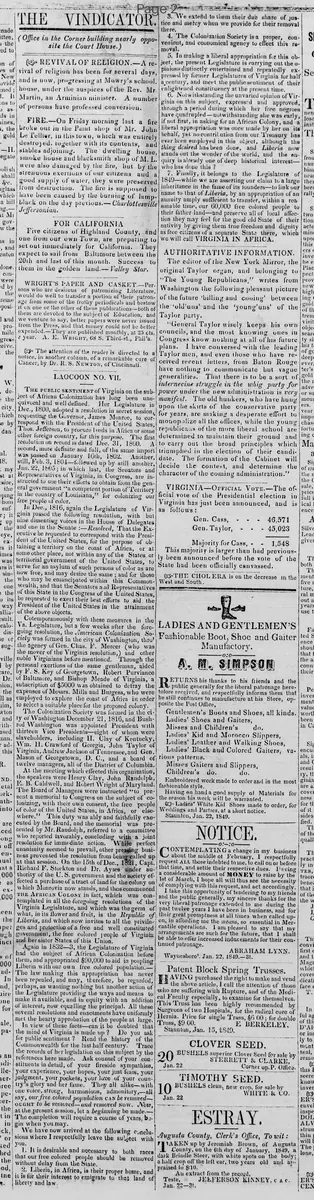
LAOCOON NO. VII.
The public sentiment of Virginia on the subject of African Colonization has long been unequivocal and well defined. Her Legislature in Dec., 1800, adopted a resolution in secret session, requesting the Governor, James Monroe, to correspond with the President of the United States, Thos. Jefferson, to procure lands in Africa or some other foreign country, for this purpose. The first resolution on record is dated Dec. 31, 1800. A second, more definite and full, of the same import was passed on January 16th, 1801. Another, still, Feb. 3, 1804 followed up by still another, Jan. 22, 1805; in which last, the Senators and Representatives of Virginia, in Congress, are instructed to use their efforts to obtain from the general government "a competent portion of Territory in the country of Louisiana," for colonizing our free people of color.
In Dec., 1816, again the Legislature of Virginia passed the following resolution, with but nine dissenting voices in the House of Delegates and one in the Senate:—Resolved, That the Executive be requested to correspond with the President of the United States, for the purpose of obtaining a territory on the coast of Africa, or at some other place, not within any of the States or territorial government of the United States, to serve for an asylum of such persons of color as are now free, and may desire the same; and for those who may be emancipated within this Commonwealth, and that the Senators and Representatives of this State in the Congress of the United States, be requested to exert their best efforts to aid the President of the United States in the attainment of the above objects.
Cotemporaneously with these measures in the Va. Legislature, but a few weeks after the foregoing resolution, the American Colonization Society was formed in the city of Washington, thro' the agency of Gen. Chas. F. Mercer (who was the mover of the Virginia resolution,) and other noble Virginians before mentioned. Through the personal exertions of the same gentleman, aided by F. S. Key of Georgetown, Robert Purviance of Baltimore, and Bishop Meade of Virginia, a subscription of $5000 was obtained to defray the expenses of Messrs. Mills and Burgess, who were employed to explore the coast of Africa in order to select a suitable place for the proposed colony.
The Colonization Society was formed in the city of Washington December 21, 1816, and Bushrod Washington was appointed President with thirteen Vice Presidents—eight of whom were slaveholders, including H. Clay of Kentucky, Wm. H. Crawford of Georgia, John Taylor of Virginia, Andrew Jackson of Tennessee, and Gen. Mason of Georgetown, D. C., and a board of twelve managers, all of the District of Columbia.
At the meeting which effected this organization, the speakers were Henry Clay, John Randolph, E. B. Caldwell, and Robert Wright of Maryland.
The Board of Managers were instructed "to present a memorial to Congress on the subject of colonizing, with their own consent, the free people of color of the United States, in Africa, or elsewhere." This duty was ably and faithfully executed by the Board, and the memorial was presented by Mr. Randolph, referred to a committee who reported favorably, concluding with a joint resolution for immediate action. While perfect unanimity seemed to prevail, other pressing business prevented the resolution from being called up at that session. On the 15th of Dec., 1821, Capt. Richard F. Stockton and Dr. Ayres under authority of the U.S. government and the society effected a purchase of a tract of land for the colony on which Monrovia now stands, and thus commenced THE AFRICAN COLONY in fact, which was contemplated in all the foregoing resolutions of the Virginia Legislature, and which was the germ of what, in its flower and fruit, is the Republic of Liberia, and which now invites to all the privileges and protection of a free and well constituted government, the free colored people of Virginia and her sister States of this Union.
Again in 1831-2, the Legislature of Virginia had the subject of African Colonization before them, and appropriated $30,000 to aid in peopling Liberia with our own free colored population.—The law making this appropriation has never been repealed, and may, therefore, be regarded, perhaps, as wanting nothing but another action of the Legislature providing the ways and means to make it available, and in equity with an addition of interest, now equalling the principal. All these several resolutions and enactments have uniformly met the hearty approbation of the people at large.
In view of these facts—can it be doubted that the mind of Virginia is made up? Do you ask for public sentiment? Read the history of the Commonwealth for the last half century. Trace the records of her legislation on this subject by the references here made. Ask counsel of your constituents in detail, of your fireside sympathies, your experience, your hopes, your just fears, your judgment, your pockets, your love of your country's glory and her fame. They all alike—with one voice, strong, harmonious, admonitory,—all say, our free colored population can be removed—ought to be removed—and removed now. Now at the present session, let a beginning be made.—The completion will require a course of years, begin when you may.
We have now arrived at the following conclusions where I respectfully leave the subject with you.
1. It is desirable and necessary to both races that our free colored people should be removed without delay from the State.
2. Liberia, in Africa, is their proper home, and it is for their interest to emigrate to that land of liberty and law.
3. We extend to them their due share of justice and mercy when we provide for their removal there.
4. The Colonization Society is a proper, convenient, and economical agency to effect this removal.
5. In making a liberal appropriation for this object, the present Legislature is carrying out the opinions distinctly entertained and repeatedly expressed by former Legislatures of Virginia for half a century, and meet the public sentiment of their enlightened constituency at the present time.
6. Notwithstanding the unvaried opinion of Virginia on this subject, expressed and approved, through a period during which her free negroes have quadrupled—notwithstanding she was early, if not first, in asking for an African Colony, and a liberal appropriation was once made by her on its behalf, yet no contribution from our Treasury has ever been employed in this object, although the thing desired has been done, and Liberia now stands out the wonder of the world, and the enquiry is already one of deep historical interest—who has done this?
7. Finally, it belongs to the Legislature of 1849—while we are asserting our claim to a large inheritance in the fame of its founders—to link our name to that of Liberia, by an appropriation of an annuity amply sufficient to transfer, within a reasonable time, our 60,000 free colored people to their father-land—and preserve all of local affection they may feel for the good old State of their nativity by giving them true freedom and dignity as free citizens of a separate State there, which we will call VIRGINIA IN AFRICA.
The public sentiment of Virginia on the subject of African Colonization has long been unequivocal and well defined. Her Legislature in Dec., 1800, adopted a resolution in secret session, requesting the Governor, James Monroe, to correspond with the President of the United States, Thos. Jefferson, to procure lands in Africa or some other foreign country, for this purpose. The first resolution on record is dated Dec. 31, 1800. A second, more definite and full, of the same import was passed on January 16th, 1801. Another, still, Feb. 3, 1804 followed up by still another, Jan. 22, 1805; in which last, the Senators and Representatives of Virginia, in Congress, are instructed to use their efforts to obtain from the general government "a competent portion of Territory in the country of Louisiana," for colonizing our free people of color.
In Dec., 1816, again the Legislature of Virginia passed the following resolution, with but nine dissenting voices in the House of Delegates and one in the Senate:—Resolved, That the Executive be requested to correspond with the President of the United States, for the purpose of obtaining a territory on the coast of Africa, or at some other place, not within any of the States or territorial government of the United States, to serve for an asylum of such persons of color as are now free, and may desire the same; and for those who may be emancipated within this Commonwealth, and that the Senators and Representatives of this State in the Congress of the United States, be requested to exert their best efforts to aid the President of the United States in the attainment of the above objects.
Cotemporaneously with these measures in the Va. Legislature, but a few weeks after the foregoing resolution, the American Colonization Society was formed in the city of Washington, thro' the agency of Gen. Chas. F. Mercer (who was the mover of the Virginia resolution,) and other noble Virginians before mentioned. Through the personal exertions of the same gentleman, aided by F. S. Key of Georgetown, Robert Purviance of Baltimore, and Bishop Meade of Virginia, a subscription of $5000 was obtained to defray the expenses of Messrs. Mills and Burgess, who were employed to explore the coast of Africa in order to select a suitable place for the proposed colony.
The Colonization Society was formed in the city of Washington December 21, 1816, and Bushrod Washington was appointed President with thirteen Vice Presidents—eight of whom were slaveholders, including H. Clay of Kentucky, Wm. H. Crawford of Georgia, John Taylor of Virginia, Andrew Jackson of Tennessee, and Gen. Mason of Georgetown, D. C., and a board of twelve managers, all of the District of Columbia.
At the meeting which effected this organization, the speakers were Henry Clay, John Randolph, E. B. Caldwell, and Robert Wright of Maryland.
The Board of Managers were instructed "to present a memorial to Congress on the subject of colonizing, with their own consent, the free people of color of the United States, in Africa, or elsewhere." This duty was ably and faithfully executed by the Board, and the memorial was presented by Mr. Randolph, referred to a committee who reported favorably, concluding with a joint resolution for immediate action. While perfect unanimity seemed to prevail, other pressing business prevented the resolution from being called up at that session. On the 15th of Dec., 1821, Capt. Richard F. Stockton and Dr. Ayres under authority of the U.S. government and the society effected a purchase of a tract of land for the colony on which Monrovia now stands, and thus commenced THE AFRICAN COLONY in fact, which was contemplated in all the foregoing resolutions of the Virginia Legislature, and which was the germ of what, in its flower and fruit, is the Republic of Liberia, and which now invites to all the privileges and protection of a free and well constituted government, the free colored people of Virginia and her sister States of this Union.
Again in 1831-2, the Legislature of Virginia had the subject of African Colonization before them, and appropriated $30,000 to aid in peopling Liberia with our own free colored population.—The law making this appropriation has never been repealed, and may, therefore, be regarded, perhaps, as wanting nothing but another action of the Legislature providing the ways and means to make it available, and in equity with an addition of interest, now equalling the principal. All these several resolutions and enactments have uniformly met the hearty approbation of the people at large.
In view of these facts—can it be doubted that the mind of Virginia is made up? Do you ask for public sentiment? Read the history of the Commonwealth for the last half century. Trace the records of her legislation on this subject by the references here made. Ask counsel of your constituents in detail, of your fireside sympathies, your experience, your hopes, your just fears, your judgment, your pockets, your love of your country's glory and her fame. They all alike—with one voice, strong, harmonious, admonitory,—all say, our free colored population can be removed—ought to be removed—and removed now. Now at the present session, let a beginning be made.—The completion will require a course of years, begin when you may.
We have now arrived at the following conclusions where I respectfully leave the subject with you.
1. It is desirable and necessary to both races that our free colored people should be removed without delay from the State.
2. Liberia, in Africa, is their proper home, and it is for their interest to emigrate to that land of liberty and law.
3. We extend to them their due share of justice and mercy when we provide for their removal there.
4. The Colonization Society is a proper, convenient, and economical agency to effect this removal.
5. In making a liberal appropriation for this object, the present Legislature is carrying out the opinions distinctly entertained and repeatedly expressed by former Legislatures of Virginia for half a century, and meet the public sentiment of their enlightened constituency at the present time.
6. Notwithstanding the unvaried opinion of Virginia on this subject, expressed and approved, through a period during which her free negroes have quadrupled—notwithstanding she was early, if not first, in asking for an African Colony, and a liberal appropriation was once made by her on its behalf, yet no contribution from our Treasury has ever been employed in this object, although the thing desired has been done, and Liberia now stands out the wonder of the world, and the enquiry is already one of deep historical interest—who has done this?
7. Finally, it belongs to the Legislature of 1849—while we are asserting our claim to a large inheritance in the fame of its founders—to link our name to that of Liberia, by an appropriation of an annuity amply sufficient to transfer, within a reasonable time, our 60,000 free colored people to their father-land—and preserve all of local affection they may feel for the good old State of their nativity by giving them true freedom and dignity as free citizens of a separate State there, which we will call VIRGINIA IN AFRICA.
What sub-type of article is it?
Slavery Abolition
Social Reform
What keywords are associated?
African Colonization
Free Colored People
Liberia
Virginia Legislature
American Colonization Society
Emigration
Racial Removal
What entities or persons were involved?
Virginia Legislature
American Colonization Society
James Monroe
Thomas Jefferson
Charles F. Mercer
Henry Clay
John Randolph
Bushrod Washington
Liberia
Editorial Details
Primary Topic
Advocacy For Colonization Of Virginia's Free Colored People To Liberia
Stance / Tone
Strongly Supportive Of Immediate Removal Via American Colonization Society
Key Figures
Virginia Legislature
American Colonization Society
James Monroe
Thomas Jefferson
Charles F. Mercer
Henry Clay
John Randolph
Bushrod Washington
Liberia
Key Arguments
Virginia Has Consistently Supported African Colonization Since 1800 Through Multiple Resolutions
American Colonization Society Formed In 1816 With Virginia Involvement Led To Liberia's Establishment
Free Colored People Should Be Removed Without Delay For Benefit Of Both Races
Liberia Is Their Proper Home Offering Liberty And Law
Colonization Society Is Efficient Agency For Removal
Legislature Should Appropriate Funds To Fulfill Historical Commitments
Virginia Claims Role In Liberia's Founding And Should Fund Emigration Of 60,000 Free Colored People