Thank you for visiting SNEWPapers!
Sign up free
Story
January 25, 1884
Bismarck Tribune
Bismarck, Burleigh County, North Dakota
What is this article about?
Article contrasts historical Missouri River navigation using primitive bull boats with modern steamer travel, highlighting the shift from pioneer and Native American ways to civilized progress, via photographs by Mr. O. S. Gof.
Clipping
OCR Quality
98%
Excellent
Full Text
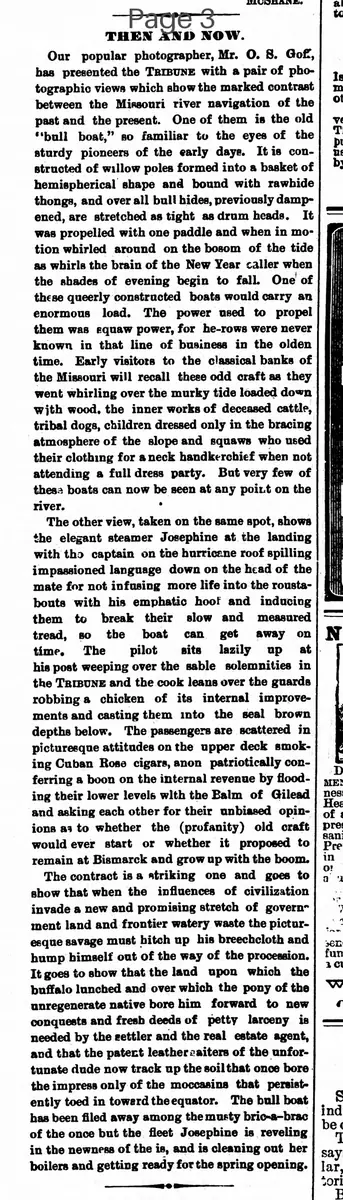
THEN AND NOW
Our popular photographer, Mr. O. S. Gof, has presented the TRIBUNE with a pair of photographic views which show the marked contrast between the Missouri river navigation of the past and the present. One of them is the old "bull boat," so familiar to the eyes of the sturdy pioneers of the early days. It is constructed of willow poles formed into a basket of hemispherical shape and bound with rawhide thongs, and over all bull hides, previously dampened, are stretched as tight as drum heads. It was propelled with one paddle and when in motion whirled around on the bosom of the tide as whirls the brain of the New Year caller when the shades of evening begin to fall. One of these queerly constructed boats would carry an enormous load. The power used to propel them was squaw power, for he-rows were never known in that line of business in the olden time. Early visitors to the classical banks of the Missouri will recall these odd craft as they went whirling over the murky tide loaded down with wood, the inner works of deceased cattle, tribal dogs, children dressed only in the bracing atmosphere of the slope and squaws who used their clothing for a neck handkerchief when not attending a full dress party. But very few of these boats can now be seen at any point on the river.
The other view, taken on the same spot, shows the elegant steamer Josephine at the landing with the captain on the hurricane roof spilling impassioned language down on the head of the mate for not infusing more life into the roustabouts with his emphatic hoof and inducing them to break their slow and measured tread, so the boat can get away on time. The pilot sits lazily up at his post weeping over the sable solemnities in the Tribune and the cook leans over the guards robbing a chicken of its internal improvements and casting them into the seal brown depths below. The passengers are scattered in picturesque attitudes on the upper deck smoking Cuban Rose cigars, anon patriotically conferring a boon on the internal revenue by flooding their lower levels with the Balm of Gilead and asking each other for their unbiased opinions as to whether the (profanity) old craft would ever start or whether it proposed to remain at Bismarck and grow up with the boom.
The contrast is a striking one and goes to show that when the influences of civilization invade a new and promising stretch of government land and frontier watery waste the picturesque savage must hitch up his breechcloth and hump himself out of the way of the procession. It goes to show that the land upon which the buffalo lunched and over which the pony of the unregenerate native bore him forward to new conquests and fresh deeds of petty larceny is needed by the settler and the real estate agent, and that the patent leather gaiters of the unfortunate dude now track up the soil that once bore the impress only of the moccasins that persistently toed in toward the equator. The bull boat has been filed away among the musty bric-a-brac of the once but the fleet Josephine is reveling in the newness of the is, and is cleaning out her boilers and getting ready for the spring opening.
Our popular photographer, Mr. O. S. Gof, has presented the TRIBUNE with a pair of photographic views which show the marked contrast between the Missouri river navigation of the past and the present. One of them is the old "bull boat," so familiar to the eyes of the sturdy pioneers of the early days. It is constructed of willow poles formed into a basket of hemispherical shape and bound with rawhide thongs, and over all bull hides, previously dampened, are stretched as tight as drum heads. It was propelled with one paddle and when in motion whirled around on the bosom of the tide as whirls the brain of the New Year caller when the shades of evening begin to fall. One of these queerly constructed boats would carry an enormous load. The power used to propel them was squaw power, for he-rows were never known in that line of business in the olden time. Early visitors to the classical banks of the Missouri will recall these odd craft as they went whirling over the murky tide loaded down with wood, the inner works of deceased cattle, tribal dogs, children dressed only in the bracing atmosphere of the slope and squaws who used their clothing for a neck handkerchief when not attending a full dress party. But very few of these boats can now be seen at any point on the river.
The other view, taken on the same spot, shows the elegant steamer Josephine at the landing with the captain on the hurricane roof spilling impassioned language down on the head of the mate for not infusing more life into the roustabouts with his emphatic hoof and inducing them to break their slow and measured tread, so the boat can get away on time. The pilot sits lazily up at his post weeping over the sable solemnities in the Tribune and the cook leans over the guards robbing a chicken of its internal improvements and casting them into the seal brown depths below. The passengers are scattered in picturesque attitudes on the upper deck smoking Cuban Rose cigars, anon patriotically conferring a boon on the internal revenue by flooding their lower levels with the Balm of Gilead and asking each other for their unbiased opinions as to whether the (profanity) old craft would ever start or whether it proposed to remain at Bismarck and grow up with the boom.
The contrast is a striking one and goes to show that when the influences of civilization invade a new and promising stretch of government land and frontier watery waste the picturesque savage must hitch up his breechcloth and hump himself out of the way of the procession. It goes to show that the land upon which the buffalo lunched and over which the pony of the unregenerate native bore him forward to new conquests and fresh deeds of petty larceny is needed by the settler and the real estate agent, and that the patent leather gaiters of the unfortunate dude now track up the soil that once bore the impress only of the moccasins that persistently toed in toward the equator. The bull boat has been filed away among the musty bric-a-brac of the once but the fleet Josephine is reveling in the newness of the is, and is cleaning out her boilers and getting ready for the spring opening.
What sub-type of article is it?
Historical Event
Curiosity
Journey
What themes does it cover?
Fortune Reversal
Triumph
Exploration
What keywords are associated?
Missouri River Navigation
Bull Boat
Steamer Josephine
Pioneer Craft
Civilization Progress
What entities or persons were involved?
Mr. O. S. Gof
Where did it happen?
Missouri River, Bismarck
Story Details
Key Persons
Mr. O. S. Gof
Location
Missouri River, Bismarck
Story Details
Photographs contrast old bull boats used by pioneers and Native Americans on the Missouri River with the modern steamer Josephine, illustrating the advance of civilization displacing traditional ways.