Thank you for visiting SNEWPapers!
Sign up free
Fowle's New Hampshire Gazette And General Advertiser
Portsmouth, Rockingham County, New Hampshire
What is this article about?
Continuation of James Mackenzie's essay on health preservation, focusing on the effects of mental passions like fear, grief, joy, and anger on the body, advocating for serenity and moderation. It discusses balancing diet and exercise, cautions against excess, sudden habit changes, and strength-impairing practices.
Merged-components note: These two components are sequential in reading order and the text directly continues from one to the other, forming a single literary article on health preservation split across columns.
Clipping
OCR Quality
Full Text
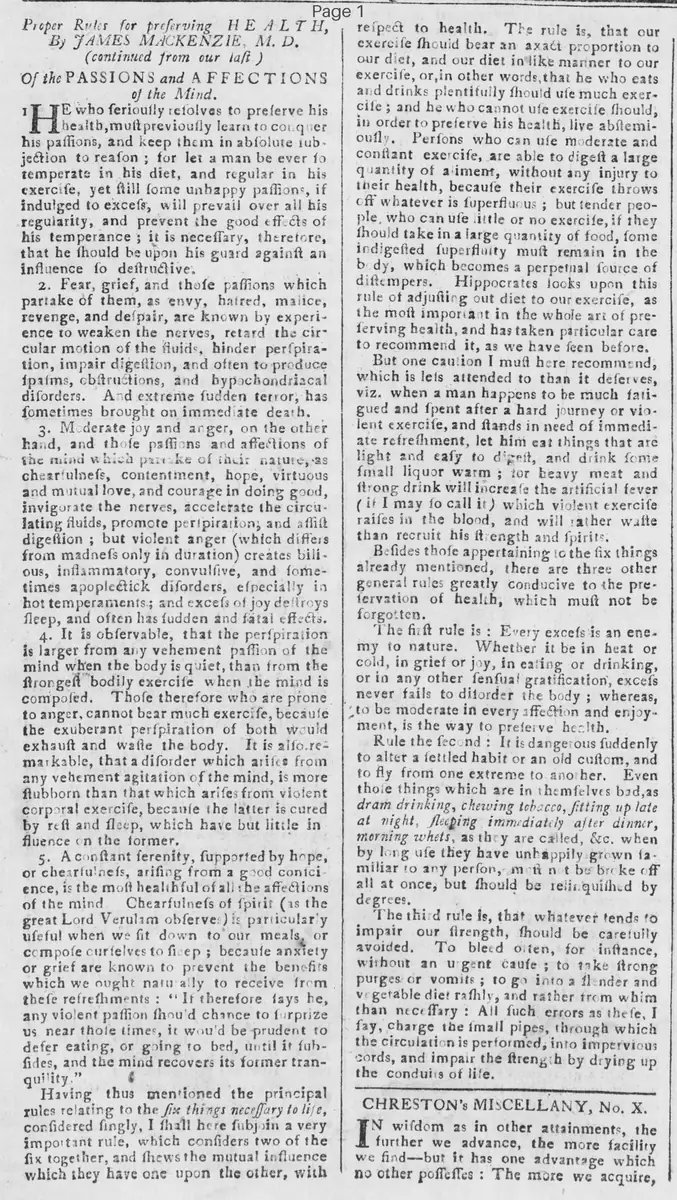
By JAMES MACKENZIE, M. D.
(continued from our last)
Of the PASSIONS and AFFECTIONS of the Mind.
He who is serious to reserve his passions, and keep them in absolute subjection to reason; for let a man be ever so temperate in his diet, and regular in his exercise, yet still some unhappy passions, if indulged to excess, will prevail over all his regularity, and prevent the good effects of his temperance; it is necessary, therefore, that he should be upon his guard against an influence so destructive.
2. Fear, grief, and those passions which partake of them, as envy, hatred, malice, revenge, and despair, are known by experience to weaken the nerves, retard the circular motion of the fluids, hinder perspiration, impair digestion, and often to produce spasms, obstructions, and hypochondriacal disorders. And extreme sudden terror has sometimes brought on immediate death.
3. Moderate joy and anger, on the other hand, and those passions and affections of the mind which partake of their nature, as cheerfulness, contentment, hope, virtuous and mutual love, and courage in doing good, invigorate the nerves, accelerate the circulating fluids, promote perspiration, and assist digestion; but violent anger (which differs from madness only in duration) creates bilious, inflammatory, convulsive, and sometimes apoplectick disorders, especially in hot temperaments; and excess of joy destroys sleep, and often has sudden and fatal effects.
4. It is observable, that the perspiration is larger from any vehement passion of the mind when the body is quiet, than from the strongest bodily exercise when the mind is composed. Those therefore who are prone to anger, cannot bear much exercise, because the exuberant perspiration of both would exhaust and waste the body. It is also remarkable, that a disorder which arises from any vehement agitation of the mind, is more stubborn than that which arises from violent corporal exercise, because the latter is cured by rest and sleep, which have but little influence on the former.
5. A constant serenity, supported by hope, or cheerfulness, arising from a good conscience, is the most healthful of all the affections of the mind. Cheerfulness of spirit (as the great Lord Verulam observes) is particularly useful when we sit down to our meals, or compose ourselves to sleep; because anxiety or grief are known to prevent the benefits which we ought naturally to receive from these refreshments: "If therefore, says he, any violent passion should chance to surprise us near those times, it would be prudent to defer eating, or going to bed, until it subsides, and the mind recovers its former tranquility."
Having thus mentioned the principal rules relating to the six things necessary to life, considered singly, I shall here subjoin a very important rule, which considers two of the six together, and shows the mutual influence which they have one upon the other, with respect to health. The rule is, that our exercise should bear an exact proportion to our diet, and our diet in like manner to our exercise, or in other words, that he who eats and drinks plentifully should use much exercise; and he who cannot use exercise should, in order to preserve his health, live abstemiously. Persons who can use moderate and constant exercise, are able to digest a large quantity of aliment, without any injury to their health, because their exercise throws off whatever is superfluous; but tender people, who can use little or no exercise, if they should take in a large quantity of food, some undigested superfluity must remain in the body, which becomes a perpetual source of distempers. Hippocrates looks upon this rule of adjusting our diet to our exercise, as the most important in the whole art of preserving health, and has taken particular care to recommend it, as we have seen before.
But one caution I must here recommend, which is less attended to than it deserves, viz. when a man happens to be much fatigued and spent after a hard journey or violent exercise, and stands in need of immediate refreshment, let him eat things that are light and easy to digest, and drink some small liquor warm; for heavy meat and strong drink will increase the artificial fever (if I may so call it) which violent exercise raises in the blood, and will rather waste than recruit his strength and spirits.
Besides those appertaining to the six things already mentioned, there are three other general rules greatly conducive to the preservation of health, which must not be forgotten.
The first rule is: Every excess is an enemy to nature. Whether it be in heat or cold, in grief or joy, in eating or drinking, or in any other sensual gratification, excess never fails to disorder the body; whereas, to be moderate in every affection and enjoyment, is the way to preserve health.
Rule the second: It is dangerous suddenly to alter a settled habit or an old custom, and to fly from one extreme to another. Even those things which are in themselves bad, as dram drinking, chewing tobacco, sitting up late at night, sleeping immediately after dinner, morning whets, as they are called, &c. when by long use they have unhappily grown familiar to any person, must not be broke off all at once, but should be relinquished by degrees.
The third rule is, that whatever tends to impair our strength, should be carefully avoided. To bleed often, for instance, without an urgent cause; to take strong purges or vomits; to go into a slender and vegetable diet rashly, and rather from whim than necessary: All such errors as these, I say, charge the small pipes, through which the circulation is performed, into impervious cords, and impair the strength by drying up the conduits of life.
What sub-type of article is it?
What themes does it cover?
What keywords are associated?
What entities or persons were involved?
Literary Details
Title
Proper Rules For Preserving Health, Of The Passions And Affections Of The Mind.
Author
By James Mackenzie, M. D.
Subject
Continued From Our Last
Key Lines