Thank you for visiting SNEWPapers!
Sign up free
Daily Los Angeles Herald
Los Angeles, Los Angeles County, California
What is this article about?
Post-Berlin Congress analysis warns of renewed European war due to unresolved tensions: Austrian resistance in Bosnia and Herzegovina, Bulgarian disputes, Greek and Italian discontent, Russian resentments, and British overextension in Cyprus and Afghanistan.
Clipping
OCR Quality
Full Text
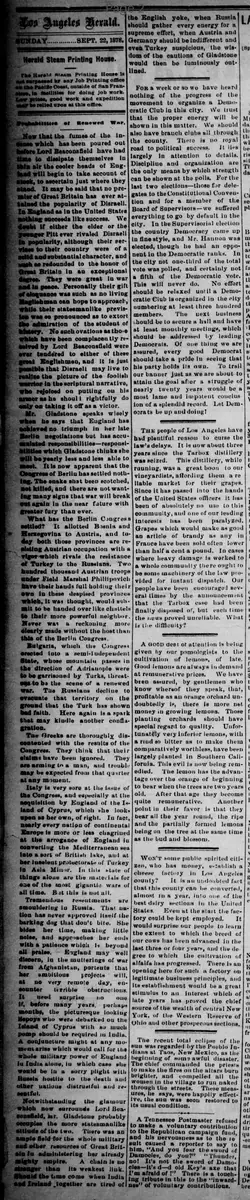
Now that the fumes of the inspe which has been poured out before Lord Beaconsfield have had time to dissipate themselves in thin air the cooler heads of England will begin to take account of stock, to ascertain just where they stand. It may be said that no premier of Great Britain has ever attained the popularity of Disraeli. In England as in the United States nothing succeeds like success. We doubt if either the elder or the younger Pitt ever rivaled Disraeli in popularity, although their services to their country were of a solid and substantial character, and such as redounded to the honor of Great Britain in an exceptional degree. They were great in war and in peace. Personally their gift of eloquence was such as no living Englishman can hope to approach, while their statesmanlike prevision was so pronounced as to extort admiration of the student of history. No such ovations as those which have been complacently received by Lord Beaconsfield were ever tendered to either of these great Englishmen, and it is just possible that Disraeli may live to realize the picture of the foolish warrior in the scriptural narrative, who rejoiced on putting on his armor as he should rightfully do on taking it off as a victor. Mr. Gladstone speaks wisely when he says that England has achieved no triumph in her late Berlin negotiations but has accumulated responsibilities—responsibilities which Gladstone thinks she will be yearly less and less able to meet. It is now apparent that the Congress of Berlin has settled nothing. The snake has been scotched, not killed, and there are not wanting many signs that war will break out again in the near future with greater fury than ever. What has the Berlin Congress settled? It allotted Bosnia and Herzegovina to Austria, and today both those provinces are resisting Austrian occupation with a vigor which rivals the resistance of Turkey to the Russians. Two hundred thousand Austrian troops under Field Marshal Phillipovich have their hands full holding their own in these despised provinces which it was thought would submit to be handed over like chattels to their more powerful neighbor. Never was a reckoning more clearly made without the host than this of the Berlin Congress. Bulgaria, which the Congress erected into a semi-independent State, whose mountain passes in the direction of Adrianople were to be garrisoned by Turks, threatens to be the scene of a renewed war. The Russians decline to evacuate that territory on the ground that the Turk has shown bad faith. Here again is a spark that may kindle another conflagration. The Greeks are thoroughly discontented with the results of the Congress. They think that their claims have been ignored. They are arming to a man, and trouble may be expected from that quarter at any moment. Italy is very sore at the issue of the Congress, and especially at the acquisition by England of the Island of Cyprus, which she looks upon as her own, of right. In fact, nearly every nation of continental Europe is more or less chagrined at the arrogance of England in converting the Mediterranean sea into a sort of British lake, and at her insolent protectorate of Turkey in Asia Minor. In this state of things alone are the materials for one of the most gigantic wars of all time. But this is not all. Tremendous resentments are smouldering in Russia. That nation has never approved itself the barking dog that don't bite. She bides her time, making little noise, and approaches her ends with a patience which is beyond all praise. England may well discern, in the mutterings of war from Afghanistan, portents that her ambitious projects will, at no very remote day, encounter terrible obstructions. It need surprise no one if, before many years, perhaps months, the picturesque looking Sepoys who were debarked on the Island of Cyprus with so much pomp should be required in India. A conjuncture might at any moment arise which would call for the whole military power of England in India alone, in which case she would be in a sorry plight with Russia hostile to the death and other nations distrustful and resentful. Notwithstanding the glamour which now surrounds Lord Beaconsfield, Mr. Gladstone probably occupies the more statesmanlike attitude of the two. There was an ample field for the whole military and other resources of Great Britain in administering her already mighty empire. A chain is no stronger than its weakest link. Should the time come when India and Ireland together are tired of the English yoke, when Russia should gather every energy for a supreme effort, when Austria and Germany should be indifferent and even Turkey suspicious, the wisdom of the cautions of Gladstone would then be luminously outlined.
What sub-type of article is it?
What keywords are associated?
What entities or persons were involved?
Where did it happen?
Foreign News Details
Primary Location
Europe
Key Persons
Outcome
bosnia and herzegovina resisting austrian occupation with 200,000 troops engaged; bulgaria threatens renewed war due to russian refusal to evacuate; greeks arming in discontent; italy sore over cyprus acquisition; russian resentments smouldering; potential for gigantic war involving multiple nations.
Event Details
The Berlin Congress has settled nothing, leading to renewed war risks: Bosnia and Herzegovina resist Austrian occupation; Bulgaria faces Russian-Turkish standoff; Greeks and Italians discontented with territorial outcomes; Russia bides time amid resentments; England accumulates responsibilities per Gladstone, risking overextension in India and elsewhere.