Thank you for visiting SNEWPapers!
Sign up free
Story
April 18, 1906
The Sun
New York, New York County, New York
What is this article about?
Theater review of 'The Strength of the Weak' starring Florence Roberts at the Liberty, a problem play about a woman's seduction, redemption attempt, and tragic suicide upon learning her lover is her seducer's son. Praised for clever dialogue but criticized for lacking depth and spiritual resolution.
Clipping
OCR Quality
95%
Excellent
Full Text
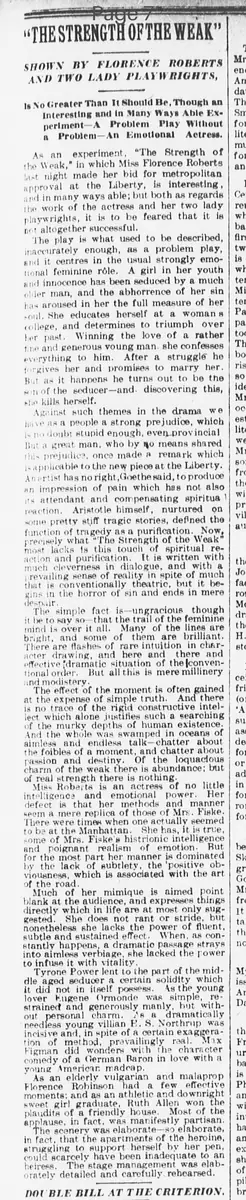
"THE STRENGTH OF THE WEAK"
SHOWN BY FLORENCE ROBERTS
AND TWO LADY PLAYWRIGHTS,
Is No Greater Than It Should Be, Though an
Interesting and In Many Ways Able Ex-
periment—A Problem Play Without
Problem—An Emotional Actress.
As an experiment, "The Strength of
the Weak," in which Miss Florence Roberts
last night made her bid for metropolitan
approval at the Liberty, is interesting,
and in many ways able; but both as regards
the work of the actress and her two lady
playwrights, it is to be feared that it is
not altogether successful.
The play is what used to be described,
and it centres in the usual strongly emo-
accurately enough, as a problem play,
tional feminine role. A girl in her youth
and innocence has been seduced by a much
older man, and the abhorrence of her sin
has aroused in her the full measure of her
soul. She educates herself at a woman's
college, and determines to triumph over
her past. Winning the love of a rather
kind and generous young man, she confesses
everything to him. After a struggle he
forgives her and promises to marry her.
But as it happens he turns out to be the
son of the seducer—and, discovering this,
she kills herself.
Against such themes in the drama we
have as a people a strong prejudice, which
is no doubt stupid enough, even provincial.
But a great man, who by no means shared
this prejudice, once made a remark which
is applicable to the new piece at the Liberty.
An artist has no right, Goethe said, to produce
an impression of pain which has not also
its attendant and compensating spiritual
reaction. Aristotle himself, nurtured on
some pretty stiff tragic stories, defined the
function of tragedy as a purification. Now,
precisely what "The Strength of the Weak"
most lacks is this touch of spiritual re-
action and purification. It is written with
much cleverness in dialogue, and with a
prevailing sense of reality in spite of much
that is conventionally theatric, but it be-
gins in the horror of sin and ends in mere
despair.
The simple fact is—ungracious though
it be to say so—that the trail of the feminine
mind is over it all. Many of the lines are
bright, and some of them are brilliant.
There are flashes of rare intuition in char-
acter drawing, and here and there an
effective dramatic situation of the conventional order. But all this is mere millinery
and modistry.
The effect of the moment is often gained
at the expense of simple truth. And there
is no trace of the rigid constructive intel-
lect which alone justifies such a searching
of the murky depths of human existence.
And the whole was swamped in oceans of
aimless and endless talk—chatter about
the foibles of a moment, and chatter about
passion and destiny. Of the loquacious
charm of the weak there is abundance; but
of real strength there is nothing.
Miss Roberts is an actress of no little
intelligence and emotional power. Her
defect is that her methods and manner
seem a mere replica of those of Mrs. Fiske.
There were times when one actually seemed
to be at the Manhattan. She has, it is true,
some of Mrs. Fiske's histrionic intelligence
and poignant realism of emotion. But
for the most part her manner is dominated
by the lack of subtlety, the positive ob-
viousness, which is associated with the art
of the road.
Much of her mime is aimed point
blank at the audience, and expresses things
directly which in life are at most only sug-
gested. She does not rant or stride, but
nonetheless she lacks the power of fluent,
subtle and sustained effect. When, as con-
stantly happens, a dramatic passage strays
into aimless verbiage, she lacked the power
to infuse it with vitality.
Tyrone Power lent to the part of the mid-
dle aged seducer a certain solidity which
it did not in itself possess. As the young
lover Eugene Ormonde was simple, re-
strained and generously manly, but with-
out personal charm. As a dramatically
needless young villain E. S. Northrup was
incisive and, in spite of a certain exaggera-
tion of method, prevailingly real. Mix
Figman did wonders with the character
comedy of a German Baron in love with a
young American madcap.
As an elderly vulgarian and malaprop
Florence Robinson had a few effective
moments; and as an athletic and downright
sweet girl graduate, Ruth Allen won the
plaudits of a friendly house. Most of the
applause, in fact, was manifestly partisan.
The scenery was elaborate—so elaborate,
in fact, that the apartments of the heroine,
struggling to support herself by her pen,
could scarcely have been inadequate to an
heiress. The stage management was elab.
orately detailed and carefully rehearsed.
SHOWN BY FLORENCE ROBERTS
AND TWO LADY PLAYWRIGHTS,
Is No Greater Than It Should Be, Though an
Interesting and In Many Ways Able Ex-
periment—A Problem Play Without
Problem—An Emotional Actress.
As an experiment, "The Strength of
the Weak," in which Miss Florence Roberts
last night made her bid for metropolitan
approval at the Liberty, is interesting,
and in many ways able; but both as regards
the work of the actress and her two lady
playwrights, it is to be feared that it is
not altogether successful.
The play is what used to be described,
and it centres in the usual strongly emo-
accurately enough, as a problem play,
tional feminine role. A girl in her youth
and innocence has been seduced by a much
older man, and the abhorrence of her sin
has aroused in her the full measure of her
soul. She educates herself at a woman's
college, and determines to triumph over
her past. Winning the love of a rather
kind and generous young man, she confesses
everything to him. After a struggle he
forgives her and promises to marry her.
But as it happens he turns out to be the
son of the seducer—and, discovering this,
she kills herself.
Against such themes in the drama we
have as a people a strong prejudice, which
is no doubt stupid enough, even provincial.
But a great man, who by no means shared
this prejudice, once made a remark which
is applicable to the new piece at the Liberty.
An artist has no right, Goethe said, to produce
an impression of pain which has not also
its attendant and compensating spiritual
reaction. Aristotle himself, nurtured on
some pretty stiff tragic stories, defined the
function of tragedy as a purification. Now,
precisely what "The Strength of the Weak"
most lacks is this touch of spiritual re-
action and purification. It is written with
much cleverness in dialogue, and with a
prevailing sense of reality in spite of much
that is conventionally theatric, but it be-
gins in the horror of sin and ends in mere
despair.
The simple fact is—ungracious though
it be to say so—that the trail of the feminine
mind is over it all. Many of the lines are
bright, and some of them are brilliant.
There are flashes of rare intuition in char-
acter drawing, and here and there an
effective dramatic situation of the conventional order. But all this is mere millinery
and modistry.
The effect of the moment is often gained
at the expense of simple truth. And there
is no trace of the rigid constructive intel-
lect which alone justifies such a searching
of the murky depths of human existence.
And the whole was swamped in oceans of
aimless and endless talk—chatter about
the foibles of a moment, and chatter about
passion and destiny. Of the loquacious
charm of the weak there is abundance; but
of real strength there is nothing.
Miss Roberts is an actress of no little
intelligence and emotional power. Her
defect is that her methods and manner
seem a mere replica of those of Mrs. Fiske.
There were times when one actually seemed
to be at the Manhattan. She has, it is true,
some of Mrs. Fiske's histrionic intelligence
and poignant realism of emotion. But
for the most part her manner is dominated
by the lack of subtlety, the positive ob-
viousness, which is associated with the art
of the road.
Much of her mime is aimed point
blank at the audience, and expresses things
directly which in life are at most only sug-
gested. She does not rant or stride, but
nonetheless she lacks the power of fluent,
subtle and sustained effect. When, as con-
stantly happens, a dramatic passage strays
into aimless verbiage, she lacked the power
to infuse it with vitality.
Tyrone Power lent to the part of the mid-
dle aged seducer a certain solidity which
it did not in itself possess. As the young
lover Eugene Ormonde was simple, re-
strained and generously manly, but with-
out personal charm. As a dramatically
needless young villain E. S. Northrup was
incisive and, in spite of a certain exaggera-
tion of method, prevailingly real. Mix
Figman did wonders with the character
comedy of a German Baron in love with a
young American madcap.
As an elderly vulgarian and malaprop
Florence Robinson had a few effective
moments; and as an athletic and downright
sweet girl graduate, Ruth Allen won the
plaudits of a friendly house. Most of the
applause, in fact, was manifestly partisan.
The scenery was elaborate—so elaborate,
in fact, that the apartments of the heroine,
struggling to support herself by her pen,
could scarcely have been inadequate to an
heiress. The stage management was elab.
orately detailed and carefully rehearsed.
What sub-type of article is it?
Tragedy
Romance
What themes does it cover?
Tragedy
Love
Misfortune
What keywords are associated?
Play Review
Tragedy
Seduction
Suicide
Problem Play
What entities or persons were involved?
Florence Roberts
Tyrone Power
Eugene Ormonde
E. S. Northrup
Mix Figman
Florence Robinson
Ruth Allen
Where did it happen?
Liberty Theater
Story Details
Key Persons
Florence Roberts
Tyrone Power
Eugene Ormonde
E. S. Northrup
Mix Figman
Florence Robinson
Ruth Allen
Location
Liberty Theater
Story Details
A young woman seduced by an older man educates herself, wins the love of a kind and generous young man, confesses her past, is forgiven, but upon discovering he is the son of her seducer, kills herself. The play is reviewed as an interesting but unsuccessful problem play lacking spiritual reaction.