Thank you for visiting SNEWPapers!
Sign up free
The Potters Herald
East Liverpool, Columbiana County, Ohio
What is this article about?
The Attlee Labour Government in Britain implements an austerity program to boost exports to dollar areas and cut expenditures by 9%, amid full employment and economic challenges from wars. Trades unions endorse cautiously, but concerns mount over impacts on workers and government control of labor, with implications for democracy and beyond.
Clipping
OCR Quality
Full Text
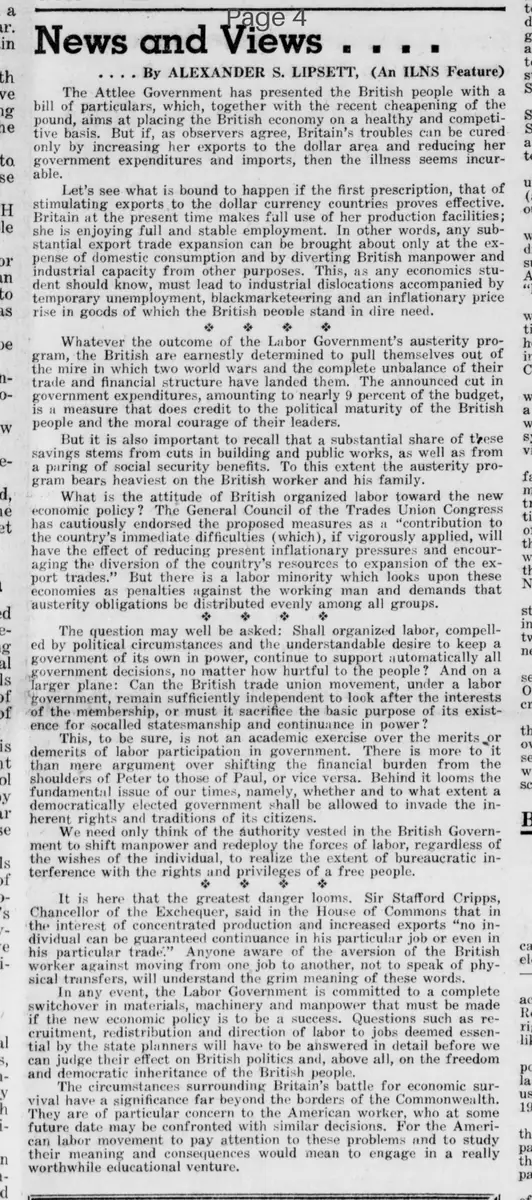
... By ALEXANDER S. LIPSETT, (An ILNS Feature)
The Attlee Government has presented the British people with a bill of particulars, which, together with the recent cheapening of the pound, aims at placing the British economy on a healthy and competitive basis. But if, as observers agree, Britain's troubles can be cured only by increasing her exports to the dollar area and reducing her government expenditures and imports, then the illness seems incurable.
Let's see what is bound to happen if the first prescription, that of stimulating exports to the dollar currency countries proves effective.
Britain at the present time makes full use of her production facilities; she is enjoying full and stable employment. In other words, any substantial export trade expansion can be brought about only at the expense of domestic consumption and by diverting British manpower and industrial capacity from other purposes. This, as any economics student should know, must lead to industrial dislocations accompanied by temporary unemployment, blackmarketeering and an inflationary price rise in goods of which the British people stand in dire need.
Whatever the outcome of the Labor Government's austerity program, the British are earnestly determined to pull themselves out of the mire in which two world wars and the complete unbalance of their trade and financial structure have landed them. The announced cut in government expenditures, amounting to nearly 9 percent of the budget, is a measure that does credit to the political maturity of the British people and the moral courage of their leaders.
But it is also important to recall that a substantial share of these savings stems from cuts in building and public works, as well as from a paring of social security benefits. To this extent the austerity program bears heaviest on the British worker and his family.
What is the attitude of British organized labor toward the new economic policy? The General Council of the Trades Union Congress has cautiously endorsed the proposed measures as a "contribution to the country's immediate difficulties (which), if vigorously applied, will have the effect of reducing present inflationary pressures and encouraging the diversion of the country's resources to expansion of the export trades." But there is a labor minority which looks upon these economies as penalties against the working man and demands that austerity obligations be distributed evenly among all groups.
The question may well be asked: Shall organized labor, compelled by political circumstances and the understandable desire to keep a government of its own in power, continue to support automatically all government decisions, no matter how hurtful to the people? And on a larger plane: Can the British trade union movement, under a labor government, remain sufficiently independent to look after the interests of the membership, or must it sacrifice the basic purpose of its existence for so-called statesmanship and continuance in power?
This, to be sure, is not an academic exercise over the merits or demerits of labor participation in government. There is more to it than mere argument over shifting the financial burden from the shoulders of Peter to those of Paul, or vice versa. Behind it looms the fundamental issue of our times, namely, whether and to what extent a democratically elected government shall be allowed to invade the inherent rights and traditions of its citizens.
We need only think of the authority vested in the British Government to shift manpower and redeploy the forces of labor, regardless of the wishes of the individual, to realize the extent of bureaucratic interference with the rights and privileges of a free people.
It is here that the greatest danger looms. Sir Stafford Cripps, Chancellor of the Exchequer, said in the House of Commons that in the interest of concentrated production and increased exports "no individual can be guaranteed continuance in his particular job or even in his particular trade." Anyone aware of the aversion of the British worker against moving from one job to another, not to speak of physical transfers, will understand the grim meaning of these words.
In any event, the Labor Government is committed to a complete switchover in materials, machinery and manpower that must be made if the new economic policy is to be a success. Questions such as recruitment, redistribution and direction of labor to jobs deemed essential by the state planners will have to be answered in detail before we can judge their effect on British politics and, above all, on the freedom and democratic inheritance of the British people.
The circumstances surrounding Britain's battle for economic survival have a significance far beyond the borders of the Commonwealth.
They are of particular concern to the American worker, who at some future date may be confronted with similar decisions. For the American labor movement to pay attention to these problems and to study their meaning and consequences would mean to engage in a really worthwhile educational venture.
What sub-type of article is it?
What keywords are associated?
What entities or persons were involved?
Where did it happen?
Foreign News Details
Primary Location
Britain
Key Persons
Outcome
announced cut in government expenditures amounting to nearly 9 percent of the budget; cuts in building and public works, paring of social security benefits
Event Details
The Attlee Government presents an austerity program including cheapening of the pound, stimulating exports to dollar areas, and reducing government expenditures and imports to address economic troubles. This involves diverting resources from domestic consumption, leading to potential industrial dislocations, unemployment, blackmarketeering, and inflation. The Trades Union Congress cautiously endorses the measures, though a minority demands even distribution of burdens. Concerns arise over government authority to shift manpower and redeploy labor, potentially interfering with individual rights and democratic traditions.