Thank you for visiting SNEWPapers!
Sign up free
Letter to Editor
June 12, 1793
National Gazette
Philadelphia, Philadelphia County, Pennsylvania
What is this article about?
In this essay, 'Philadelphus' argues that the United States should extend moral gratitude and support to the French nation, not the king, for their aid during the American Revolution, emphasizing that nations should follow individual virtues in policy, especially amid the French Revolution.
Clipping
OCR Quality
95%
Excellent
Full Text
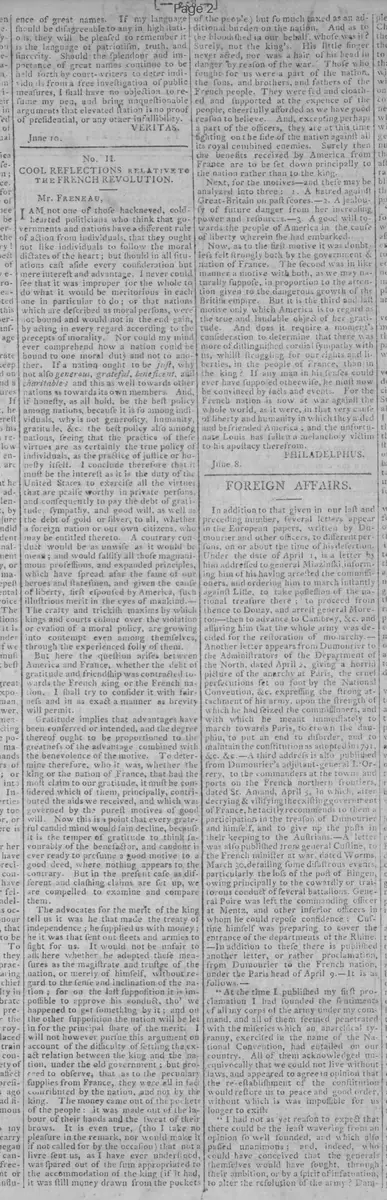
No. II.
COOL REFLECTIONS RELATIVE TO
THE FRENCH REVOLUTION.
Mr. FRENEAU,
I am not one of those hackneyed, cold-hearted politicians who think that governments and nations have a different rule of action from individuals, that they ought not like individuals to follow the moral dictates of the heart; but should in all situations cast aside every consideration but mere interest and advantage. I never could see that it was improper for the whole to do what it would be meritorious in each one in particular to do; or that nations which are described as moral persons, were not bound and would not in the end gain, by acting in every regard according to the precepts of morality. Nor could my mind ever comprehend how a nation could be bound to one moral duty and not to another. If a nation ought to be just, why not also generous, grateful, beneficent, and charitable; and this as well towards other nations as towards its own members. And, if honesty, as all hold, be the best policy among nations, because it is so among individuals, why is not generosity, humanity, gratitude, &c. the best policy also among nations, seeing that the practice of these virtues are as certainly the true policy of individuals, as the practice of justice or honesty itself. I conclude therefore that it must be the interest as it is the duty of the United States to exercise all the virtues that are praiseworthy in private persons, and consequently to pay the debt of gratitude, sympathy, and good will, as well as the debt of gold or silver, to all, whether a foreign nation or our own citizens, who may be entitled thereto. A contrary conduct would be as unwise as it would be mean; and would falsify all those magnanimous professions, and expanded principles, which have spread afar the fame of our heroes and statesmen, and given the cause of liberty, first espoused by America, such illustrious merit in the eyes of mankind.
The crafty and trickish maxims by which kings and courts colour over the violation or evasion of a moral policy, are growing into contempt even among themselves, through the experienced folly of them.
But here the question arises between America and France, whether the debt of gratitude and friendship was contracted towards the French king or the French nation. I shall try to consider it with fairness and in as exact a manner as brevity will permit.
Gratitude implies that advantages have been conferred or intended, and the degree thereof ought to be proportioned to the greatness of the advantage combined with the benevolence of the motive. To determine therefore, who it was, whether the king or the nation of France, that had the most claim to our gratitude, it must be considered which of them, principally, contributed the aids we received, and which was governed by the purest motives of good will. Now this is a point that every grateful candid mind would fain decline, because it is the temper of gratitude to think favourably of the benefactor, and candour is ever ready to presume a good motive to a good deed, where nothing appears to the contrary. But in the present case as different and clashing claims are set up, we are compelled to examine and compare them.
The advocates for the merit of the king tell us it was he that made the treaty of independence; he supplied us with money; he it was that sent out fleets and armies to fight for us. It would not be unfair to ask here whether he adopted these measures as the magistrate and trustee of the nation, or merely of himself, without regard to the sense and inclination of the nation; for on the last supposition it is impossible to approve his conduct, tho' we happened to get something by it; and on the other supposition the nation will be let in for the principal share of the merit. I will not however pursue this argument on account of the difficulty of settling the exact relation between the king and the nation, under the old government: but proceed to observe, that as to the pecuniary supplies from France, they were all in fact contributed by the nation, and not by the king. The money came out of the pockets of the people: it was made out of the labour of their hands and the sweat of their brows. It is even true, (tho I take no pleasure in the remark, nor would make it if not called for by the occasion) that not a livre sent us, as I have ever understood, was pared out of the sum appropriated to the accommodation of the king (if it had, it was still money drawn from the pockets of the people) but so much taxed as an additional burden on the nation. And as to the bloodshed in our behalf, whose was it? Surely, not the king's. His little finger never acted, nor was a hair of his head in danger by reason of the war. Those who fought for us were a part of the nation, the sons, and brothers, and fathers of the French people. They were fed and clothed and supported at the expense of the people, cheerfully afforded as we have good reason to believe. And, excepting perhaps a part of the officers, they are at this time fighting on the side of the nation against all its royal combined enemies. Surely then the benefits received by America from France are to be set down principally to the nation rather than to the king.
Next, for the motives—and these may be analyzed into three: 1. A hatred against Great-Britain on past scores.—2. A jealousy of future danger from her increasing power and resources.—3. A good will towards the people of America in the cause of liberty wherein she had embarked.
Now, as to the first motive it was doubtless felt strongly both by the government & nation of France. The second was in like manner a motive with both, as we may naturally suppose, in proportion to the attention given to the dangerous growth of the British empire. But it is the third and last motive only which America is to regard as the true and laudable object of her gratitude. And does it require a moment's consideration to determine that there was more of distinguished cordial sympathy with us, whilst struggling for our rights and liberties, in the people of France, than in the king? If any man in his senses could ever have supposed otherwise, he must now be convinced by facts and events. For the French nation is now at war against the whole world, as it were, in that very cause of liberty and humanity in which they aided and befriended America: and the unfortunate Louis has fallen a melancholy victim to his apostasy therefrom.
PHILADELPHUS.
June 8.
COOL REFLECTIONS RELATIVE TO
THE FRENCH REVOLUTION.
Mr. FRENEAU,
I am not one of those hackneyed, cold-hearted politicians who think that governments and nations have a different rule of action from individuals, that they ought not like individuals to follow the moral dictates of the heart; but should in all situations cast aside every consideration but mere interest and advantage. I never could see that it was improper for the whole to do what it would be meritorious in each one in particular to do; or that nations which are described as moral persons, were not bound and would not in the end gain, by acting in every regard according to the precepts of morality. Nor could my mind ever comprehend how a nation could be bound to one moral duty and not to another. If a nation ought to be just, why not also generous, grateful, beneficent, and charitable; and this as well towards other nations as towards its own members. And, if honesty, as all hold, be the best policy among nations, because it is so among individuals, why is not generosity, humanity, gratitude, &c. the best policy also among nations, seeing that the practice of these virtues are as certainly the true policy of individuals, as the practice of justice or honesty itself. I conclude therefore that it must be the interest as it is the duty of the United States to exercise all the virtues that are praiseworthy in private persons, and consequently to pay the debt of gratitude, sympathy, and good will, as well as the debt of gold or silver, to all, whether a foreign nation or our own citizens, who may be entitled thereto. A contrary conduct would be as unwise as it would be mean; and would falsify all those magnanimous professions, and expanded principles, which have spread afar the fame of our heroes and statesmen, and given the cause of liberty, first espoused by America, such illustrious merit in the eyes of mankind.
The crafty and trickish maxims by which kings and courts colour over the violation or evasion of a moral policy, are growing into contempt even among themselves, through the experienced folly of them.
But here the question arises between America and France, whether the debt of gratitude and friendship was contracted towards the French king or the French nation. I shall try to consider it with fairness and in as exact a manner as brevity will permit.
Gratitude implies that advantages have been conferred or intended, and the degree thereof ought to be proportioned to the greatness of the advantage combined with the benevolence of the motive. To determine therefore, who it was, whether the king or the nation of France, that had the most claim to our gratitude, it must be considered which of them, principally, contributed the aids we received, and which was governed by the purest motives of good will. Now this is a point that every grateful candid mind would fain decline, because it is the temper of gratitude to think favourably of the benefactor, and candour is ever ready to presume a good motive to a good deed, where nothing appears to the contrary. But in the present case as different and clashing claims are set up, we are compelled to examine and compare them.
The advocates for the merit of the king tell us it was he that made the treaty of independence; he supplied us with money; he it was that sent out fleets and armies to fight for us. It would not be unfair to ask here whether he adopted these measures as the magistrate and trustee of the nation, or merely of himself, without regard to the sense and inclination of the nation; for on the last supposition it is impossible to approve his conduct, tho' we happened to get something by it; and on the other supposition the nation will be let in for the principal share of the merit. I will not however pursue this argument on account of the difficulty of settling the exact relation between the king and the nation, under the old government: but proceed to observe, that as to the pecuniary supplies from France, they were all in fact contributed by the nation, and not by the king. The money came out of the pockets of the people: it was made out of the labour of their hands and the sweat of their brows. It is even true, (tho I take no pleasure in the remark, nor would make it if not called for by the occasion) that not a livre sent us, as I have ever understood, was pared out of the sum appropriated to the accommodation of the king (if it had, it was still money drawn from the pockets of the people) but so much taxed as an additional burden on the nation. And as to the bloodshed in our behalf, whose was it? Surely, not the king's. His little finger never acted, nor was a hair of his head in danger by reason of the war. Those who fought for us were a part of the nation, the sons, and brothers, and fathers of the French people. They were fed and clothed and supported at the expense of the people, cheerfully afforded as we have good reason to believe. And, excepting perhaps a part of the officers, they are at this time fighting on the side of the nation against all its royal combined enemies. Surely then the benefits received by America from France are to be set down principally to the nation rather than to the king.
Next, for the motives—and these may be analyzed into three: 1. A hatred against Great-Britain on past scores.—2. A jealousy of future danger from her increasing power and resources.—3. A good will towards the people of America in the cause of liberty wherein she had embarked.
Now, as to the first motive it was doubtless felt strongly both by the government & nation of France. The second was in like manner a motive with both, as we may naturally suppose, in proportion to the attention given to the dangerous growth of the British empire. But it is the third and last motive only which America is to regard as the true and laudable object of her gratitude. And does it require a moment's consideration to determine that there was more of distinguished cordial sympathy with us, whilst struggling for our rights and liberties, in the people of France, than in the king? If any man in his senses could ever have supposed otherwise, he must now be convinced by facts and events. For the French nation is now at war against the whole world, as it were, in that very cause of liberty and humanity in which they aided and befriended America: and the unfortunate Louis has fallen a melancholy victim to his apostasy therefrom.
PHILADELPHUS.
June 8.
What sub-type of article is it?
Philosophical
Persuasive
Reflective
What themes does it cover?
Politics
Morality
Military War
What keywords are associated?
French Revolution
American Gratitude
French Aid
Moral Policy
Louis Xvi
Revolutionary War
National Virtues
What entities or persons were involved?
Philadelphus
Mr. Freneau
Letter to Editor Details
Author
Philadelphus
Recipient
Mr. Freneau
Main Argument
nations, like individuals, should act according to moral virtues including gratitude; thus, the united states owes gratitude to the french nation, not the king, for revolutionary war aid, and should support france's revolutionary cause of liberty.
Notable Details
Treaty Of Independence
Pecuniary Supplies From French People
Fleets And Armies Sent
Motives: Hatred Of Britain, Jealousy Of Power, Goodwill To Liberty
Louis Xvi's Apostasy And Fall