Thank you for visiting SNEWPapers!
Sign up free
The Prison Mirror
Stillwater, Washington County, Minnesota
What is this article about?
A letter critiquing labor union strikes, arguing they cause widespread economic harm to non-striking workers, businesses, consumers, and the public ('Mr. Public'), eroding sympathy for unions despite initial support for collective bargaining.
Merged-components note: Continuation of letter to the editor across pages 1-3; original label of continuations was editorial, changed to match primary content
Clippings
1 of 3
OCR Quality
Full Text
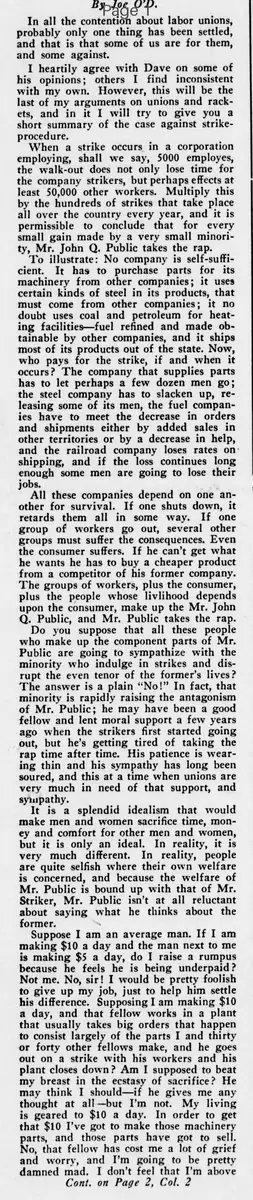
probably only one thing has been settled,
and that is that some of us are for them,
and some against.
I heartily agree with Dave on some of
his opinions; others I find inconsistent
with my own. However, this will be the
last of my arguments on unions and rack-
ets, and in it I will try to give you a
short summary of the case against strike-
procedure.
When a strike occurs in a corporation
employing, shall we say, 5000 employees,
the walk-out does not only lose time for
the company strikers, but perhaps affects at
least 50,000 other workers. Multiply this
by the hundreds of strikes that take place
all over the country every year, and it is
permissible to conclude that for every
small gain made by a very small minori-
ty, Mr. John Q. Public takes the rap.
To illustrate: No company is self-suffi-
ient. It has to purchase parts for its
machinery from other companies; it uses
certain kinds of steel in its products, that
must come from other companies; it no
doubt uses coal and petroleum for heat-
ing facilities-fuel refined and made ob-
tainable by other companies, and it ships
most of its products out of the state. Now,
who pays for the strike, if and when it
occurs? The company that supplies parts
has to let perhaps a few dozen men go;
the steel company has to slacken up, re-
leasing some of its men, the fuel compan-
ies have to meet the decrease in orders
and shipments either by added sales in
other territories or by a decrease in help,
and the railroad company loses rates on
shipping, and if the loss continues long
enough some men are going to lose their
jobs.
All these companies depend on one an-
other for survival. If one shuts down. it
retards them all in some way. If one
group of workers go out, several other
groups must suffer the consequences. Even
the consumer suffers. If he can't get what
he wants he has to buy a cheaper product
from a competitor of his former company.
The groups of workers, plus the consumer,
plus the people whose livelihood depends
upon the consumer, make up the Mr. John
Q. Public, and Mr. Public takes the rap.
Do you suppose that all these people
who make up the component parts of Mr.
Public are going to sympathize with the
minority who indulge in strikes and dis-
rupt the even tenor of the former's lives?
The answer is a plain "No!" In fact, that
minority is rapidly raising the antagonism
of Mr. Public; he may have been a good
fellow and lent moral support a few years
ago when the strikers first started going
out, but he's getting tired of taking the
rap time after time. His patience is wear-
ing thin and his sympathy has long been
soured, and this at a time when unions are
very much in need of that support, and
sympathy.
It is a splendid idealism that would
make men and women sacrifice time, mon-
ey and comfort for other men and women,
but it is only an ideal. In reality, it is
very much different. In reality, people
are quite selfish where their own welfare
is concerned, and because the welfare of
Mr. Public is bound up with that of Mr.
Striker, Mr. Public isn't at all reluctant
about saying what he thinks about the
former.
Suppose I am an average man. If I am
making $10 a day and the man next to me
is making $5 a day, do I raise a rumpus
because he feels he is being underpaid?
Not me. No, sir! I would be pretty foolish
to give up my job, just to help him settle
his difference. Supposing I am making $10
a day, and that fellow works in a plant
that usually takes big orders that happen
to consist largely of the parts I and thirty
or forty other fellows make, and he goes
out on a strike with his workers and his
plant closes down? Am I supposed to beat
my breast in the ecstasy of sacrifice? He
may think I should--if he gives me any
thought at all-but I'm not. My living
is geared to $10 a day. In order to get
that $10 I've got to make those machinery
parts, and those parts have got to sell.
No. that fellow has cost me a lot of grief
and worry, and I'm going to be pretty
damned mad. I don't feel that I'm above
Cont on Page 2 Col2
Mr. Public Takes the Rap
Cont. from Page 1
any man, but I've studied and waited for this job I've got; my wife, my kids, my home, my future depends on it—is it common sense to expect me to rejoice while he cuts my throat? If I get sick, injured or something else, will he pay my bills? He will not! But what he will do is to move over into my plant, and into my job while I'm off, and you can bet he won't give me any of the additional pay he will get in my place. Maybe he's an all right guy. Maybe his union is on the up-and-up. But why bother me? I'm Mr. Public and I'm getting good and tired of his interference with my life.
To go on with Mr. Public's grievance—There are three classes of people effected by union walkouts. The first are the strikers; the second are the employers. and the third is Mr. Public. Let's take a look and see what happens to them.
When a strike is called, the first class to be effected by it are the strikers. The moment they go out the pay check stops coming in, and doesn't come in again until they go back to work. Whether they ever make up what is thus lost is uncertain. In the last General Motors strike 63,000 men lost $70,000,000. Can they ever get it back at 6½ cents an hour? Perhaps. But what about the other losses that are sustained—losses stemming directly from the discontinued pay-check? In long, drawn-out strikes, the money on hand does not last long, and as a consequence secondary, but very important, losses result. People are turned out of their homes for lack of rent money; long-owned establishments are forfeited by failure to meet mortgages; if it is the winter season the jobless run short of fuel, food and other necessities; money gets scarcer and the striker borrows cash at an exorbitant rate of interest; children suffer, the family suffers, the community suffers; the striker ends up with a pile of bills a mountain high, a serious disharmony in his household, and a dangerous peeve at his employer—the first places the community in jeopardy, the second jeopardizes the family, and the third jeopardizes the national unity of the country. Everybody loses, nobody wins.
So much for the strikers. Now for the employers. As with the striker, the employer gains absolutely nothing. He can't manufacture his product, so he has nothing to sell—yet, his insurance, taxes and depreciation go on. The stock-holders want their semi-annual or annual dividends and either get them, or else. The employer can't quit. He can't go into bankruptcy, because the labor courts will bring an injunction against him for un-American activities, as they did to an eastern manufacturer who attempted to close up. Most companies are incorporated, and exist on sales of their products and investment in their company. A lot of the money that is supposed to be profit goes for taxes, dividends, purchasing of materials, wages, upkeep and overhead. The employer sustains a loss all around. And again the community suffers, the national welfare of the nation drops lower, and the negative result is bad feeling and friction that is sure to crop out with disastrous consequences in the future.
Now for Mr. Public. Mr. Public loses heavily on every strike. He has to pay additional taxes for every striker who goes on relief during a lay-off. As a rule, more policemen are put on duty, and Mr. Pub—
Cont. on Page 3, Col. 2
Mr. Public
Cont. from Page 2
Public pays for this, too. If Mr. Public owns a grocery store, he has to purchase fresh merchandise every day, he has to pay for depreciation, he has to pay for loans, he has to pay on the wholesaler's accounts, he has to pay taxes, he has to support his family. But if half his customers are men who are out on strike, they can't pay him, he can't keep up his own payments, and he loses. The same goes for the man who can't collect his rent; his taxes go on, his cost of living remains the same, but his income ceases. The doctor can't collect his fees, the installment people can't collect their payments, the theatres and places of amusement lose. When the company closes, everyone in the community pays for it-grocer, doctor, clothier, merchant, everyone.
There are good reasons why Mr. Public doesn't like unions and the strikes they call. To him, a strike, no matter how reasonable, means a change, an interference, a loss. He simply can't profit by it, and he's beginning to realize it. He's getting down on the unions, getting impatient with both them and the employers. Mr. Public hasn't much interest in either one; primarily, his interest is in living as peacefully and as comfortably as he can, and whosoever denies him that invokes his wrath.
No union has ever been able to sell its cause to Mr. Public, and never will be able just so long as it employs tactics that are detrimental to Mr. Public's welfare. He, at first, championed the right to use collective bargaining and is probably still at heart a supporter, passively. But he became disgusted with the sit-down strikes, which the Supreme Court outlawed, the evidence of racketeering within the union ranks, and the dictatorial powers the unions tried to assume in their dealings with people, with government and with business. Thus, whatever favor Mr. Public once bestowed upon the unions, has now turned to opposition-and that opposition is growing stronger day by day. Mr. Public is getting tired of taking the rap, and who can blame him?
So, Dave and Bucky, you fellows are right in some of your contentions, but in others you are dead wrong. However, neither of our opinions will help to settle the issue one way or another. But it's been fun, and I'm going to tangle with you again, soon, on another subject that needs clarifying. Here's for bigger and better criticisms.
What sub-type of article is it?
What themes does it cover?
What keywords are associated?
Letter to Editor Details
Main Argument
strikes by labor unions harm not only strikers and employers but especially the broader public through economic ripple effects, leading to loss of jobs, increased taxes, and eroded public sympathy for unions.
Notable Details