Thank you for visiting SNEWPapers!
Sign up free
Editorial
July 24, 1810
Alexandria Daily Gazette, Commercial & Political
Alexandria, Virginia
What is this article about?
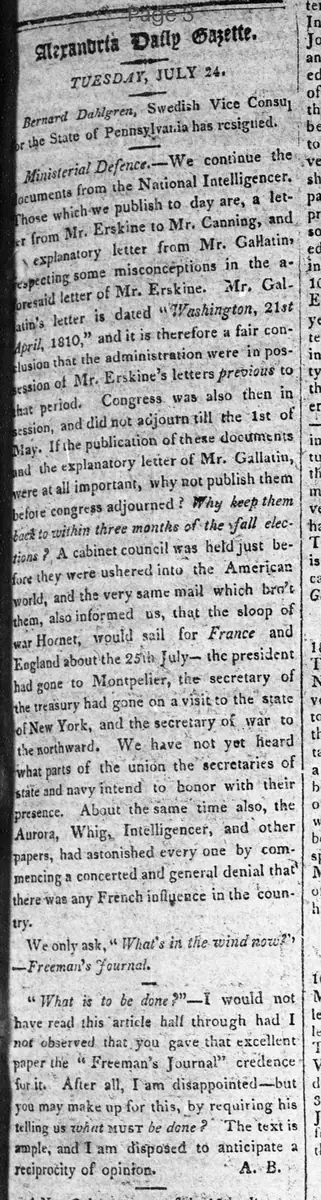
The Alexandria Daily Gazette editorial critiques the U.S. administration's publication of diplomatic correspondence between Erskine, Canning, and Gallatin in April 1810, questioning the timing near fall elections, cabinet travels, and simultaneous denials of French influence. It includes a response to Freeman's Journal signed A.B.
Clipping
OCR Quality
88%
Good
Full Text
Alexandria Daily Gazette.
TUESDAY, JULY 24.
or the State of Pennsylvania has resigned:
Bernard Dahlgren, Swedish Vice Consul
letters from Mr. Erskine to Mr. Canning, and
Those which we publish today are, a letter-
documents from the National Intelligencer.
Ministerial Defence.--We continue the
respecting some misconceptions in the affair
explanatory letter from Mr. Gallatin,
Gallatin's letter is dated "Washington, 21st
of the aforesaid letter of Mr. Erskine. Mr. Gallatin
session of Mr. Erskine's letters previous to
illusion that the administration were in possession
April, 1810," and it is therefore a fair conclusion
that period. Congress was also then in
and the explanatory letter of Mr. Gallatin,
May. If the publication of these documents
session, and did not adjourn till the 1st of
were at all important, why not publish them
back to within three months of the fall elections?
A cabinet council was held just before
they were ushered into the American
world, and the very same mail which brought
them, also informed us, that the sloop of
war Hornet, would sail for France and
England about the 25th July- the president
had gone to Montpelier, the secretary of
the treasury had gone on a visit to the state
of New York, and the secretary of war to
the northward. We have not yet heard
what parts of the union the secretaries of
state and navy intend to honor with their
presence. About the same time also, the
Aurora, Whig, Intelligencer, and other
papers, had astonished every one by commencing
a concerted and general denial that
there was any French influence in the country.
We only ask. "What's in the wind now?",
Freeman's Journal.
"What is to be done?" I would not
have read this article half through had I
not observed that you gave that excellent
paper the "Freeman's Journal" credence
for it. After all, I am disappointed--but
you may make up for this, by requiring his
telling us what must be done?" The text is
ample, and I am disposed to anticipate a
reciprocity of opinion.
A.B.
TUESDAY, JULY 24.
or the State of Pennsylvania has resigned:
Bernard Dahlgren, Swedish Vice Consul
letters from Mr. Erskine to Mr. Canning, and
Those which we publish today are, a letter-
documents from the National Intelligencer.
Ministerial Defence.--We continue the
respecting some misconceptions in the affair
explanatory letter from Mr. Gallatin,
Gallatin's letter is dated "Washington, 21st
of the aforesaid letter of Mr. Erskine. Mr. Gallatin
session of Mr. Erskine's letters previous to
illusion that the administration were in possession
April, 1810," and it is therefore a fair conclusion
that period. Congress was also then in
and the explanatory letter of Mr. Gallatin,
May. If the publication of these documents
session, and did not adjourn till the 1st of
were at all important, why not publish them
back to within three months of the fall elections?
A cabinet council was held just before
they were ushered into the American
world, and the very same mail which brought
them, also informed us, that the sloop of
war Hornet, would sail for France and
England about the 25th July- the president
had gone to Montpelier, the secretary of
the treasury had gone on a visit to the state
of New York, and the secretary of war to
the northward. We have not yet heard
what parts of the union the secretaries of
state and navy intend to honor with their
presence. About the same time also, the
Aurora, Whig, Intelligencer, and other
papers, had astonished every one by commencing
a concerted and general denial that
there was any French influence in the country.
We only ask. "What's in the wind now?",
Freeman's Journal.
"What is to be done?" I would not
have read this article half through had I
not observed that you gave that excellent
paper the "Freeman's Journal" credence
for it. After all, I am disappointed--but
you may make up for this, by requiring his
telling us what must be done?" The text is
ample, and I am disposed to anticipate a
reciprocity of opinion.
A.B.
What sub-type of article is it?
Foreign Affairs
Partisan Politics
What keywords are associated?
Diplomatic Letters
Gallatin Explanation
Erskine Canning
Administration Timing
French Influence
Fall Elections
Ministerial Defence
What entities or persons were involved?
Mr. Erskine
Mr. Canning
Mr. Gallatin
President
Secretary Of The Treasury
Secretary Of War
Aurora
Whig
Intelligencer
Freeman's Journal
A.B.
Editorial Details
Primary Topic
Timing Of Diplomatic Correspondence Publication
Stance / Tone
Critical Of Administration Motives
Key Figures
Mr. Erskine
Mr. Canning
Mr. Gallatin
President
Secretary Of The Treasury
Secretary Of War
Aurora
Whig
Intelligencer
Freeman's Journal
A.B.
Key Arguments
Publication Of Erskine Canning Letters And Gallatin's Explanatory Note Timed Suspiciously Near Fall Elections
Administration Held Cabinet Council Before Release
Secretaries Traveling While Hornet Sails To Europe
Concurrent Denial Of French Influence By Administration Papers
Questions Motives: 'What's In The Wind Now?'
Response To Freeman's Journal Seeks Clarity On Actions