Thank you for visiting SNEWPapers!
Sign up free
The New Hampshire Gazette And General Advertiser
Portsmouth, Rockingham County, New Hampshire
What is this article about?
European reports to late September 1790 detail escalating Britain-Spain tensions with arming of privateers and ships, Spanish preparations for imminent war, and rumors of alliances involving Russia, France against Britain, Prussia. (198 characters)
Clipping
OCR Quality
Full Text
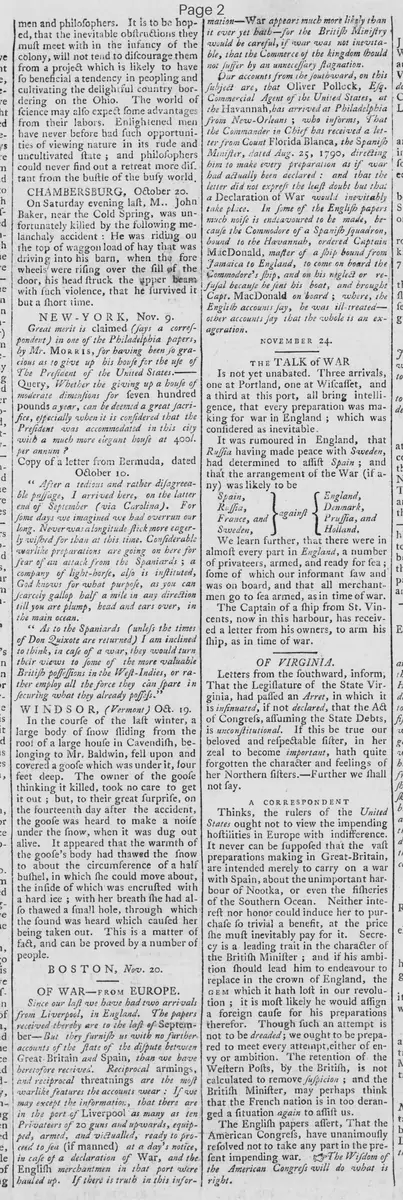
OF WAR—FROM EUROPE.
Since our last we have had two arrivals from Liverpool, in England. The papers received thereby are to the last of September. But they furnish us with no further accounts of the state of the dispute between Great-Britain and Spain, than we have heretofore received. Reciprocal armings, and reciprocal threatenings are the most warlike features the accounts wear: If we may except the information, that there are in the port of Liverpool as many as ten Privateers of 20 guns and upwards, equipped, armed, and victualled; ready to proceed to sea (if manned) at a day's notice, in case of a declaration of War, and the English merchantmen in that port were hauled up. If there is truth in this information—War appears much more likely than it ever yet hath—for the British Ministry would be careful, if war was not inevitable, that the Commerce of the kingdom should not suffer by an unnecessary stagnation.
Our accounts from the southward, on this subject are, that Oliver Pollock, Esq. Commercial Agent of the United States, at the Havannah, has arrived at Philadelphia from New-Orleans; who informs, That the Commander in Chief has received a letter from Count Florida Blanca, the Spanish Minister, dated Aug. 25, 1790, directing him to make every preparation as if war had actually been declared: and that the letter did not express the least doubt but that a Declaration of War would inevitably take place. In some of the English papers much noise is endeavoured to be made, because the Commodore of a Spanish Squadron bound to the Havannah, ordered Captain MacDonald, master of a ship bound from Jamaica to England, to come on board the Commodore's ship, and on his neglect or refusal because he sent his boat, and brought Capt. MacDonald on board; where, the English accounts say, he was ill-treated—other accounts say that the whole is an exaggeration.
NOVEMBER 24.
THE TALK Of WAR
Is not yet unabated. Three arrivals, one at Portland, one at Wiscasset, and a third at this port, all bring intelligence, that every preparation was making for war in England; which was considered as inevitable.
It was rumoured in England, that Russia having made peace with Sweden, had determined to assist Spain; and that the arrangement of the War (if any) was likely to be
Spain,
England,
Denmark,
Russia,
France, and
against
Prussia, and
Sweden,
Holland.
We learn further, that there were in almost every part in England, a number of privateers, armed, and ready for sea; some of which our informant saw and was on board, and that all merchantmen go to sea armed, as in time of war.
The Captain of a ship from St. Vincents, now in this harbour, has received a letter from his owners, to arm his ship, as in time of war.
What sub-type of article is it?
What keywords are associated?
What entities or persons were involved?
Where did it happen?
Foreign News Details
Primary Location
Europe
Event Date
As Of Late September 1790
Key Persons
Outcome
war appears much more likely; preparations as if war declared; rumors of alliances: spain, england, denmark, russia, france against prussia, sweden, holland
Event Details
Arrivals from Liverpool bring papers to late September showing reciprocal armings and threatenings between Great Britain and Spain. Ten privateers ready in Liverpool; merchantmen hauled up. Oliver Pollock reports Spanish Commander in Chief directed to prepare as if war declared per letter from Count Florida Blanca dated Aug. 25, 1790. Incident involving Spanish Commodore and Captain MacDonald exaggerated in English papers. Further arrivals confirm preparations in England; rumors Russia to assist Spain; privateers armed; merchantmen go armed as in war. Captain from St. Vincents instructed to arm ship.