Thank you for visiting SNEWPapers!
Sign up free
Literary
May 4, 1818
Alexandria Gazette & Daily Advertiser
Alexandria, Virginia
What is this article about?
Continuation of the Edinburgh Review's satirical critique of Charles Phillips's oratorical style, condemning his excessive use of alliteration, antithesis, mixed metaphors, and nonsensical imagery. Includes examples from his speeches on liberty of the press and other topics, portraying them as overwrought and tasteless.
Clipping
OCR Quality
95%
Excellent
Full Text
PHILLIPS'S ELOQUENCE CHARACTERISED
BY THE EDINBURGH REVIEWERS.
[Continued.]
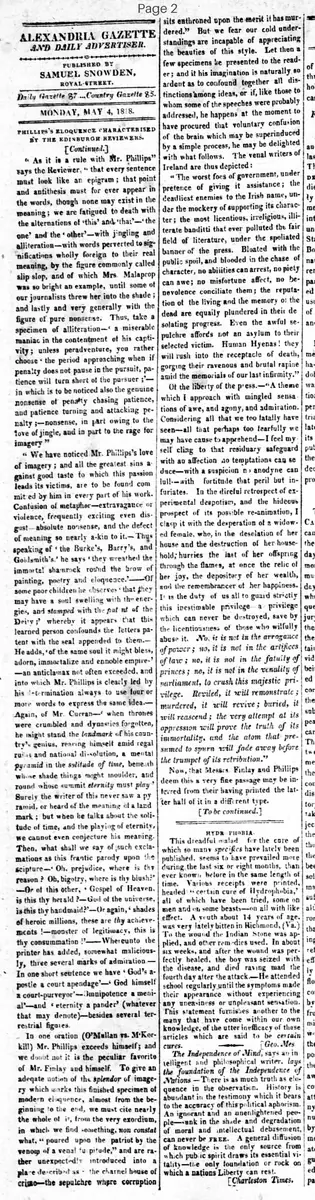
"As it is a rule with Mr. Phillips says the Reviewer, " that every sentence must look like an epigram; that point and antithesis must for ever appear in the words, though none may exist in the meaning; we are fatigued to death with the alternations of 'this' and 'that' the one' and the other'-with jingling and alliteration-with words perverted to significations wholly foreign to their real meaning, by the figure commonly called slip slop, and of which Mrs. Malaprop was so bright an example, until some of our journalists threw her into the shade ; and lastly and very generally with the figure of pure nonsense. Thus, take a specimen of alliteration-' a miserable maniac in the contentment of his captivity; unless peradventure, you rather choose the period approaching when if penalty does not pause in the pursuit, patience will turn short of the pursuer ;'- in which is to be noticed also the genuine nonsense of penalty chasing patience, and patience turning and attacking penalty;-nonsense, in part owing to the love of jingle, and in part to the rage for imagery
"We have noticed Mr. Phillips's love of imagery; and all the greatest sins against good taste to which this passion leads its victims, are to be found committed by him in every part of his work. Confusion of metaphor-extravagance or violence, frequently exciting even disgust-absolute nonsense, and the defect of meaning so nearly a-kin to it.- Thus speaking of ' the Burke's. Barry's, and Goldsmith's.' he says 'they wreathed the immortal shamrock round the brow of painting, poetry and eloquence.'.-Of some poor children he observes 'that they may have a soul swelling with the energies, and stamped with the patent of the Deity'; whereby it appears that this learned person confounds the letters patent with the seal appended to them.- He adds, 'of the same soul it might bless, adorn, immortalize and ennoble empire- an anticlimax not often exceeded, and into which Mr. Phillips is clearly led by his term-termination always to use four or more words to express the same idea.- Again, of Mr. Curran-' when thrones were crumbled and dynasties forgotten, he might stand the landmark of his country's genius, rearing himself amid regal ruins and national dissolution, a mental pyramid in the solitude of time, beneath whose shade things might moulder. and round whose summit eternity must play Surely the writer of this never saw a pyramid. or heard of the meaning of a land mark; but when he talks about the solitude of time, and the playing of eternity, we cannot even conjecture his meaning Then. what shall we say of such exclamations as this frantic parody upon the scripture-'Oh. prejudice, where is thy reason? Oh, bigotry, where is thy blush?'-Or of this other, Gospel of Heaven. is this thy herald ?-God of the universe, is this thy handmaid?'-Or again, 'shades of heroic millions, these are thy achievements!-monster of legitimacy, this is thy consummation! Whereunto the printer has added, somewhat maliciously, three several marks of admiration- In one short sentence we have ' God's apostle a court appendage'-' God himself a court-purveyor'-Omnipotence a menial'--and eternity a pander' (whatever that may denote)-besides several terrestrial figures. In one oration (O'Mullan vs. M'Cormick) Mr. Phillips exceeds himself; and we doubt not it is the peculiar favorite of Mr. Finlay and himself. To give an adequate notion of the splendor of imagery which marks this finished specimen of modern eloquence, almost from the beginning to the end, we must cite nearly the whole of it, from the very exordium, in which, we find something, non constat what,"poured upon the patriot by the venom of a venal stupitude,"and are rather unexpectedly introduced into a place described as the charnel house of crime--the sepulchre where corruption sits enthroned upon the merit it has murdered." But we fear our cold understandings are incapable of appreciating the beauties of this style. Let then a few specimens be presented to the reader; and if his imagination is naturally so ardent as to confound together all distinctions among ideas, or if, like those to whom some of the speeches were probably addressed, he happens at the moment to have procured that voluntary confusion of the brain which may be superinduced by a simple process, he may be delighted with what follows. The venal writers of Ireland are thus depicted: " The worst foes of government, under pretence of giving it assistance; the deadliest enemies to the Irish name, under the mockery of supporting its character; the most licentious, irreligious, illiterate banditti that ever polluted the fair field of literature, under the spoliated banner of the press. Bloated with the public spoil, and blooded in the chase of character, no abilities can arrest, no piety can awe; no misfortune affect, no benevolence conciliate them; the reputation of the living and the memory of the dead are equally plundered in their desolating progress. Even the awful sepulchre affords not an asylum to their selected victim. Human Hyenas! they will rush into the receptacle of death. gorging their ravenous and brutal rapine amid the memorials of our last infirmity." Of the liberty of the press.-"A theme which I approach with mingled sensations of awe, and agony, and admiration. Considering all that we too fatally have seen-all that perhaps too fearfully we may have cause to apprehend-I feel myself cling to that residuary safeguard with an affection no temptations can seduce-with a suspicion no anodyne can lull!--with fortitude that peril but infuriates. In the direful retrospect of experimental despotism, and the hideous prospect of its possible re-animation, I clasp it with the desperation of a widowed female, who, in the desolation of her house and the destruction of her household; hurries the last of her offspring through the flames, at once the relic of her joy, the depositary of her wealth, and the remembrancer of her happiness. It is the duty of us all to guard strictly this inestimable privilege-a privilege which can never be destroyed, save by the licentiousness of those who wilfully abuse it. No, it is not in the arrogance of power ; no, it is not in the artifices of law ; no, it is not in the fatuity of princes; no, it is not in the venality of parliament. to crush this majestic privilege. Reviled, it will remonstrate ; murdered, it will revive: buried, it will reascend; the very attempt at its oppression will prove the truth of its immortality, and the atom that presumed to spurn will fade away before the trumpet of its retribution." Now, that Messrs. Finlay and Phillips deem this a very fine passage may be inferred from their having printed the latter half of it in a different type.
[To be continued.]
BY THE EDINBURGH REVIEWERS.
[Continued.]
"As it is a rule with Mr. Phillips says the Reviewer, " that every sentence must look like an epigram; that point and antithesis must for ever appear in the words, though none may exist in the meaning; we are fatigued to death with the alternations of 'this' and 'that' the one' and the other'-with jingling and alliteration-with words perverted to significations wholly foreign to their real meaning, by the figure commonly called slip slop, and of which Mrs. Malaprop was so bright an example, until some of our journalists threw her into the shade ; and lastly and very generally with the figure of pure nonsense. Thus, take a specimen of alliteration-' a miserable maniac in the contentment of his captivity; unless peradventure, you rather choose the period approaching when if penalty does not pause in the pursuit, patience will turn short of the pursuer ;'- in which is to be noticed also the genuine nonsense of penalty chasing patience, and patience turning and attacking penalty;-nonsense, in part owing to the love of jingle, and in part to the rage for imagery
"We have noticed Mr. Phillips's love of imagery; and all the greatest sins against good taste to which this passion leads its victims, are to be found committed by him in every part of his work. Confusion of metaphor-extravagance or violence, frequently exciting even disgust-absolute nonsense, and the defect of meaning so nearly a-kin to it.- Thus speaking of ' the Burke's. Barry's, and Goldsmith's.' he says 'they wreathed the immortal shamrock round the brow of painting, poetry and eloquence.'.-Of some poor children he observes 'that they may have a soul swelling with the energies, and stamped with the patent of the Deity'; whereby it appears that this learned person confounds the letters patent with the seal appended to them.- He adds, 'of the same soul it might bless, adorn, immortalize and ennoble empire- an anticlimax not often exceeded, and into which Mr. Phillips is clearly led by his term-termination always to use four or more words to express the same idea.- Again, of Mr. Curran-' when thrones were crumbled and dynasties forgotten, he might stand the landmark of his country's genius, rearing himself amid regal ruins and national dissolution, a mental pyramid in the solitude of time, beneath whose shade things might moulder. and round whose summit eternity must play Surely the writer of this never saw a pyramid. or heard of the meaning of a land mark; but when he talks about the solitude of time, and the playing of eternity, we cannot even conjecture his meaning Then. what shall we say of such exclamations as this frantic parody upon the scripture-'Oh. prejudice, where is thy reason? Oh, bigotry, where is thy blush?'-Or of this other, Gospel of Heaven. is this thy herald ?-God of the universe, is this thy handmaid?'-Or again, 'shades of heroic millions, these are thy achievements!-monster of legitimacy, this is thy consummation! Whereunto the printer has added, somewhat maliciously, three several marks of admiration- In one short sentence we have ' God's apostle a court appendage'-' God himself a court-purveyor'-Omnipotence a menial'--and eternity a pander' (whatever that may denote)-besides several terrestrial figures. In one oration (O'Mullan vs. M'Cormick) Mr. Phillips exceeds himself; and we doubt not it is the peculiar favorite of Mr. Finlay and himself. To give an adequate notion of the splendor of imagery which marks this finished specimen of modern eloquence, almost from the beginning to the end, we must cite nearly the whole of it, from the very exordium, in which, we find something, non constat what,"poured upon the patriot by the venom of a venal stupitude,"and are rather unexpectedly introduced into a place described as the charnel house of crime--the sepulchre where corruption sits enthroned upon the merit it has murdered." But we fear our cold understandings are incapable of appreciating the beauties of this style. Let then a few specimens be presented to the reader; and if his imagination is naturally so ardent as to confound together all distinctions among ideas, or if, like those to whom some of the speeches were probably addressed, he happens at the moment to have procured that voluntary confusion of the brain which may be superinduced by a simple process, he may be delighted with what follows. The venal writers of Ireland are thus depicted: " The worst foes of government, under pretence of giving it assistance; the deadliest enemies to the Irish name, under the mockery of supporting its character; the most licentious, irreligious, illiterate banditti that ever polluted the fair field of literature, under the spoliated banner of the press. Bloated with the public spoil, and blooded in the chase of character, no abilities can arrest, no piety can awe; no misfortune affect, no benevolence conciliate them; the reputation of the living and the memory of the dead are equally plundered in their desolating progress. Even the awful sepulchre affords not an asylum to their selected victim. Human Hyenas! they will rush into the receptacle of death. gorging their ravenous and brutal rapine amid the memorials of our last infirmity." Of the liberty of the press.-"A theme which I approach with mingled sensations of awe, and agony, and admiration. Considering all that we too fatally have seen-all that perhaps too fearfully we may have cause to apprehend-I feel myself cling to that residuary safeguard with an affection no temptations can seduce-with a suspicion no anodyne can lull!--with fortitude that peril but infuriates. In the direful retrospect of experimental despotism, and the hideous prospect of its possible re-animation, I clasp it with the desperation of a widowed female, who, in the desolation of her house and the destruction of her household; hurries the last of her offspring through the flames, at once the relic of her joy, the depositary of her wealth, and the remembrancer of her happiness. It is the duty of us all to guard strictly this inestimable privilege-a privilege which can never be destroyed, save by the licentiousness of those who wilfully abuse it. No, it is not in the arrogance of power ; no, it is not in the artifices of law ; no, it is not in the fatuity of princes; no, it is not in the venality of parliament. to crush this majestic privilege. Reviled, it will remonstrate ; murdered, it will revive: buried, it will reascend; the very attempt at its oppression will prove the truth of its immortality, and the atom that presumed to spurn will fade away before the trumpet of its retribution." Now, that Messrs. Finlay and Phillips deem this a very fine passage may be inferred from their having printed the latter half of it in a different type.
[To be continued.]
What sub-type of article is it?
Essay
Satire
What themes does it cover?
Political
Liberty Freedom
Moral Virtue
What keywords are associated?
Phillips Eloquence
Edinburgh Review
Rhetorical Critique
Mixed Metaphors
Liberty Press
Irish Oratory
Satirical Analysis
What entities or persons were involved?
Edinburgh Reviewers
Literary Details
Title
Phillips's Eloquence Characterised By The Edinburgh Reviewers.
Author
Edinburgh Reviewers
Subject
Critique Of Mr. Phillips's Rhetorical Style
Form / Style
Satirical Prose Review With Quoted Excerpts
Key Lines
A Miserable Maniac In The Contentment Of His Captivity; Unless Peradventure, You Rather Choose The Period Approaching When If Penalty Does Not Pause In The Pursuit, Patience Will Turn Short Of The Pursuer
They Wreathed The Immortal Shamrock Round The Brow Of Painting, Poetry And Eloquence.
When Thrones Were Crumbled And Dynasties Forgotten, He Might Stand The Landmark Of His Country's Genius, Rearing Himself Amid Regal Ruins And National Dissolution, A Mental Pyramid In The Solitude Of Time, Beneath Whose Shade Things Might Moulder. And Round Whose Summit Eternity Must Play
Oh. Prejudice, Where Is Thy Reason? Oh, Bigotry, Where Is Thy Blush?
A Theme Which I Approach With Mingled Sensations Of Awe, And Agony, And Admiration.