Thank you for visiting SNEWPapers!
Sign up free
Story
February 2, 1885
The Dallas Daily Herald
Dallas, Dallas County, Texas
What is this article about?
Account of Confederate Gen. Albert Sidney Johnston's fatal wounding during a successful bayonet charge against Union forces at a key battlefield position, leading to his death from an arterial leg wound despite its treatability.
Clipping
OCR Quality
98%
Excellent
Full Text
Albert Sidney Johnston's Death.
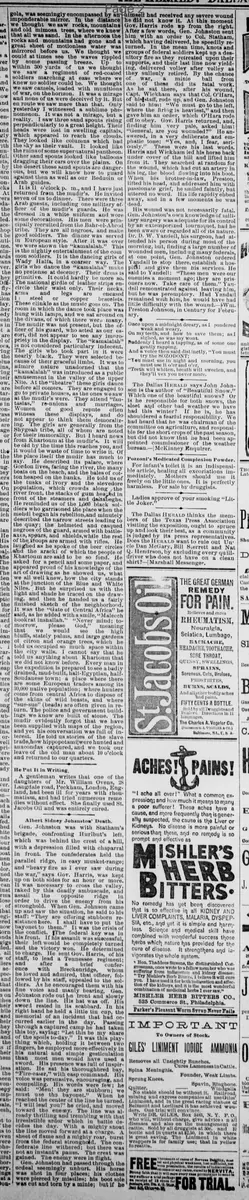
Gen. Johnston was with Statham's brigade, confronting Hurlbut's left, which was behind the crest of a hill, with a depression filled with chaparral in front. The confederates held the parallel ridge, in easy musket-range; and "heavy fire as I ever saw during the war," says Gov. Harris, was kept up on both sides for an hour or more. It was necessary to cross the valley, raked by this deadly ambuscade, and assail the opposite ridge in order to drive the enemy from his stronghold. When Gen. Johnston came up and saw the situation, he said to his staff: "They are offering stubborn resistance here. I shall have to put the bayonet to them." It was the crisis of the conflict. The federal key was in his front. If his assault was successful, their left would be completely turned and the victory won. He determined to charge. He sent Gov. Harris, of his staff, to lead a Tennessee regiment; and after a brief conference with Breckenridge, whom he loved and admired, that officer, followed by his staff, appealed to the soldiers. As he encouraged them with his fine voice and manly bearing, Gen. Johnston rode out in front and slowly down the line. His hat was off. His sword rested in its scabbard. In his right hand he held a little tin cup, the memorial of an incident that had occurred earlier in the day. Passing through a captured camp he had taken this toy, saying: "Let this be my share of the spoils to-day." It was this plaything which, holding it between two fingers, he employed more effectively in his natural and simple gesticulation than most men would have used a sword. His presence was full of inspiration. He sat his thoroughbred bay. "Fire-eater," with easy command. His voice was persuasive, encouraging, and compelling. His words were few; he said: "Men! they are stubborn; we must use the bayonet." When he reached the center of the line he turned. "I will lead you!" he cried, and moved toward the enemy. The line was already thrilling and trembling with that irresistible ardor which in battle decides the day. With a mighty shout the line moved forward at a charge. A sheet of flame and a mighty roar, burst from the federal stronghold. The confederate line withered; but there was not an instant's pause. The crest was gained. The enemy were in flight. Gen. Johnston had passed through the ordeal seemingly unhurt. His horse was shot in four places; his clothes were pierced by missiles; his boot sole was cut and torn by a minie; but if he himself had received any severe wound he did not know it. At this moment Gov. Harris rode up from the right. After a few words, Gen. Johnston sent him with an order to Col. Statham, which having delivered, he speedily returned. In the mean time, knots and groups of federal soldiers kept up a desultory fire as they retreated upon their supports, and their last line now yielding, delivered volley after volley as they sullenly retired. By the chance of war, a minie ball from one of these did its fatal work. As he sat there, after his wound, Capt. Wickham says that Col. O'Hara, of his staff, rode up, and Gen. Johnston said to him: "We must go to the left, where the firing is heaviest," and then gave him an order, which O'Hara rode off to obey. Gov. Harris returned, and, finding him very pale, asked him: "General, are you wounded?" He answered, in a very deliberate and emphatic tone: "Yes, and, I fear, seriously." These were his last words. Harris and Wickham led his horse back under cover of the hill and lifted him from it. They searched at random for the wound, which had cut an artery in his leg, the blood flowing into his boot. When his brother-in-law, Preston, lifted his head, and addressed him with passionate grief, he smiled faintly, but uttered no word. His life rapidly ebbed away, and in a few moments he was dead. His wound was not necessarily fatal. Gen. Johnston's own knowledge of military surgery was adequate for its control by an extemporized tourniquet, had he been aware or regarded all of its nature. Dr. D. W. Yandell, his surgeon, had attended his person during most of the morning, but, finding a large number of wounded men, including many federals, at one point, Gen. Johnston ordered Yandell to stop there, establish a hospital and give them his services. He said to Yandell: "These men were our enemies a moment ago; they are prisoners now. Take care of them." Yandell remonstrated against leaving him, but he was peremptory. Had Yandell remained with him, he would have had little difficulty with the wound.—Wm. Preston Johnston, in Century for February.
Gen. Johnston was with Statham's brigade, confronting Hurlbut's left, which was behind the crest of a hill, with a depression filled with chaparral in front. The confederates held the parallel ridge, in easy musket-range; and "heavy fire as I ever saw during the war," says Gov. Harris, was kept up on both sides for an hour or more. It was necessary to cross the valley, raked by this deadly ambuscade, and assail the opposite ridge in order to drive the enemy from his stronghold. When Gen. Johnston came up and saw the situation, he said to his staff: "They are offering stubborn resistance here. I shall have to put the bayonet to them." It was the crisis of the conflict. The federal key was in his front. If his assault was successful, their left would be completely turned and the victory won. He determined to charge. He sent Gov. Harris, of his staff, to lead a Tennessee regiment; and after a brief conference with Breckenridge, whom he loved and admired, that officer, followed by his staff, appealed to the soldiers. As he encouraged them with his fine voice and manly bearing, Gen. Johnston rode out in front and slowly down the line. His hat was off. His sword rested in its scabbard. In his right hand he held a little tin cup, the memorial of an incident that had occurred earlier in the day. Passing through a captured camp he had taken this toy, saying: "Let this be my share of the spoils to-day." It was this plaything which, holding it between two fingers, he employed more effectively in his natural and simple gesticulation than most men would have used a sword. His presence was full of inspiration. He sat his thoroughbred bay. "Fire-eater," with easy command. His voice was persuasive, encouraging, and compelling. His words were few; he said: "Men! they are stubborn; we must use the bayonet." When he reached the center of the line he turned. "I will lead you!" he cried, and moved toward the enemy. The line was already thrilling and trembling with that irresistible ardor which in battle decides the day. With a mighty shout the line moved forward at a charge. A sheet of flame and a mighty roar, burst from the federal stronghold. The confederate line withered; but there was not an instant's pause. The crest was gained. The enemy were in flight. Gen. Johnston had passed through the ordeal seemingly unhurt. His horse was shot in four places; his clothes were pierced by missiles; his boot sole was cut and torn by a minie; but if he himself had received any severe wound he did not know it. At this moment Gov. Harris rode up from the right. After a few words, Gen. Johnston sent him with an order to Col. Statham, which having delivered, he speedily returned. In the mean time, knots and groups of federal soldiers kept up a desultory fire as they retreated upon their supports, and their last line now yielding, delivered volley after volley as they sullenly retired. By the chance of war, a minie ball from one of these did its fatal work. As he sat there, after his wound, Capt. Wickham says that Col. O'Hara, of his staff, rode up, and Gen. Johnston said to him: "We must go to the left, where the firing is heaviest," and then gave him an order, which O'Hara rode off to obey. Gov. Harris returned, and, finding him very pale, asked him: "General, are you wounded?" He answered, in a very deliberate and emphatic tone: "Yes, and, I fear, seriously." These were his last words. Harris and Wickham led his horse back under cover of the hill and lifted him from it. They searched at random for the wound, which had cut an artery in his leg, the blood flowing into his boot. When his brother-in-law, Preston, lifted his head, and addressed him with passionate grief, he smiled faintly, but uttered no word. His life rapidly ebbed away, and in a few moments he was dead. His wound was not necessarily fatal. Gen. Johnston's own knowledge of military surgery was adequate for its control by an extemporized tourniquet, had he been aware or regarded all of its nature. Dr. D. W. Yandell, his surgeon, had attended his person during most of the morning, but, finding a large number of wounded men, including many federals, at one point, Gen. Johnston ordered Yandell to stop there, establish a hospital and give them his services. He said to Yandell: "These men were our enemies a moment ago; they are prisoners now. Take care of them." Yandell remonstrated against leaving him, but he was peremptory. Had Yandell remained with him, he would have had little difficulty with the wound.—Wm. Preston Johnston, in Century for February.
What sub-type of article is it?
Military Action
Historical Event
Tragedy
What themes does it cover?
Bravery Heroism
Tragedy
Misfortune
What keywords are associated?
Albert Sidney Johnston
Bayonet Charge
Battle Death
Confederate Assault
Minie Ball Wound
Civil War Battle
What entities or persons were involved?
Albert Sidney Johnston
Isham G. Harris
Stephen A. Hurlbut
John C. Breckenridge
Preston
D. W. Yandell
Wickham
O'hara
Statham
Where did it happen?
A Ridge And Valley On The Battlefield
Story Details
Key Persons
Albert Sidney Johnston
Isham G. Harris
Stephen A. Hurlbut
John C. Breckenridge
Preston
D. W. Yandell
Wickham
O'hara
Statham
Location
A Ridge And Valley On The Battlefield
Story Details
Gen. Albert Sidney Johnston leads a bayonet charge against federal forces, successfully turning their left flank, but is mortally wounded by a minie ball and dies shortly after, despite the wound not being immediately fatal.