Thank you for visiting SNEWPapers!
Sign up free
The Caledonian
Saint Johnsbury, Caledonia County, Vermont
What is this article about?
The semi-annual meeting of the Vermont Anti-Slavery Society was held in Montpelier on October 24, 1838, where a business committee was appointed and numerous resolutions condemning slavery and advocating abolition were adopted. Addresses were given, and plans for an anti-slavery paper and agent were made.
Clipping
OCR Quality
Full Text
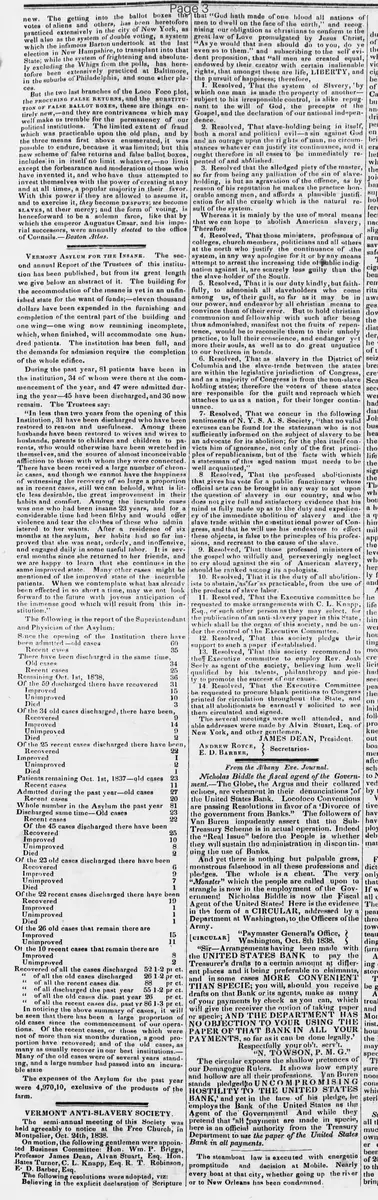
The semi-annual meeting of this Society was held agreeably to notice at the Free Church, in Montpelier, Oct. 24th, 1838.
On motion, the following gentlemen were appointed Business Committee: Hon. Wm. P. Briggs, Professor James Dean, Alvan Stuart, Esq. Hon. Bates Turner, C. L. Knapp, Esq. R. T. Robinson, E. D. Barber, Esq.
The following resolutions were adopted, viz:
Believing in the explicit declaration of Scripture that "God hath made of one blood all nations of men to dwell on the face of the earth," and recognizing our obligation as Christians to conform to the great law of Love promulgated by Jesus Christ, "As ye would that men should do to you, do ye even so to them." and subscribing to the self-evident proposition, that "all men are created equal, endowed by their Creator with certain inalienable rights, that amongst these are life, LIBERTY, and the pursuit of happiness;" therefore,
1. Resolved, That the system of Slavery, by which one man is made the property of another—subject to his irresponsible control, is alike repugnant to the will of God, the precepts of the Gospel, and the declaration of our national independence.
2. Resolved, That slave-holding being in itself, both a moral and political evil—a sin against God and an outrage upon the rights of man, no circumstances whatever can justify its continuance, and it ought therefore in all cases to be immediately repented of and abolished.
3. Resolved that the alleged piety of the master, so far from being any palliation of the sin of slave-holding, is but an aggravation of the offence, as by reason of his reputation he makes the practice honorable among men, and affords a plausible justification for all the cruelty which is the natural result of the system.
Whereas it is mainly by the use of moral means that we can hope to abolish American slavery,
Therefore
4. Resolved, That those ministers, professors of colleges, church members, politicians and all others at the north who justify the continuance of the system, in any way apologise for it or by any means attempt to arrest the increasing tide of public indignation against it, are scarcely less guilty than the slave-holder of the South.
5. Resolved, That it is our duty kindly, but faithfully, to admonish all slaveholders who come among us, of their guilt, so far as it may be in our power, and endeavor by all Christian means to convince them of their error. But to hold Christian communion and fellowship with such after being thus admonished, manifest not the fruits of repentance, would be to reconcile them to their unholy practice, to lull their conscience, and endanger yet more their souls, as well as to do great injustice to our brethren in bonds.
6. Resolved, That as slavery in the District of Columbia and the slave-trade between the states are within the legislative jurisdiction of Congress, and as a majority of Congress is from the non-slave holding states; therefore the voters of these states are responsible for the guilt and reproach which attaches to us as a nation, for their longer continuance.
7. Resolved, That we concur in the following sentiments of N. Y. S. A. S. Society, "that no valid excuses can be found for the statesman who is not sufficiently informed on the subject of slavery to be an advocate for its abolition; for the plea itself convicts him of ignorance, not only of the first principles of republicanism, but of the facts with which a statesman of this enlightened nation must needs to be well acquainted."
8. Resolved, That the professed abolitionist that gives his vote for a public functionary whose official acts can be brought in any way to act upon the question of slavery in our country, and who does not give full and satisfactory evidence that his mind is fully made up as to the duty and expediency of the immediate abolition of slavery and the slave trade within the constitutional power of Congress, and that he will use his endeavors to effect these objects, is false to the principles of his profession, and recreant to the cause of the slave.
9. Resolved, That those professed ministers of the gospel who wilfully and perseveringly neglect to cry aloud against the sin of American slavery, should be ranked among its apologists.
10. Resolved, That it is the duty of all abolitionists to abstain, as far as practicable, from the use of the products of slave labor.
11. Resolved, That the Executive committee be requested to make arrangements with C. L. Knapp, Esq., or such other person as they may select, for the publication of an anti-slavery paper in this State, which shall be the organ of this society, and be under the control of the Executive Committee.
12. Resolved, That this society pledge their support to such a paper if established.
13. Resolved, That this society recommend to the Executive committee to employ Rev. Josh Seely as agent of the society, believing him well qualified by his talents, philanthropy and piety to promote the success of our cause.
14. Resolved, That the Executive Committee be requested to procure blank petitions to Congress printed for circulation throughout the State, and that all abolitionists be earnestly solicited to see them circulated and signed.
The several meetings were well attended, and able addresses were made by Alvin Stuart, Esq. of New York, and other gentlemen.
JAMES DEAN, President.
Andrew Royce,
Secretaries.
E. D. BARBER,
What sub-type of article is it?
What keywords are associated?
What entities or persons were involved?
Where did it happen?
Domestic News Details
Primary Location
Montpelier
Event Date
Oct. 24th, 1838
Key Persons
Outcome
resolutions adopted condemning slavery, appointing business committee, requesting anti-slavery paper publication, employing agent, and circulating petitions; well-attended meetings with addresses.
Event Details
Semi-annual meeting held at Free Church in Montpelier; business committee appointed; 14 resolutions adopted affirming anti-slavery principles based on scripture, gospel, and Declaration of Independence, calling for immediate abolition, admonishing slaveholders, criticizing apologists, advocating moral means, abstaining from slave labor products, and planning publications, agency, and petitions.