Thank you for visiting SNEWPapers!
Sign up free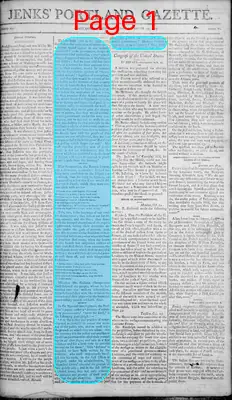
Editorial
November 12, 1803
Jenks' Portland Gazette
Portland, Cumberland County, Maine
What is this article about?
Federalist editorial from Utica Patriot criticizes the rise of a democratic faction that slandered Washington and Adams, undermined the Constitution through hypocrisy, and concealed government proceedings despite republican claims. Draws analogies to Roman demagogues like Sempronius and references Gallatin's role in the western insurrection.
Clipping
OCR Quality
98%
Excellent
Full Text
FROM THE UTICA PATRIOT.
Had we been told in the year 1783 that before the expiration of twenty years, a faction would appear in our country and succeed to its government, in opposition to the tried patriotism, correct principles, and approved wisdom of Washington and Adams: had we been told that these men, as a reward for their eminent services to their country, would be branded with the opprobrious epithets of 'hoary-headed traitor,' 'legalizer of corruption,' &c. and that they would be accused of being hostile to the liberties of that country for whose interests they had exerted their best talents;—had we been told, in 1792, that before the expiration of ten years, the then enemies of the federal constitution, would succeed to supplant its friends; that by flattery and hypocritical professions the more easily to accomplish the work of destruction, they would gain the ascendency of power, that—they would administer the government under this very constitution, and be suffered to waste its energy and destroy its vital principle by the debilitating effects of democratic improvement, we should have been slow to believe; we should have said the people of this country are too enlightened, they are too virtuous to suffer these things— But there is a destiny which shapes our ends. We trust that the protecting arm of providence is not yet withdrawn; that the power which has preserved us in the hour of danger, will again be exerted, to pluck us as 'brands from the burning.'
That Sempronius, the Roman senator, was a democrat, is certain: Indeed nothing more conclusive on the subject can be wished, than his reply to Syphax, on his expressing a fear that Cato would discover their frauds, unless they were covered thick with art: —
'Let me alone, good Syphax, I'll conceal My thoughts in passion, ('tis the surest way) I'll bellow out for Rome, and for my country, And mouth at Caesar till I shake the senate. Your cold hypocrisy's a stale device, A worn out trick: Would'st thou be thought in earnest? Clothe thy feign'd zeal in rage, in fire, in fury!'
This, too, is the language of our modern demagogues; they bellow out for liberty, equality, and the like; they stand forth the intrepid champions of the people's rights—and, veiling their detestable designs under the garb of patriotic zeal, they rise to power on the shoulders of their misguided followers;—but when the hour of detection shall come, when the hearts of the honest but misguided victims of their craft shall shrink from executing the sacrilegious deeds which shall be proposed to them; then will these disinterested patriots cast them off, and with Sempronius exclaim—
'Know, villains, when such paltry slaves presume To mix in treason, if the plot succeeds They're thrown neglected by: But if it fails, They've sure to die like dogs, 'as you shall do. Here, take these factious monsters, drag 'em forth To sudden death.'
Whether Mr. Gallatin (Sempronius like) deserted the people, whom he had deluded into the western insurrection, when he found they were like to fail in the execution of their plans—let the impartial pen of history record.—Charls. Cour.
In the National Intelligencer, the President's paper, under a 'defence of republican governments,' letter the sixth, is the following paragraph:
It is the policy and practice of monarchies and aristocracies to conceal the initiation of the public acts, and in most cases the grounds on which they are taken. On the contrary it is the policy and practice of republican government to expose their proceedings in all their stages, and only in a few instances and for a short time to conceal the reasons for them. This defence is supposed to have been written by the president, who must undoubtedly recollect that his tools, in the first session of Congress under his administration, by 'dignified silence' concealed the grounds of their public acts; and in the last session by closed doors, they not only concealed the initiation and grounds of their public acts, but the acts themselves. Now what must be the opinion of his excellency (and those who publish his 'defence') of our present government? Do they think it a monarchy or an aristocracy? They surely will not call it a republic?....Sal. Gaz.
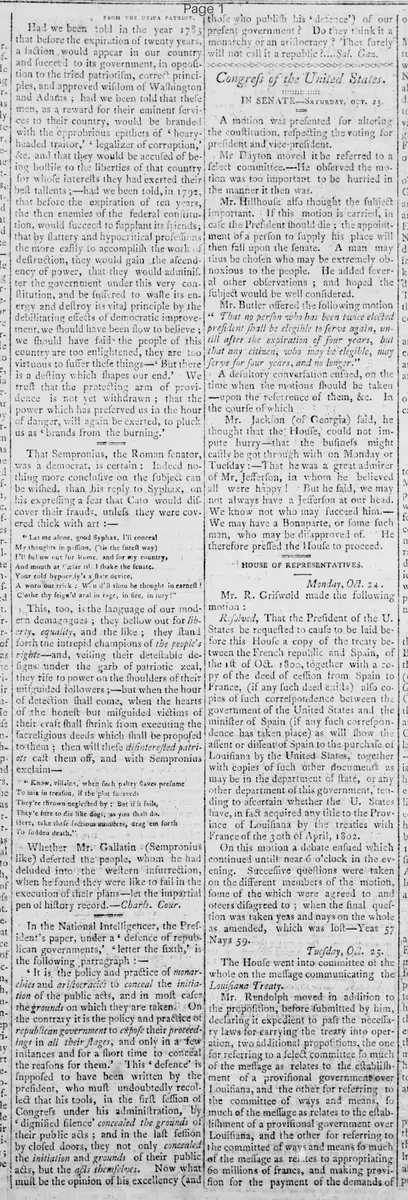
Had we been told in the year 1783 that before the expiration of twenty years, a faction would appear in our country and succeed to its government, in opposition to the tried patriotism, correct principles, and approved wisdom of Washington and Adams: had we been told that these men, as a reward for their eminent services to their country, would be branded with the opprobrious epithets of 'hoary-headed traitor,' 'legalizer of corruption,' &c. and that they would be accused of being hostile to the liberties of that country for whose interests they had exerted their best talents;—had we been told, in 1792, that before the expiration of ten years, the then enemies of the federal constitution, would succeed to supplant its friends; that by flattery and hypocritical professions the more easily to accomplish the work of destruction, they would gain the ascendency of power, that—they would administer the government under this very constitution, and be suffered to waste its energy and destroy its vital principle by the debilitating effects of democratic improvement, we should have been slow to believe; we should have said the people of this country are too enlightened, they are too virtuous to suffer these things— But there is a destiny which shapes our ends. We trust that the protecting arm of providence is not yet withdrawn; that the power which has preserved us in the hour of danger, will again be exerted, to pluck us as 'brands from the burning.'
That Sempronius, the Roman senator, was a democrat, is certain: Indeed nothing more conclusive on the subject can be wished, than his reply to Syphax, on his expressing a fear that Cato would discover their frauds, unless they were covered thick with art: —
'Let me alone, good Syphax, I'll conceal My thoughts in passion, ('tis the surest way) I'll bellow out for Rome, and for my country, And mouth at Caesar till I shake the senate. Your cold hypocrisy's a stale device, A worn out trick: Would'st thou be thought in earnest? Clothe thy feign'd zeal in rage, in fire, in fury!'
This, too, is the language of our modern demagogues; they bellow out for liberty, equality, and the like; they stand forth the intrepid champions of the people's rights—and, veiling their detestable designs under the garb of patriotic zeal, they rise to power on the shoulders of their misguided followers;—but when the hour of detection shall come, when the hearts of the honest but misguided victims of their craft shall shrink from executing the sacrilegious deeds which shall be proposed to them; then will these disinterested patriots cast them off, and with Sempronius exclaim—
'Know, villains, when such paltry slaves presume To mix in treason, if the plot succeeds They're thrown neglected by: But if it fails, They've sure to die like dogs, 'as you shall do. Here, take these factious monsters, drag 'em forth To sudden death.'
Whether Mr. Gallatin (Sempronius like) deserted the people, whom he had deluded into the western insurrection, when he found they were like to fail in the execution of their plans—let the impartial pen of history record.—Charls. Cour.
In the National Intelligencer, the President's paper, under a 'defence of republican governments,' letter the sixth, is the following paragraph:
It is the policy and practice of monarchies and aristocracies to conceal the initiation of the public acts, and in most cases the grounds on which they are taken. On the contrary it is the policy and practice of republican government to expose their proceedings in all their stages, and only in a few instances and for a short time to conceal the reasons for them. This defence is supposed to have been written by the president, who must undoubtedly recollect that his tools, in the first session of Congress under his administration, by 'dignified silence' concealed the grounds of their public acts; and in the last session by closed doors, they not only concealed the initiation and grounds of their public acts, but the acts themselves. Now what must be the opinion of his excellency (and those who publish his 'defence') of our present government? Do they think it a monarchy or an aristocracy? They surely will not call it a republic?....Sal. Gaz.
What sub-type of article is it?
Partisan Politics
Constitutional
What keywords are associated?
Democratic Hypocrisy
Federalist Defense
Constitutional Betrayal
Political Demagogues
Western Insurrection
Republican Government Critique
What entities or persons were involved?
Washington
Adams
Sempronius
Syphax
Cato
Mr. Gallatin
President
Congress
Editorial Details
Primary Topic
Criticism Of Democratic Faction's Hypocrisy And Betrayal Of Federalist Principles
Stance / Tone
Strongly Anti Democratic And Pro Federalist
Key Figures
Washington
Adams
Sempronius
Syphax
Cato
Mr. Gallatin
President
Congress
Key Arguments
Democratic Faction Rose To Power Against Washington And Adams' Patriotism
Slandered Federalists As Traitors Despite Their Services
Undermined Constitution Through Hypocritical Democratic Improvements
Modern Demagogues Mimic Sempronius' Feigned Zeal For Liberty
Gallatin Deserted Followers In Western Insurrection
Jefferson's Defense Of Republican Openness Contradicted By Congress' Secrecy