Thank you for visiting SNEWPapers!
Sign up free
The New Hampshire Gazette
Portsmouth, Rockingham County, New Hampshire
What is this article about?
A letter defending the newspaper's account of a Triton sighted near Martinico, arguing against skeptics who attribute mermaid legends to sea cows. The writer cites historical references, including Mr. Gordon's descriptions, Father Henríques' observations, and Capt. Richard Whitbourne's 1610 eyewitness account of a mermaid-like creature in Newfoundland harbor.
Merged-components note: These two components form a single continuous letter to the editor discussing mermaids and sea creatures, split likely due to column boundaries.
Clipping
OCR Quality
Full Text
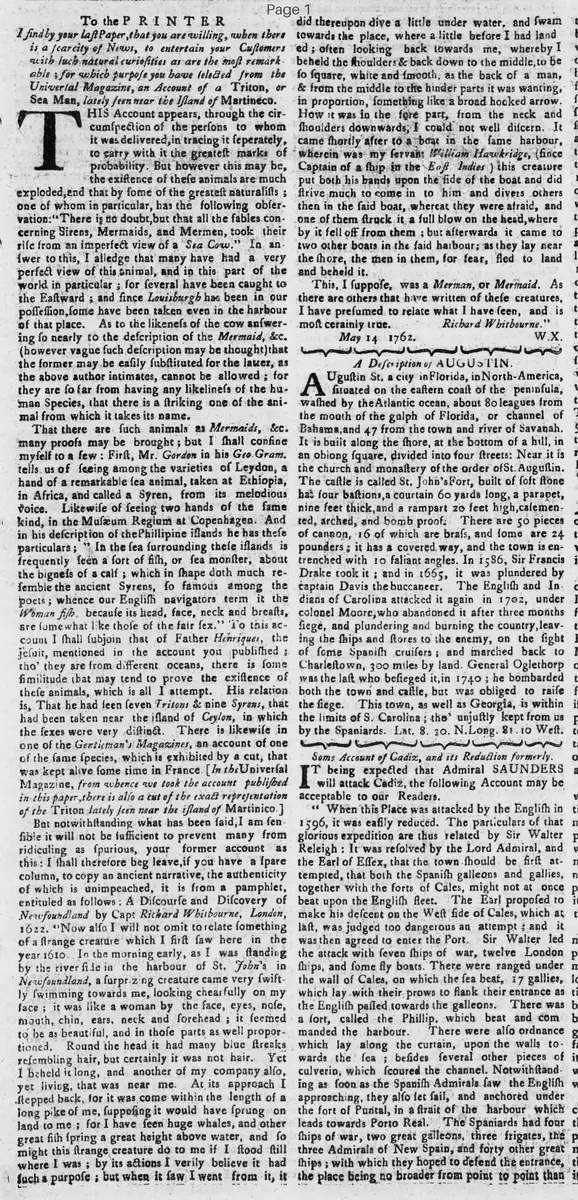
I find by your last Paper, that you are willing, when there is a scarcity of News, to entertain your Customers with such natural curiosities as are the most remarkable; for which purpose you have selected from the Universal-Magazine, an Account of a Triton, or Sea Man, lately seen near the Island of Martinico. His Account appears, through the circumspection of the persons to whom it was delivered, in tracing it separately, to carry with it the greatest marks of probability. But however this may be, the existence of these animals are much exploded, and that by some of the greatest naturalists; one of whom in particular, has the following observation: "There is no doubt, but that all the fables concerning Sirens, Mermaids, and Mermen, took their rise from an imperfect view of a Sea Cow." In answer to this, I allege that many have had a very perfect view of this animal, and in this part of the world in particular; for several have been caught to the Eastward; and since Louisburgh has been in our possession, some have been taken even in the harbour of that place. As to the likeness of the cow answering so nearly to the description of the Mermaid, &c. (however vague such description may be thought) that the former may be easily substituted for the latter, as the above author intimates, cannot be allowed; for they are so far from having any likeliness of the human Species, that there is a striking one of the animal from which it takes its name.
That there are such animals as Mermaids, &c. many proofs may be brought; but I shall confine myself to a few: First, Mr. Gordon in his Geo. Gram. tells us of seeing among the varieties of Leyden, a hand of a remarkable sea animal, taken at Ethiopia, in Africa, and called a Syren, from its melodious voice. Likewise of seeing two hands of the same kind, in the Museum Regium at Copenhagen. And in his description of the Philippine islands he has these particulars; "In the sea surrounding these islands is frequently seen a sort of fish, or sea monster, about the bigness of a calf; which in shape doth much resemble the ancient Syrens, so famous among the poets; whence Our English navigators term it the Woman fish, because its head, face, neck and breasts, are somewhat like those of the fair sex." To this account I shall subjoin that of Father Henríques, the Jesuit, mentioned in the account you published; tho' they are from different oceans, there is some similitude that may tend to prove the existence of these animals, which is all I attempt. His relation is, That he had seen even Tritons & nine Syrens, that had been taken near the island of Ceylon, in which the sexes were very distinct. There is likewise in one of the Gentleman's Magazines, an account of one of the same species, which is exhibited by a cut, that was kept alive some time in France. [In the Universal Magazine, from whence we took the account published in this paper, there is also a cut of the exact representation of the Triton lately seen near the island of Martinico.]
But notwithstanding what has been said, I am sensible it will not be sufficient to prevent many from ridiculing as spurious, your former account as this: I shall therefore beg leave, if you have a spare column, to copy an ancient narrative, the authenticity of which is unimpeached, it is from a pamphlet, entitled as follows: A Discourse and Discovery of Newfoundland by Capt. Richard Whitbourne, London, 1622. "Now also I will not omit to relate something of a strange creature which I first saw here in the year 1610. In the morning early, as I was standing by the river side in the harbour of St. John's in Newfoundland, a surprising creature came very swiftly swimming towards me, looking cheerfully on my face; it was like a woman by the face, eyes, nose, mouth, chin, ears, neck and forehead; it seemed to be as beautiful, and in those parts as well proportioned. Round the head it had many blue streaks resembling hair, but certainly it was not hair. Yet I beheld it long, and another of my company also, yet living, that was near me. At its approach I stepped back, for it was come within the length of a long pike of me, supposing it would have sprung on land to me; for I have seen huge whales, and other great fish spring a great height above water, and so might this strange creature do to me if I stood still where I was; by its actions I verily believe it had such a purpose; but when it saw I went from it,
did thereupon dive a little under water, and swam towards the place, where a little before I had landed; often looking back towards me, whereby I beheld the shoulders & back down to the middle, to be so square, white and smooth, as the back of a man, & from the middle to the hinder parts it was wanting, in proportion, something like a broad hooked arrow. How it was in the fore part, from the neck and shoulders downwards, I could not well discern. It came shortly after to a boat in the same harbour, wherein was my servant: William Hawkbridge, (since Captain of a ship in the East Indies) this creature put both his hands upon the side of the boat and did strive much to come in to him, and divers others then in the said boat, whereat they were afraid, and one of them struck it a full blow on the head, whereby it fell off from them; but afterwards it came to two other boats in the said harbour, as they lay near the shore, the men in them, for fear, fled to land and beheld it.
This, I suppose, was a Merman, or Mermaid. As there are others that have written of these creatures, I have presumed to relate what I have seen, and is most certainly true.
Richard Whitbourne."
May 14, 1762.
W. X.
What sub-type of article is it?
What themes does it cover?
What keywords are associated?
What entities or persons were involved?
Letter to Editor Details
Author
W. X.
Recipient
To The Printer
Main Argument
the existence of mermaids, tritons, and similar sea creatures is probable and supported by historical eyewitness accounts and naturalist observations, countering claims that they are misidentified sea cows.
Notable Details