Thank you for visiting SNEWPapers!
Sign up free
The Virginia Gazette
Richmond, Williamsburg, Richmond County, Virginia
What is this article about?
An editor introduces a letter in which the writer thanks a friend for alerting him to damaging rumors, reflects on handling criticism through self-examination and forgiveness, emphasizes moral virtue and equity to avoid disputes, and pledges to prioritize public peace and good conduct.
Merged-components note: This is a single philosophical letter split across pages 1 and 2; the text continues directly from the cutoff 'believe' in the first part to 'believe mine to be more just' in the second part, indicating a continuation of the same logical component.
Clippings
1 of 2
OCR Quality
Full Text
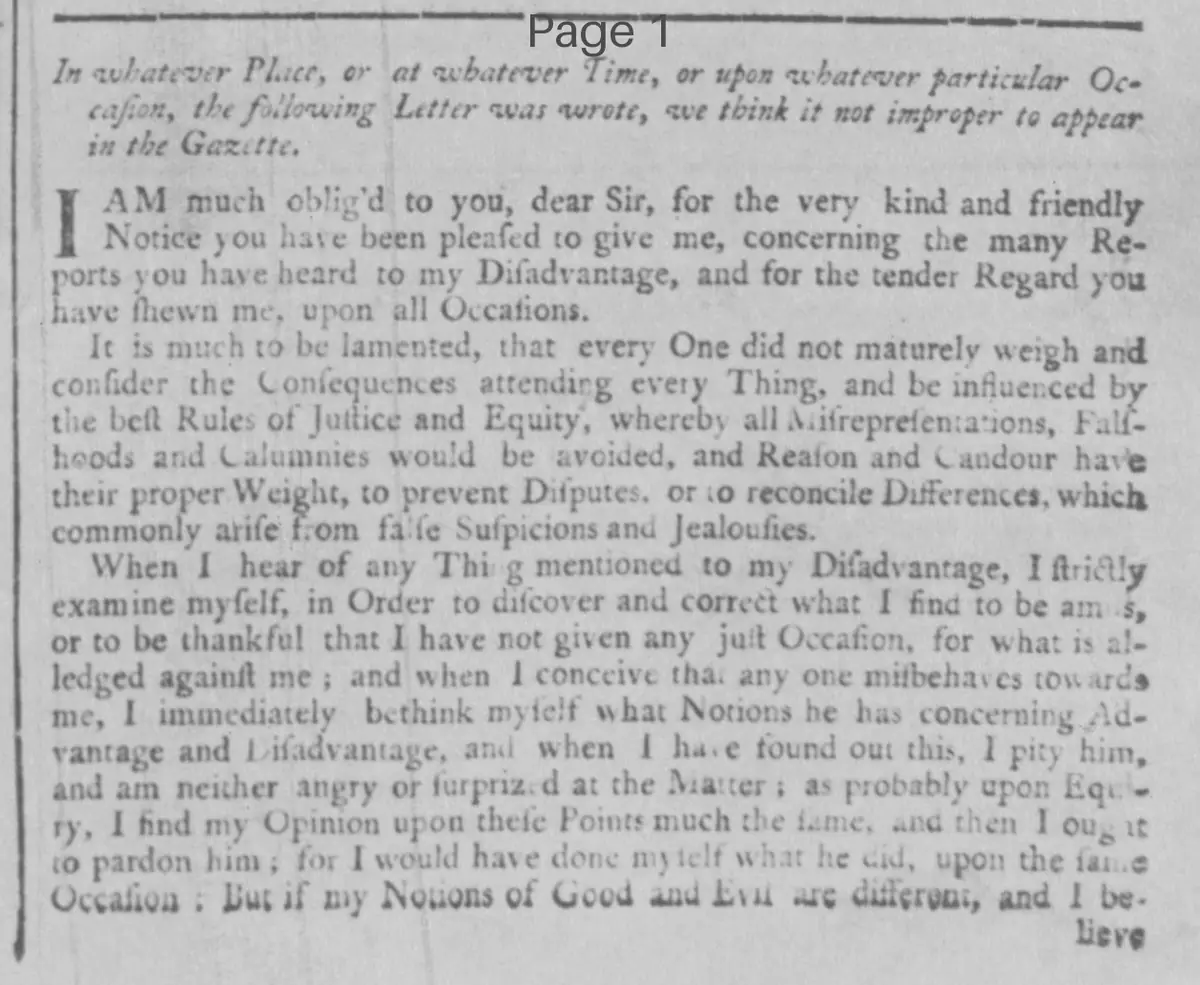
I am much obliged to you, dear Sir, for the very kind and friendly Notice you have been pleased to give me, concerning the many Reports you have heard to my Disadvantage, and for the tender Regard you have shown me, upon all Occasions.
It is much to be lamented, that every One did not maturely weigh and consider the Consequences attending every Thing, and be influenced by the best Rules of Justice and Equity, whereby all Misrepresentations, Falseheads and Calumnies would be avoided, and Reason and Candour have their proper Weight, to prevent Disputes, or to reconcile Differences, which commonly arise from false Suspicions and Jealousies.
When I hear of any Thing mentioned to my Disadvantage, I strictly examine myself, in Order to discover and correct what I find to be amiss, or to be thankful that I have not given any just Occasion, for what is alledged against me; and when I conceive that any one misbehaves towards me, I immediately bethink myself what Notions he has concerning Advantage and Disadvantage, and when I have found out this, I pity him. and am neither angry or surprised at the Matter; as probably upon Enquiry, I find my Opinion upon these Points much the same, and then I ought to pardon him; for I would have done myself what he did, upon the same Occasion: But if my Notions of Good and Evil are different, and I believe mine to be more just than his, then my Passions ought to yield to my good Nature, and I should easily bear with his Ignorance.
The most wise and circumspect are liable to many Slips and Inadvertencies, and the least real or imaginary Escape, in one of the fairest Characters. or whose Fame has been highly extolled will appear as a very great Blemish when probably not the least Notice would have been taken of the Action, in one of less Eminency.
As People in general are more fond of Satyr than Panegyrick, and to propagate Evil than Good, it is not to be wonder'd at, that an improbable Tale is easily believed, which could not have gained Credit had the whole Truth been disclosed, and the Matter duly considered.
The slightest Circumstance in an Action changes it greatly, and as every one ought to incline to the most favourable Opinion, so he should be as ready, to pardon the Errors of Mankind, as if he were every Day guilty of one himself, and at the same Time as cautious of committing a Fault as if he never so gave one, and be inexorable to his own Failings, while he treats those of the rest of the World with Tenderness, not excepting even such as forgive none but themselves.
You justly observe, that Glory is the Portion of Virtue, the sweet Reward of honourable Toils, the triumphant Crown that covers the thoughtful Head of the disinterested Patriot, or the dusty Brow of the victorious Warrior. Elevated by so sublime a Prize, the Man of Virtue looks down with contempt on all the Allurements of Pleasure, and all the Menaces of Danger. Death itself loses its Terrors, when he considers, that its Dominion extends only over a Part of him, and that in Spite of Death and Time, the Rage of the Elements, and the endless Vicissitude of human Affairs. he is assured of an immortal Fame among all the Sons of Men.
It is most certain, that almost every one has a predominant Inclination, to which all his other Desires and Affections submit, and which governs him, tho' perhaps with some Intervals, thro' the whole Course of his Life. His own Pursuits are always, in his Account, the most engaging; the Objects of his Passion, the most valuable; and the Road he pursues, the only one that leads to Happiness.
I wish this Observation was not frequently verified, That the Injured often forgive, but the Injurer never : The same Malignity of Mind, which makes them do an Injury, will not suffer them to forgive it; they have no Notion, that others have Generosity enough to remit what they are sure they themselves never would, in the same Circumstances : And therefore the Injured are always treated by them as irreconcilable Enemies. whom the Interest of their own Safety obliges them to oppress; but surely the greatest Injuries should be remitted.
There is, indeed, something so powerful in the cordial, candid, reasonable, and affectionate Advice of a true Friend, as can hardly be resisted, as can hardly fail to work it's Way into the most obstinate Breast ; and I am truly sensible, that to retrench or mend a Fault at the Admonition of a Friend, hurts my Credit, or Liberty, no more than if I had grown wiser upon my own Thought, for 'tis still my own Judgment and Temper, which makes me see my Mistake, and willing to retrieve it.
I subscribe entirely to what you mention, that neither Learning, nor Wealth, nor Fame, nor Pleasure, can ever help me to Happiness, which is only to be had by acting up to the Height of human Nature, and getting a right Set of Principles for Thought and Practice, such as state and distinguish Good and Evil; such as give us to understand, that there is nothing properly good for a Man, but what promotes the Virtues of Justice, Temperance, Fortitude, and Benevolence, nor any Thing bad for him, but that which carries him off to the contrary Vices.
It gives me great Satisfaction that I can, after the most impartial Scrutiny, solemnly assure you, that many of the Particulars you mention to have heard to my Disadvantage are not true, and others are misrepresented, but I will endeavour to profit by the Misrepresentations, and must earnestly intreat you always to mention to me what you hear me blamed for, that I may shew --- I have a Mind open to Conviction—Believe it the truest Honour and Glory, to confess my Faults, and reform my Mistakes, —Manifest such a consistent Conduct upon all Occasions, as may convince the most obstinate and prejudiced, that it is my most earnest Desire to do all the Good I possibly can, and cautiously to avoid making an Enemy, or giving the least just Offence to the most inconsiderable Person in the Community.
I have a greater Regard to the Quiet of Mankind, than to disturb it for Things of so little Consequence as my Credit, and my Sense, and am fully resolved to sacrifice my Resentment to the publick Peace, and rejoice at every Measure taken for the Advantage of the Publick, whose Rights and Privileges I heartily wish may be preferred to all other Considerations, and supported with such a Spirit as may prevent all Faction and Discord, and secure Peace and Harmony among all Degrees of Men.
I am,
Your most faithful,
sincere, affectionate, and
Obliged Friend.
What sub-type of article is it?
What themes does it cover?
What keywords are associated?
What entities or persons were involved?
Letter to Editor Details
Recipient
Dear Sir
Main Argument
the writer responds to a friend's warnings about damaging reports by advocating self-examination, forgiveness of others' errors, adherence to virtues like justice and benevolence, and commitment to public harmony over personal resentment.
Notable Details