Thank you for visiting SNEWPapers!
Sign up free
The Mahnomen Pioneer
Mahnomen, Mahnomen County, Minnesota
What is this article about?
Parker O. Anderson, extension forester at University Farm in St. Paul, advises on controlling insects damaging trees in shelterbelts and woodlots using poisons for leaf-eaters and contact sprays for aphids like plant lice.
Clipping
OCR Quality
Full Text
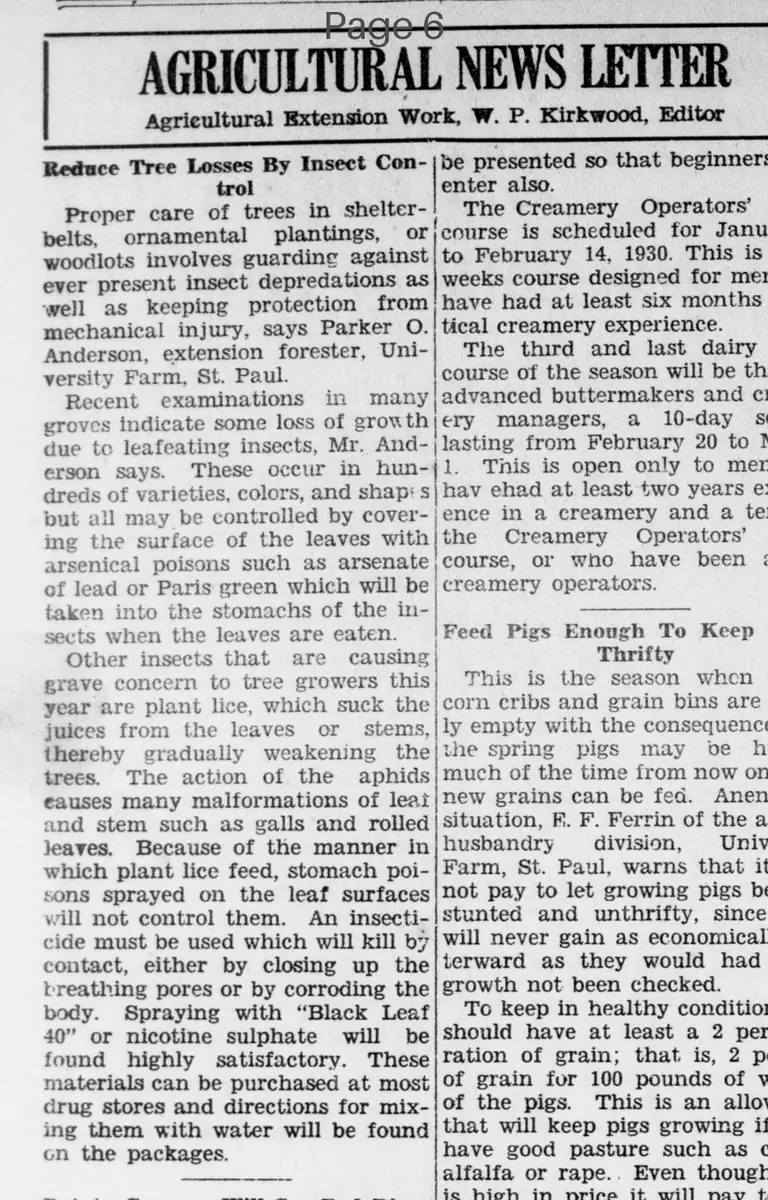
Reduce Tree Losses By Insect Control
Proper care of trees in shelterbelts, ornamental plantings, or woodlots involves guarding against ever present insect depredations as well as keeping protection from mechanical injury, says Parker O. Anderson, extension forester, University Farm, St. Paul. Recent examinations in many groves indicate some loss of growth due to leaf-eating insects, Mr. Anderson says. These occur in hundreds of varieties, colors, and shapes but all may be controlled by covering the surface of the leaves with arsenical poisons such as arsenate of lead or Paris green which will be taken into the stomachs of the insects when the leaves are eaten. Other insects that are causing grave concern to tree growers this year are plant lice, which suck the juices from the leaves or stems, thereby gradually weakening the trees. The action of the aphids causes many malformations of leaf and stem such as galls and rolled leaves. Because of the manner in which plant lice feed, stomach poisons sprayed on the leaf surfaces will not control them. An insecticide must be used which will kill by contact, either by closing up the breathing pores or by corroding the body. Spraying with "Black Leaf 40" or nicotine sulphate will be found highly satisfactory. These materials can be purchased at most drug stores and directions for mixing them with water will be found on the packages.
What sub-type of article is it?
What keywords are associated?
What entities or persons were involved?
Where did it happen?
Domestic News Details
Primary Location
St. Paul
Key Persons
Event Details
Proper care of trees in shelterbelts, ornamental plantings, or woodlots involves guarding against insect depredations and mechanical injury. Recent examinations show some growth loss due to leaf-eating insects, controllable by arsenical poisons like arsenate of lead or Paris green. Plant lice, which suck juices and cause malformations, require contact insecticides like Black Leaf 40 or nicotine sulphate.