Thank you for visiting SNEWPapers!
Sign up free
The Wheeling Repository
Wheeling, Ohio County, West Virginia
What is this article about?
An editorial by Richard Rummager critiques the prevalence of vice and party spirit in modern society, quoting Addison's 1711 Spectator essay on the divisive effects of political factions in England, applying it to America's recent divisions, urging unity and judgment based on merit over party loyalty.
Merged-components note: This is a single essay titled 'THE FUNKET' continuing across pages 2-4, discussing societal enlightenment, vices, and party spirit with quotes from Addison; relabeled from 'literary' to 'editorial' as it is an opinion piece.
Clippings
1 of 3
OCR Quality
Full Text
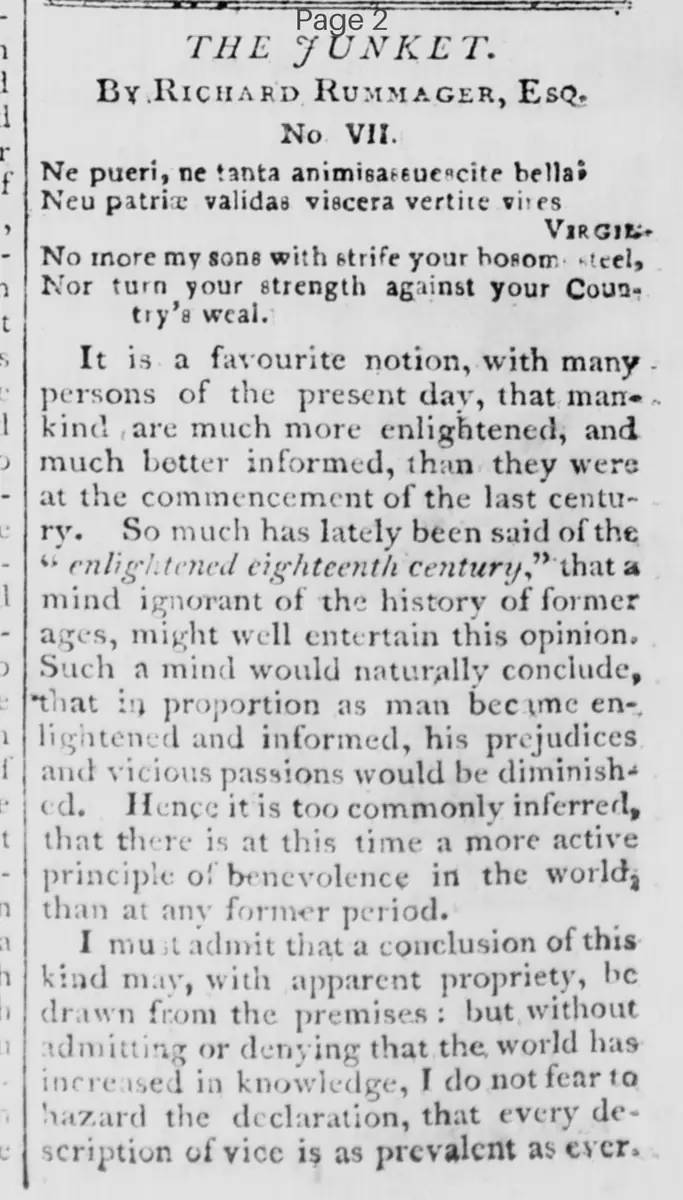
By Richard Rummager, Esq.
No VII.
Ne pueri, ne tanta animis aequescite bella
Neu patriae validas viscera vertite vires
VIRGIL.
No more my sons with strife your bosoms steel,
Nor turn your strength against your Country's weal.
It is a favourite notion, with many persons of the present day, that mankind are much more enlightened, and much better informed, than they were at the commencement of the last century. So much has lately been said of the "enlightened eighteenth century," that a mind ignorant of the history of former ages, might well entertain this opinion. Such a mind would naturally conclude, that in proportion as man became enlightened and informed, his prejudices and vicious passions would be diminished. Hence it is too commonly inferred, that there is at this time a more active principle of benevolence in the world; than at any former period.
I must admit that a conclusion of this kind may, with apparent propriety, be drawn from the premises: but without admitting or denying that the world has increased in knowledge, I do not fear to hazard the declaration, that every description of vice is as prevalent as ever.
No matter to what extent our knowledge on speculative subjects is increased; no matter what advantages we derive from useful inventions and discoveries; we still continue to disregard our true interest, and madly refuse to profit by the experience of others.
Whoever is acquainted with the history of former times, knows that the mass of mankind have always been liable to be acted upon by the same means, and influenced by the same motives.—
In all civilized countries, the shafts of the satirist have been levelled against the same object; the same topics have furnished matter of complaint and regret, for the pen of the moralist. The labours of neither have, at any time, effected more than a partial reformation.
I could illustrate the truth of the above reflections, by reference to the history of all civilized people; but it is more to my purpose at present, to lay before the readers of the Repository the following essay. It was written by Addison, and published in the Spectator, in the year 1711,—nearly an hundred years back. It was intended to describe the condition of England at that time; yet it is scarcely possible to deliver sentiments more exactly applicable to the state of America for the last fourteen years.
"There cannot a greater judgment befal a country, than such a dreadful spirit of division as rends a government into two distinct people, and makes them greater strangers and more averse to one another, than if they were actually two different nations. The effects of such a division are pernicious to the last degree, not only with regard to those advantages which they give the common enemy, but to those private evils which they produce in the heart of almost every particular person. This influence is very fatal both to men's morals and their understandings; it sinks the virtue of a nation, and not only so, but destroys even common sense.
"A furious party spirit, when it rages in its full violence, exerts itself in civil war and bloodshed; and when it is under its greatest restraints, naturally breaks out in falsehood, detraction, calumny, and a partial administration of justice. In a word, it fills a nation with spleen and rancour, and extinguishes all the seeds of good nature, compassion, and humanity.
"Plutarch says very finely, that a man should not allow himself to hate even his enemies; because, says he, if you indulge this passion on some occasions, it will rise of itself in others: if you hate your enemies, you will contract such a vicious habit of mind, as by degrees will break out upon those who are your friends or those who are indifferent to you.
I might here observe how admirably this precept of morality (which derives the malignity of hatred from the passion itself, and not from its object,) answers to that great rule which was dictated to the world about an hundred years before this philosopher wrote; but instead of that, I shall only take notice, with a real grief of heart, that the minds of many good men among us appear soured with party principles, and alienated from one another, in such a manner as seems to me altogether inconsistent with the dictates either of reason or religion. Zeal for a public cause is apt to breed passions in the breasts of virtuous persons, into which the regard of their own private interest would never have betrayed them.
"If this party spirit has so ill an effect on our morals, it has likewise a very great one upon our judgments. We often hear a poor insipid paper or pamphlet cried up, and sometimes a noble piece depreciated by those who are of a different principle from the author.— One who is actuated by this spirit is almost under an incapacity of discerning either real blemishes or beauties. A man of merit, in a different principle, is like an object seen in two different mediums, that appears crooked or broken, however straight and entire it may be in itself. For this reason there is scarce a person of any figure in England, who does not go by two contrary characters, as opposite to one another as light and darkness. Knowledge and learning suffer in a particular manner from this strange prejudice, which at present prevails amongst all ranks and degrees in the British nation.
As men formerly became eminent in learned societies by their parts and acquisitions, they now distinguish themselves by the warmth and violence with which they espouse their respective parties. Books are valued upon the like considerations; and abusive scurrilous style passes for satire, and a dull scheme of party notions is called fine writing.
"There is one piece of sophistry practised by both sides, and that is the taking any scandalous story, that has been ever whispered or invented of a private man, for a known, undoubted truth, and raising suitable speculations upon it.— Calumnies that have been never proved, or have been often refuted, are the ordinary postulatums of these infamous scribblers, upon which they proceed as upon first principles granted by all men, though in their hearts they know they are false, or at best very doubtful. When they have laid these foundations of scurrility, it is no wonder that their superstructure is answerable to them. If this shameless practice of the present age endures much longer, praise and reproach will cease to be motives of action in good men.
"There are certain periods of time in all governments when this inhuman spirit prevails. Italy was long torn in pieces by the Guelses & Gibellines, and France by those who were for and against the League; but it is very unhappy for a man to be born in such a stormy and tempestuous season. It is the restless ambition of artful men, that thus breaks a people into factions, and draws several well-meaning persons to their interest by a specious concern for their country: How many honest minds are filled with uncharitable and barbarous notions, out of their zeal for the public good? What cruelties and outrages would they not commit against men of an adverse party, whom they would honour and esteem, if, instead of considering them as they are represented, they knew them as they are? Thus are persons of the greatest probity seduced into shameful errors and prejudices, and made bad men by that noblest of principles, the love of their country. I cannot here forbear mentioning the famous Spanish proverb, "If there were neither fools nor knaves in the world, all people would be of one mind."
"For my own part, I could heartily wish that all honest men would enter into an association for the support of one another against the endeavours of those whom they ought to look upon as their common enemies, whatsoever side they may belong to. Were there such an honest body of neutral forces, we would never see the worst of men in great figures of life, because they are useful to a party; nor the best unregarded, because they are above practising those methods which would be grateful to their faction. We should then single every criminal out of the herd, and hunt him down, however formidable and overgrown he might appear: on the contrary, we should
shelter distressed innocence, and defend
virtue, however beset with contempt or
ridicule, envy or defamation. In short,
we should not any longer regard our
fellow-subjects as Whigs or Tories, but
should make the man of merit
our
friend, and the villain our enemy.
What sub-type of article is it?
What keywords are associated?
What entities or persons were involved?
Editorial Details
Primary Topic
Critique Of Party Spirit And Political Division
Stance / Tone
Warning Against Factionalism And Advocacy For Unity Based On Merit
Key Figures
Key Arguments