Thank you for visiting SNEWPapers!
Sign up free
Nashville Union And American
Nashville, Davidson County, Tennessee
What is this article about?
A book by O. Gieske on the humorous element in German law describes historical punishments in Germany aimed at public humiliation, including processions in chastisement attire, women riding donkeys backwards in Hesse and Darmstadt until mid-17th century, roof removal for henpecked husbands, fighting women in sentry-boxes, shameful stones, and self-striking for slanderers in Hamburg until 30-40 years ago.
Clipping
OCR Quality
Full Text
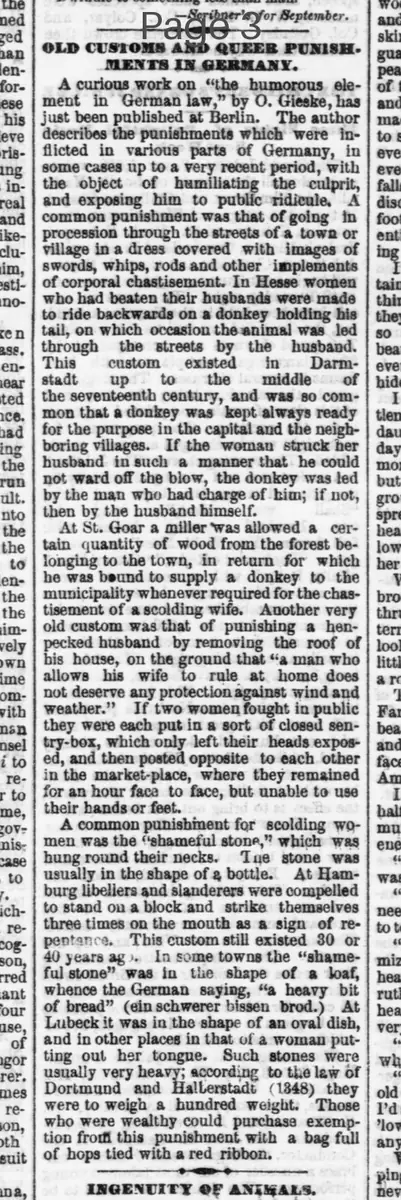
A curious work on "the humorous element in German law," by O. Gieske, has just been published at Berlin. The author describes the punishments which were inflicted in various parts of Germany, in some cases up to a very recent period, with the object of humiliating the culprit, and exposing him to public ridicule. A common punishment was that of going in procession through the streets of a town or village in a dress covered with images of swords, whips, rods and other implements of corporal chastisement. In Hesse women who had beaten their husbands were made to ride backwards on a donkey holding his tail, on which occasion the animal was led through the streets by the husband. This custom existed in Darmstadt up to the middle of the seventeenth century, and was so common that a donkey was kept always ready for the purpose in the capital and the neighboring villages. If the woman struck her husband in such a manner that he could not ward off the blow, the donkey was led by the man who had charge of him; if not, then by the husband himself. At St. Goar a miller was allowed a certain quantity of wood from the forest belonging to the town, in return for which he was bound to supply a donkey to the municipality whenever required for the chastisement of a scolding wife. Another very old custom was that of punishing a henpecked husband by removing the roof of his house, on the ground that "a man who allows his wife to rule at home does not deserve any protection against wind and weather." If two women fought in public they were each put in a sort of closed sentry-box, which only left their heads exposed, and then posted opposite to each other in the market-place, where they remained for an hour face to face, but unable to use their hands or feet. A common punishment for scolding women was the "shameful stone," which was hung round their necks. The stone was usually in the shape of a bottle. At Hamburg libellers and slanderers were compelled to stand on a block and strike themselves three times on the mouth as a sign of repentance. This custom still existed 30 or 40 years ago. In some towns the "shameful stone" was in the shape of a loaf, whence the German saying, "a heavy bit of bread" (ein schwerer bissen brod.) At Lubeck it was in the shape of an oval dish, and in other places in that of a woman putting out her tongue. Such stones were usually very heavy; according to the law of Dortmund and Halberstadt (1348) they were to weigh a hundred weight. Those who were wealthy could purchase exemption from this punishment with a bag full of hops tied with a red ribbon.
What sub-type of article is it?
What keywords are associated?
What entities or persons were involved?
Where did it happen?
Foreign News Details
Primary Location
Germany
Key Persons
Event Details
A curious work on 'the humorous element in German law,' by O. Gieske, has just been published at Berlin. The author describes the punishments which were inflicted in various parts of Germany, in some cases up to a very recent period, with the object of humiliating the culprit, and exposing him to public ridicule. A common punishment was that of going in procession through the streets of a town or village in a dress covered with images of swords, whips, rods and other implements of corporal chastisement. In Hesse women who had beaten their husbands were made to ride backwards on a donkey holding his tail, on which occasion the animal was led through the streets by the husband. This custom existed in Darmstadt up to the middle of the seventeenth century, and was so common that a donkey was kept always ready for the purpose in the capital and the neighboring villages. If the woman struck her husband in such a manner that he could not ward off the blow, the donkey was led by the man who had charge of him; if not, then by the husband himself. At St. Goar a miller was allowed a certain quantity of wood from the forest belonging to the town, in return for which he was bound to supply a donkey to the municipality whenever required for the chastisement of a scolding wife. Another very old custom was that of punishing a henpecked husband by removing the roof of his house, on the ground that 'a man who allows his wife to rule at home does not deserve any protection against wind and weather.' If two women fought in public they were each put in a sort of closed sentry-box, which only left their heads exposed, and then posted opposite to each other in the market-place, where they remained for an hour face to face, but unable to use their hands or feet. A common punishment for scolding women was the 'shameful stone,' which was hung round their necks. The stone was usually in the shape of a bottle. At Hamburg libellers and slanderers were compelled to stand on a block and strike themselves three times on the mouth as a sign of repentance. This custom still existed 30 or 40 years ago. In some towns the 'shameful stone' was in the shape of a loaf, whence the German saying, 'a heavy bit of bread' (ein schwerer bissen brod.) At Lubeck it was in the shape of an oval dish, and in other places in that of a woman putting out her tongue. Such stones were usually very heavy; according to the law of Dortmund and Halberstadt (1348) they were to weigh a hundred weight. Those who were wealthy could purchase exemption from this punishment with a bag full of hops tied with a red ribbon.