Thank you for visiting SNEWPapers!
Sign up free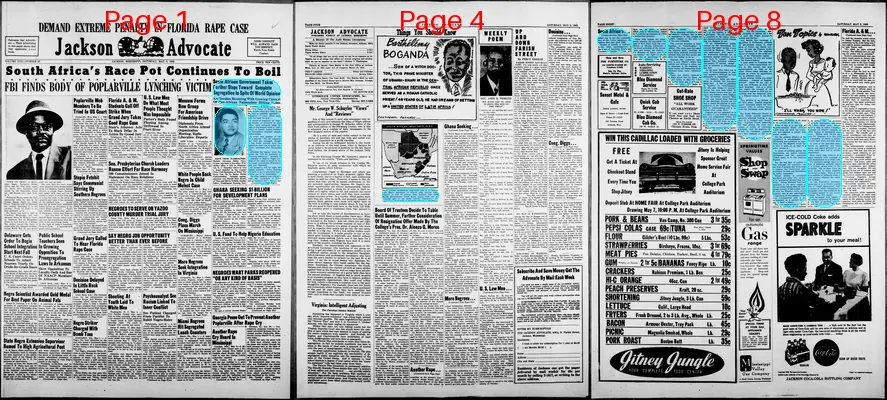
Jackson Advocate
Jackson, Hinds County, Mississippi
What is this article about?
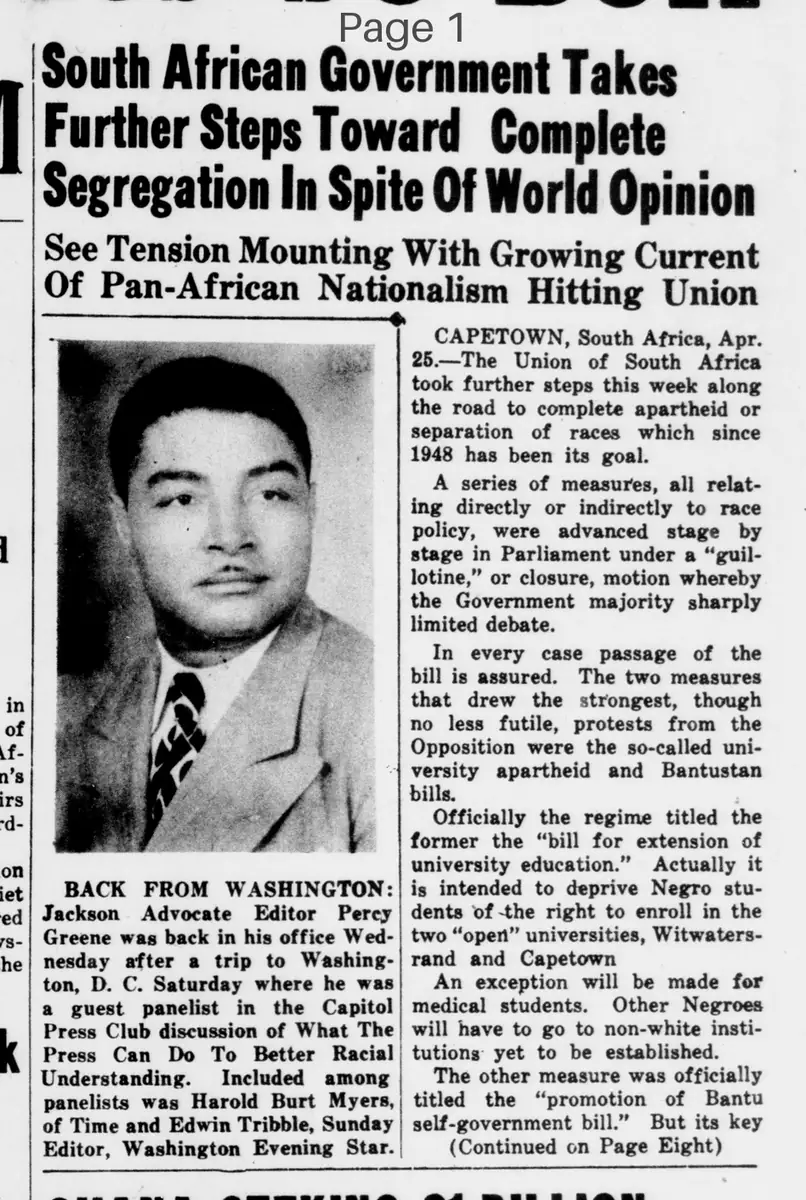
The South African government advanced apartheid measures in Parliament, including university segregation and Bantustan self-government bills, limiting debate and ignoring opposition and international criticism amid rising pan-African nationalism.
Merged-components note: Merged headline, image, body on page 1, sidebar on page 4, and continuation on page 8 for South African apartheid/segregation story
Clippings
1 of 3
OCR Quality
Full Text
See Tension Mounting With Growing Current Of Pan-African Nationalism Hitting Union
CAPETOWN. South Africa, Apr. 25.-The Union of South Africa took further steps this week along the road to complete apartheid or separation of races which since 1948 has been its goal.
A series of measures, all relating directly or indirectly to race policy, were advanced stage by stage in Parliament under a "guillotine," or closure, motion whereby the Government majority sharply limited debate.
In every case passage of the bill is assured. The two measures that drew the strongest, though no less futile, protests from the Opposition were the so-called university apartheid and Bantustan bills.
Officially the regime titled the former the "bill for extension of university education." Actually it is intended to deprive Negro students of the right to enroll in the two "open" universities, Witwatersrand and Capetown.
An exception will be made for medical students. Other Negroes will have to go to non-white institutions yet to be established.
The other measure was officially titled the "promotion of Bantu self-government bill." But its key effect was to end the representation in the Union legislature the natives have had since 1936.
Instead of directly or indirectly chosen white representatives in the House of Assembly, Senate and Provincial Councils, Negroes will have regional autonomy within tribal areas or "Bantustans" linked to the central government by white commissioner generals.
Other bills lumped for closure would transfer the non-white College of Fort Hare from the jurisdiction of Rhodes University to the direct authority of the Government and extend the control of the Minister of Labor over "job reservation," the right to specify what jobs or percentage of jobs in a given industry must be reserved for whites.
These measures collectively and individually evidence the system of segregation in this prosperous modern country at the very end of the vast continent.
The over-all direction is clear: baaskap, or "bossmanship," by whites. The races must live apart, use separate public facilities, develop along separate economic and cultural lines and face severe penalties for failing to do so.
Negroes-the preferred name here is now "Bantu" rather than natives and African is never used as elsewhere in the continent because whites call themselves South Africans-must carry "reference" books.
These are brown, hard-cover booklets about five by three and a half inches in size for which the holder must pay 2 shillings 6 pence (35 cents). The pages include the holder's identification, tax payment record and, for the bulk of the booklet, a record of employment. The job record must be reported to the Labor Bureau and stamped every month whether jobs are changed or not.
Of all discriminatory policies evolved by the Nationalist Government the "pass" system is most resented by Negroes. This is the case particularly with regard to the authorized although not yet generally applied extension of the pass laws to women.
Protests against this, including collective provocation arrests, caused a rash of incidents in Johannesburg last fall.
At the same time there are all sorts of inconsistencies in practical apartheid, although its basic philosophy is changeless.
For instance, buses are segregated in Durban but non-segregated here. A ban on admission of "natives" to "non-European" (in this case Indian or colored) movies has just been lifted for those cinema owners who are willing to sell tickets to dark Negroes.
The all-African musical "King Kong" was barred from Pretoria by the Municipal Council, yet has been a smash hit playing to mixed audiences in the University Great Hall in Johannesburg and a suburban civic center here.
Negroes are not supposed to be out after 11 p.m. without a special pass, but sympathetic whites will go out of their way to give stranded Negroes a lift home so as to keep them out of the hands of the police.
Meanwhile tension builds inevitably as currents of pan-African nationalism waft down on the Union. For the Government simply continues to tighten the reins and push the Negro population further and further.
And despite dire warnings of opposition in Parliament, protests by pan-African bodies in other parts of Africa and liberal criticism all over the Western world, there appears not the slightest chance of change in the racial policies of the Nationalist regime.
The reasons for this are rooted in the Union's history.
It must never be forgotten that there is a white-versus-white rivalry in this country that goes psychologically as deep as the white-versus-black cleavage, although of course its applications are on different levels.
South African whites are either Afrikaans-oriented or English-oriented. About 60 per cent of them use Afrikaans as their primary language. And in a sense they regard the triumph of the Nationalist regime in 1948 and everything that has happened since as a delayed victory in the Boer War.
This division is as obvious as the daily press. English language papers invariably attack the Government, often in extreme terms, while the Afrikaans press defends it.
The Dutch Reformed Church in South Africa upholds apartheid generally although wishing it applied in a humane and "moral" way.
Anglican Church leadership has been among the most outspoken of critics of university apartheid.
And the Anglican Cathedral in Capetown pointedly bears this message on the front steps:
"This cathedral is open to welcome men and women of all races to all services at all times."
None of this is to say that all English-oriented South Africans would drop the color bar tomorrow and approve a wholly integrated society.
But the general division of the population is unmistakable: The Afrikaners are committed to apartheid and the English would like to slow it down or, at least to a point, reverse it.
In terms of political parties the Nationalists are almost entirely Afrikaners and the opposition United party is in the majority English.
But the key fact of politics is that although the opposition can say what it pleases and write what it pleases, the Government pays absolutely no heed and implements its policy inexorably.
Recent debates on university apartheid and other bills subjected to "guillotine" showed that perfectly.
Prime Minister Verwoerd remarked in the early stages of the university debate that the widespread protests it had evoked, from all over the Western world, would probably end in the wastebasket.
Opponents of the measure thereupon demonstrated with a big wastebasket as a symbol but it was in itself a waste.
The long-range outlook for South Africa is dubious.
Johannesburg is an uneasy city.
Its problems of juvenile delinquency and crime often have racial roots. Resentment is deep in native townships.
Incidents of abusive remarks to white women in residential areas recur.
Whites hold 100,000 permits for firearms in a city with a population of about a million, roughly half white and half black.
In view of the one-sided distribution of authority and police power, any native outbreak or uprising could only end in ruthless suppression.
More likely than violence is a major boycott, work stoppage or civil disobedience on a broad scale.
Yet curiously enough there is a kind of fatalistic attitude shared to a certain extent even by Nationalists. All of them know serious trouble is being predicted for sooner or later. None of them in a position of influence seeks to alter policies whereon the prediction is based.
As one Nationalist parliamentarian put it to a visitor, current talk of "black nationalism" tends to ignore a "white nationalism" Afrikaner-that had withstood the "strongest empire in the world," Britain, "for 300 years."
And, he added, with regard to the steady tightening of apartheid in the face of growing criticism in and out of Africa, "We know we're right."
What sub-type of article is it?
What keywords are associated?
What entities or persons were involved?
Where did it happen?
Foreign News Details
Primary Location
South Africa
Event Date
Apr. 25
Key Persons
Outcome
passage of bills assured, including end of negro representation in legislature, university segregation for non-medical students, transfer of fort hare college, extension of job reservation; no immediate casualties but rising tension and potential for future unrest.
Event Details
The South African Parliament advanced multiple race policy bills under limited debate, focusing on university apartheid depriving Negro students access to open universities, Bantustan bill ending legislative representation for natives and granting regional autonomy in tribal areas, transfer of Fort Hare College to government control, and extension of job reservation for whites. These measures reinforce complete racial segregation despite opposition protests and international criticism.