Thank you for visiting SNEWPapers!
Sign up free
White Pine News Weekly Mining Review
East Ely, Ely, White Pine County, Nevada
What is this article about?
New food preservation method by Major William Edward Fitch allows indefinite storage without preservatives, enabling quick boiling with water for fresh-tasting meals; revolutionizes army rations at 3 cents per soldier and simplifies home cooking; includes soups, meats, fish; prevents poisoning.
Clipping
OCR Quality
Full Text
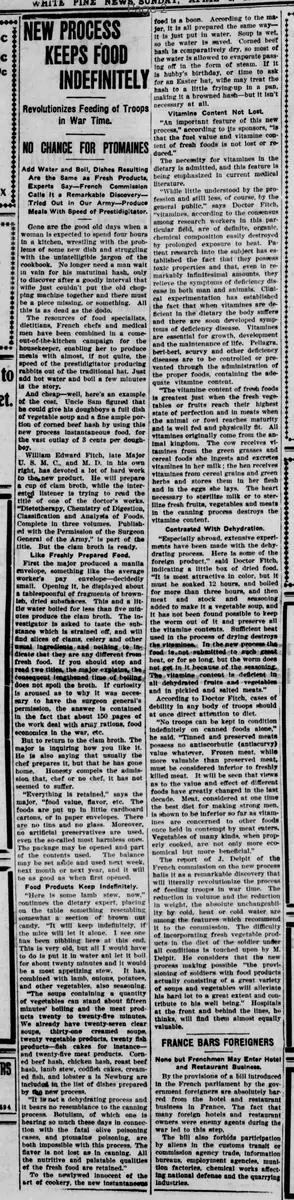
Revolutionizes Feeding of Troops in War Time.
NO CHANCE FOR PTOMAINES
Add Water and Boil, Dishes Resulting Are the Same as Fresh Products, Experts Say-French Commission Calls It a Remarkable Discovery-
Tried Out in Our Army-Produce Meals With Speed of Prestidigitator.
Gone are the good old days when a woman is expected to spend four hours in a kitchen, wrestling with the problems of some new dish and struggling with the unintelligible jargon of the cookbook. No longer need a man wait in vain for his matutinal hash, only to discover after a goodly interval that wifie just couldn't put the old chopping machine together and there must be a piece missing, or something. All this is as dead as the dodo.
The resources of food specialists, dietitians, French chefs and medical men have been combined in a come-out-of-the-kitchen campaign for the housekeeper, enabling her to produce meals with almost, if not quite, the speed of the prestidigitator producing rabbits out of the traditional hat. Just add hot water and boil a few minutes is the story.
And cheap-well, here's an example of the cost, Uncle Sam figured that he could give his doughboys a full dish of vegetable soup and a fine ample portion of corned beef hash by using this new process instantaneous food, for the vast outlay of 3 cents per doughboy.
William Edward Fitch, late Major U. S. M. C., and M. D. in his own right, has devoted a lot of hard work to the new product. He will prepare a cup of clam broth, while the interested listener is trying to read the title of one of the doctor's works.
"Dietotherapy, Chemistry of Digestion, Classification and Analysis of Foods. Complete in three volumes. Published with the Permission of the Surgeon General of the Army." is part of the title. But the clam broth is ready.
Like Freshly Prepared Food.
First the major produced a manila envelope, something like the average worker's pay envelope-decidedly small. Opening it, he displayed about a tablespoonful of fragments of brown-leb, dried substances. This and a little water boiled for less than five minutes produce the clam broth. The investigator is asked to taste the substance which is strained off, and will find slices of clams, celery and other usual ingredients-and nothing to indicate that they are any different from fresh food. If you should stop and read two titles, the major explains, the consequent lengthened time of boiling does not spoil the broth. If curiosity is aroused as to why it was necessary to have the surgeon general's permission, the answer is contained in the fact that about 150 pages of the work deal with army rations, food economics in the war, etc.
But to return to the clam broth. The major is inquiring how you like it. He is also saying that usually the chef prepares it, but that he has gone home. Honesty compels the admission that, chef or no chef, it has not seemed to suffer.
"Everything is retained," says the major, "food value, flavor, etc. The foods are put up in little cardboard cartons, or in paper envelopes. There are no tins and no glass. Moreover, no artificial preservatives are used, even the so-called most harmless ones. The package may be opened and part of the contents used. The balance may be set aside and used next week, next month or next year, and it will be as good as when first opened.
Food Products Keep Indefinitely.
"Here is some lamb stew, now," continues the dietary expert, placing on the table something resembling somewhat a section of brown nut candy. "It will keep indefinitely, if the mice will let it alone. I see one has been nibbling here at this end. This is very old, but all I would have to do is put it in water and let it boil for about twenty minutes and it would be a most appetizing stew. It has, combined with lamb, onions, potatoes, and other vegetables, also seasoning.
"The soups containing a quantity of vegetables can stand about fifteen minutes' boiling and the meat products twenty to twenty-five minutes. We already have twenty-seven clear soups, thirty-one creamed soups, twenty vegetable products, twenty fish products-fish cakes for instance- and twenty-five meat products. Corned beef hash, chicken hash, roast beef hash, lamb stew, codfish cakes, creamed fish, and lobster a la Newburg are included in the list of dishes prepared by the new process.
"It is not a dehydrating process and it bears no resemblance to the canning process. Botulism, of which one is hearing so much these days in connection with the fatal olive poisoning cases, and ptomaine poisoning, are both impossible with this process. The flavor is not lost as in canning. All the nutritive and palatable qualities of the fresh food are retained."
To the newlywed innocent of the art of cookery, the new instantaneous food is a boon.
What sub-type of article is it?
What themes does it cover?
What keywords are associated?
What entities or persons were involved?
Where did it happen?
Story Details
Key Persons
Location
U.S. Army
Story Details
A new food preservation process enables indefinite storage of food without preservatives or cans, allowing quick preparation by adding water and boiling; retains full nutritive value and flavor like fresh food; used for cheap, rapid meals in wartime troops and home cooking; demonstrated by Major William Edward Fitch with examples like clam broth and lamb stew; prevents ptomaine and botulism poisoning.