Thank you for visiting SNEWPapers!
Sign up free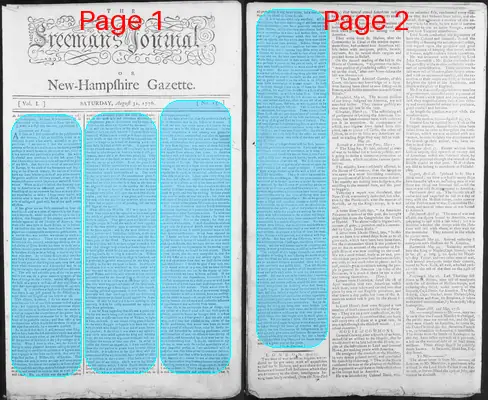
The Freeman's Journal, Or, New Hampshire Gazette
Portsmouth, Rockingham County, New Hampshire
What is this article about?
John Witherspoon, President of the College of New-Jersey, addresses Scottish natives in America, expressing affection and urging support for American independence. He refutes prejudices against Scots, critiques British policies and John Wilkes's influence, and argues that independence is necessary, honorable, profitable, and beneficial to Britain, forming a new era in human history.
Merged-components note: Merging continuation of the address by John Witherspoon across pages 1 and 2, as the text flows directly from one to the other and ends with '[To be Continued.]'. Label adjusted to 'editorial' as it is an opinionated, partisan essay signed by the author.
Clippings
1 of 2
OCR Quality
Full Text
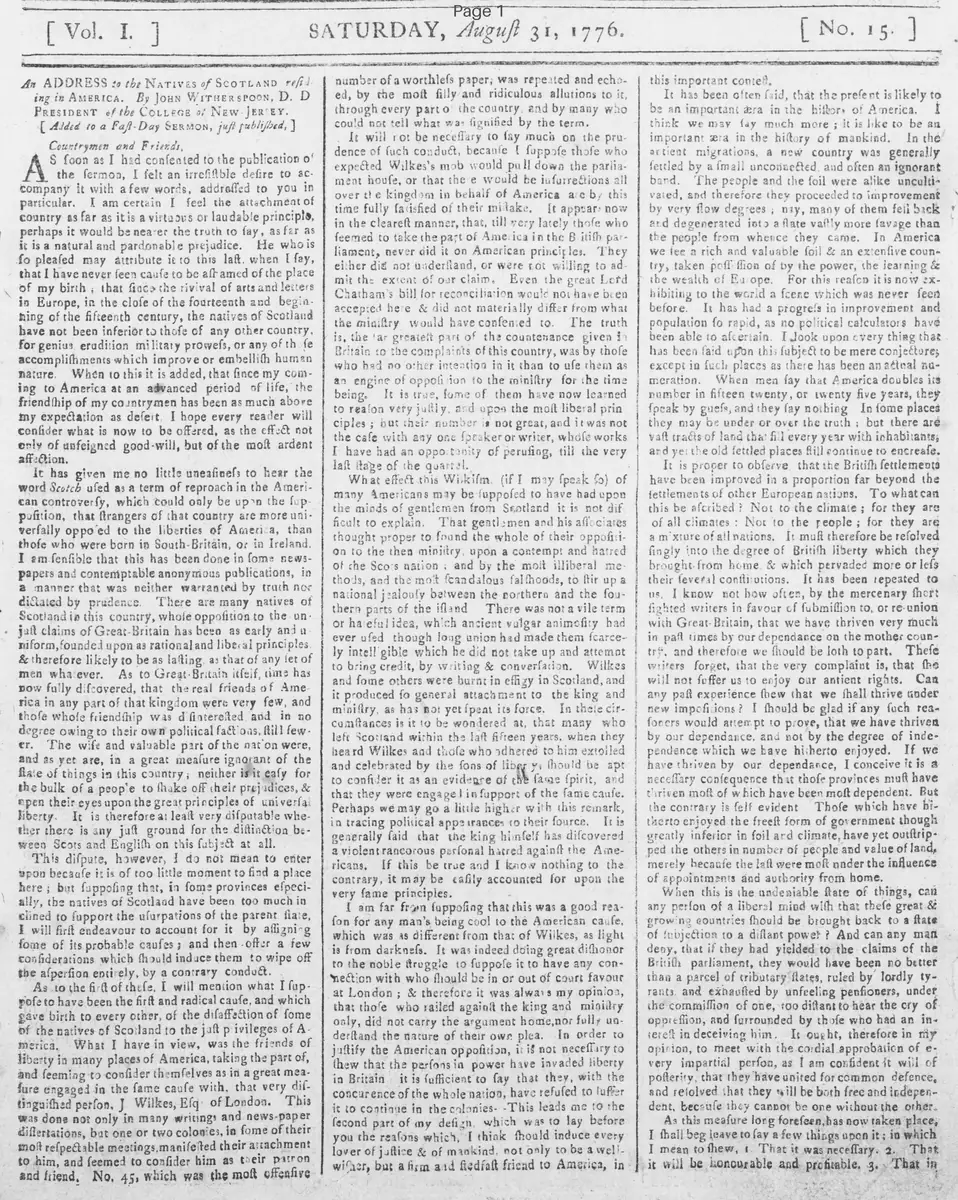
[ Added to a Fast-Day Sermon, just published, ]
Countrymen and Friends.
As soon as I had consented to the publication of the sermon, I felt an irresistible desire to accompany it with a few words, addressed to you in particular. I am certain I feel the attachment of country as far as it is a virtuous or laudable principle, perhaps it would be nearer the truth to say, as far as it is a natural and pardonable prejudice. He who is so pleased may attribute it to this last. When I say, that I have never seen cause to be ashamed of the place of my birth: that since the revival of arts and letters in Europe, in the close of the fourteenth and beginning of the fifteenth century, the natives of Scotland have not been inferior to those of any other country, for genius, erudition, military prowess, or any of those accomplishments which improve or embellish human nature. When to this it is added, that since my coming to America at an advanced period of life, the friendship of my countrymen has been as much above my expectation as desert, I hope every reader will consider what is now to be offered, as the effect not only of unfeigned good-will, but of the most ardent affection.
It has given me no little uneasiness to hear the word Scotch used as a term of reproach in the American controversy, which could only be upon the supposition, that strangers of that country are more universally opposed to the liberties of America, than those who were born in South-Britain, or in Ireland. I am sensible that this has been done in some newspapers and contemptible anonymous publications, in a manner that was neither warranted by truth nor dictated by prudence.
There are many natives of Scotland in this country, whose opposition to the unjust claims of Great-Britain has been as early and uniform, founded upon as rational and liberal principles, & therefore likely to be as lasting, as that of any set of men whatever. As to Great-Britain itself, time has now fully discovered, that the real friends of America in any part of that kingdom were very few, and those whose friendship was disinterested and in no degree owing to their own political factions, still fewer. The wise and valuable part of the nation were, and as yet are, in a great measure ignorant of the state of things in this country; neither is it easy for the bulk of a people to shake off their prejudices, & open their eyes upon the great principles of universal liberty. It is therefore at least very disputable whether there is any just ground for the distinction between Scots and English on this subject at all.
This dispute, however, I do not mean to enter upon because it is of too little moment to find a place here; but supposing that, in some provinces especially, the natives of Scotland have been too much inclined to support the usurpations of the parent state, I will first endeavour to account for it by assigning some of its probable causes; and then offer a few considerations which should induce them to wipe off the aspersion entirely, by a contrary conduct.
As to the first of these, I will mention what I suppose to have been the first and radical cause, and which gave birth to every other, of the disaffection of some of the natives of Scotland to the just privileges of America. What I have in view, was the friends of liberty in many places of America, taking the part of, and seeming to consider themselves as in a great measure engaged in the same cause with, that very distinguished person, J. Wilkes, Esq. of London. This was done not only in many writings and newspaper dissertations, but one or two colonies, in some of their most respectable meetings, manifested their attachment to him, and seemed to consider him as their patron and friend. No. 45, which was the most offensive number of a worthless paper, was repeated and echoed, by the most silly and ridiculous allusions to it through every part of the country, and by many who could not tell what was signified by the term.
It will not be necessary to say much on the prudence of such conduct, because I suppose those who expected Wilkes's mob would pull down the parliament house, or that there would be insurrections all over the kingdom in behalf of America are by this time fully satisfied of their mistake. It appears now in the clearest manner, that, till very lately those who seemed to take the part of America in the British parliament, never did it on American principles. They either did not understand, or were not willing to admit the extent of our claim. Even the great Lord Chatham's bill for reconciliation would not have been accepted here & did not materially differ from what the ministry would have condescended to. The truth is, the far greatest part of the countenance given in Britain to the complaints of this country, was by those who had no other intention in it than to use them as an engine of opposition to the ministry for the time being. It is true, some of them have now learned to reason very justly, and upon the most liberal principles: but their number is not great, and it was not the case with any one speaker or writer, whose works I have had an opportunity of perusing, till the very last stage of the quarrel.
What effect this Wilkesism, (if I may so speak) of many Americans may be supposed to have had upon the minds of gentlemen from Scotland it is not difficult to explain. That gentleman and his associates thought proper to found the whole of their opposition to the then ministry, upon a contempt and hatred of the Scots nation, and by the most illiberal methods, and the most scandalous falsehoods, to stir up a national jealousy between the northern and the southern parts of the island. There was not a vile term or hateful idea, which ancient vulgar animosity had ever used though long union had made them scarcely intelligible which he did not take up and attempt to bring into credit, by writing & conversation. Wilkes and some others were burnt in effigy in Scotland, and it produced so general attachment to the king and ministry, as has not yet spent its force. In these circumstances is it to be wondered at, that many who left Scotland within the last fifteen years, when they heard Wilkes and those who adhered to him extolled and celebrated by the sons of liberty, should be apt to consider it as an evidence of the same spirit, and that they were engaged in support of the same cause.
Perhaps we may go a little higher with this remark, in tracing political appearances to their source. It is generally said that the king himself has discovered a violent rancorous personal hatred against the Americans. If this be true and I know nothing to the contrary, it may be easily accounted for upon the very same principles.
I am far from supposing that this was a good reason for any man's being cool to the American cause, which was as different from that of Wilkes, as light is from darkness. It was indeed doing great dishonor to the noble struggle to suppose it to have any connection with who should be in or out of court favour at London: & therefore it was always my opinion, that those who railed against the king and ministry only, did not carry the argument home, nor fully understand the nature of their own plea. In order to justify the American opposition, it is not necessary to show that the persons in power have invaded liberty in Britain it is sufficient to say that they, with the concurrence of the whole nation, have refused to suffer it to continue in the colonies. This leads me to the second part of my design, which was to lay before you the reasons which, I think should induce every lover of justice & of mankind, not only to be a well-wisher, but a firm aid steadfast friend to America, in this important contest.
It has been often said, that the present is likely to be an important era in the history of America.
I think we may say much more; it is like to be an important era in the history of mankind. In the ancient migrations, a new country was generally settled by a small unconnected, and often an ignorant band. The people and the soil were alike uncultivated, and therefore they proceeded to improvement by very slow degrees; nay, many of them fell back and degenerated into a state vastly more savage than the people from whence they came. In America we see a rich and valuable soil & an extensive country, taken possession of by the power, the learning & the wealth of Europe. For this reason it is now exhibiting to the world a scene which was never seen before. It has had a progress in improvement and population so rapid, as no political calculators have been able to ascertain. I look upon every thing that has been said upon this subject to be mere conjectures except in such places as there has been an actual numberation. When men say that America doubles its number in fifteen twenty, or twenty five years, they speak by guess, and they say nothing. In some places they may be under or over the truth: but there are vast tracts of land that fill every year with inhabitants, and yet the old settled places still continue to increase.
It is proper to observe that the British settlements have been improved in a proportion far beyond the settlements of other European nations. To what can this be ascribed? Not to the climate; for they are of all climates: Not to the people: for they are a mixture of all nations. It must therefore be resolved singly into the degree of British liberty which they brought from home & which pervaded more or less their several constitutions. It has been repeated to us, I know not how often, by the mercenary short-sighted writers in favour of submission to, or re-union with Great-Britain, that we have thriven very much in past times by our dependence on the mother country, and therefore we should be loth to part. These writers forget, that the very complaint is, that she will not suffer us to enjoy our ancient rights. Can any past experience show that we shall thrive under new impositions? I should be glad if any other reasoners would attempt to prove, that we have thriven by our dependence, and not by the degree of independence which we have hitherto enjoyed. If we have thriven by our dependence, I conceive it is a necessary consequence that those provinces must have thriven most of which have been most dependent. But the contrary is self-evident. Those which have hitherto enjoyed the freest form of government though greatly inferior in soil and climate, have yet outstripped the others in number of people and value of land, merely because the last were most under the influence of appointments and authority from home.
When this is the undeniable state of things, can any person of a liberal mind wish that these great & growing countries should be brought back to a state of subjection to a distant power? And can any man deny, that if they had yielded to the claims of the British parliament, they would have been no better than a parcel of tributary states, ruled by lordly tyrants, and exhausted by unfeeling pensioners, under the commission of one, too distant to hear the cry of oppression, and surrounded by those who had an interest in deceiving him. It ought, therefore in my opinion, to meet with the cordial approbation of every impartial person, as I am confident it will of posterity, that they have united for common defence, and resolved that they will be both free and independent, because they cannot be one without the other.
As this measure long foreseen, has now taken place, I shall beg leave to say a few things upon it; in which I mean to show, I. That it was necessary. 2. That it will be honourable and profitable. 3. That in
In all probability, it will be no injury, but a real advantage to the Island of Great-Britain.
I. It had become absolutely necessary. All reconciliation, but upon the footing of absolute unconditional submission, had been positively refused by Great Britain: profess therefore the colonies had resolved to continue in a loose and broken state, with the name of a government which they had taken arms to oppose, the step which they have now taken could not have been avoided. Besides, things had proceeded so far, and such measures had been taken on both sides, that it became impossible to lay down a scheme, by which they should be sure of our dependence, and we the same time secured in our liberties.
While things continued in their ancient state, there was perhaps a power on the part of each, of which they were hardly conscious, or were afraid or unwilling to exert. But after the encroachments had been made and resisted, to expect any thing else than a continual attempt to extend authority on the one hand, and to guard against it on the other, is to discover very little knowledge of human nature. In such a situation, though every claim of America should be yielded, she would soon be either in a state of continual confusion or absolute submission. The king of England, living in his English dominions, would not, and indeed durst not, assent to any act of an American legislature, that was, or was supposed to be hurtful to his English subjects. This is not founded on conjecture, but experience. There is not (at least Dean Swift affirms) any dependence of Ireland upon England, except an act of the Irish parliament, that the king of England shall be king of Ireland. This last has a separate independent legislature, and in every thing else but the above circumstance, seems to be perfectly free; yet if any man should assert, that the one kingdom is not truly subject to the other he would in my opinion know very little of the state and history of either.
2. A state of independency will be both honourable and profitable to this country. I pass over many advantages in the way of commerce, as in other respects, that must necessarily accrue from it, that I may dwell a little upon the great & leading benefit, which is the foundation of all the rest. We shall have the opportunity of forming plans of government upon the most rational, just and equal principles. I confess I have always looked upon this with a kind of enthusiastic satisfaction. The case never happened before since the world began. All the governments we have read of in former ages were settled by caprice or accident, by the influence of prevailing parties or particular persons, or prescribed by a conqueror. Important improvements indeed have been forced upon some constitutions by the spirit of daring men supported by successful insurrections. - But to see government in large and populous countries settled from its foundation, by deliberate council, and directed immediately to the public good of the present & future generations, while the people are waiting for the decision with full confidence in the wisdom and impartiality of those to whom they have committed the important trust, is certainly altogether new. We learn indeed, from history, that small tribes and feeble new settlements, did some times employ one man of eminent wisdom, to prepare a system of laws for them. Even this was a wise measure, and attended with happy effects. But how vast the difference, when we have the experience of past ages, the history of human society, and the well known causes of prosperity and misery in other governments, to assist us in the choice. The prospect of this happy circumstance, and the possibility of losing it, and suffering the season to pass over, has filled me with anxiety for some time. So far as we have hitherto proceeded, there has been great unanimity and public spirit. The inhabitants of every province, and persons of all denominations, have vied with each other in zeal for the common interest. But was it not to be feared that some men would acquire overbearing influence? that human weakness and human passions would discover themselves, and prevent the finishing what had been so happily begun. In the time of the civil wars in England, had they settled a regular form of government as the parliament had obtained an evident superiority, their liberties would never have been shaken and the revolution would have been unnecessary. - But by delaying the thing too long, they were broken into parties & bewildered in their views, and at last tamely submitted without resistance to that very tyrant against whom they had fought with so much glory & success. For this reason I think that every candid and liberal mind ought to rejoice in the measures lately taken through the States of America, and particularly the late Declaration of Independence, as it will not only give union and force to the measures of defence while they are necessary, but lay a foundation for the birth of millions, and the future improvement of a great part of the globe.
[To be Continued.]
What sub-type of article is it?
What keywords are associated?
What entities or persons were involved?
Editorial Details
Primary Topic
Appeal To Scottish Americans To Support Independence From Britain
Stance / Tone
Strongly Supportive Of American Independence And Liberties
Key Figures
Key Arguments