Thank you for visiting SNEWPapers!
Sign up free
The Enquirer
Richmond, Henrico County, Virginia
What is this article about?
A letter from Chancellor Livingston to Mr. Curtis details agricultural and manufacturing prosperity in Northern states, highlighting reduced prejudices against domestic goods, increased sheep farming with Merino wool, local production of various items, and contrasts with Southern education needs. Dated January 5, 1810.
Clipping
OCR Quality
Full Text
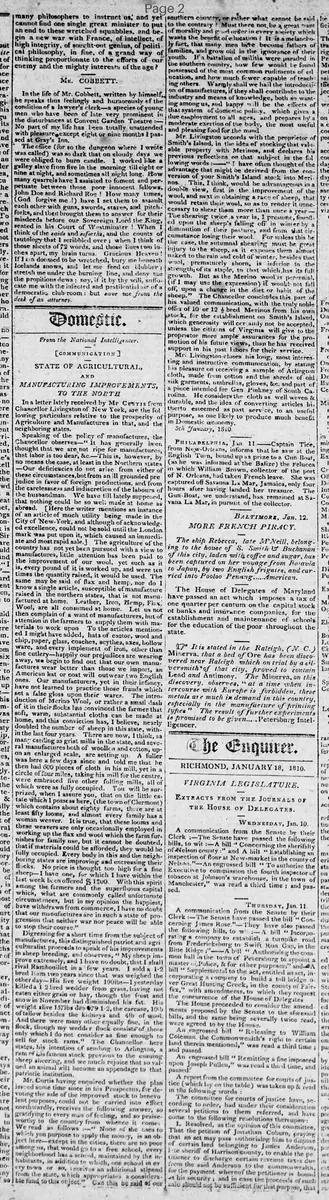
From the National Intelligencer.
[COMMUNICATION]
STATE OF AGRICULTURAL,
AND
MANUFACTURING IMPROVEMENTS,
TO THE NORTH
In a letter lately received by Mr. Curtis from Chancellor Livingston of New York, are the following particulars relative to the prosperity of Agriculture and Manufactures in that, and the neighboring states.
Speaking of the policy of manufactures, the Chancellor observes—"It has generally been thought that we are not ripe for manufactures, that labor is too dear, &c.—This is, however, by no means the case, at least in the Northern states—Our deficiencies do not arise from either of these circumstances, but from an ill grounded prejudice in favor of foreign productions, and from the carelessness and indiscretion of the labours of the husbandman. We have till lately supposed, that nothing could be so well made at home as abroad. [Here the writer mentions an instance of an article of much utility being made in the City of New-York, and although of acknowledged excellence, could not be sold until the London mark was put upon it, which caused an immediate and most rapid sale.] The agriculture of the country has not yet been pursued with a view to manufactures, little attention has been paid to the improvement of our wool, yet such as it is, every pound of it is worked up, and were ten times the quantity raised, it would be used. The same may be said of flax and hemp, nor do I know a single article, susceptible of manufacture raised in the northern states, that is not manufactured at home. Leather, Iron, Hemp, Flax, Wool, are all consumed at home. Let us not then complain of a want of manufacturers, but of attention in the farmers to supply them with materials to work upon. To the articles mentioned I might have added, hats of castor, wool and chip, paper, glass, coaches, scythes, axes, hollow ware, and every implement of iron, other than fine cutlery—happily our prejudices are wearing away, we begin to find out that our own manufactures wear better than those we import, an American hat or coat will outwear two English ones. Our manufacturers, yet in their infancy, have not learned to practice those frauds which set a false gloss upon their wares. The introduction of Merino Wool, or rather a small dash of it in their flocks has convinced the farmer that soft, warm, substantial cloths can be made at home, and this conviction has, I believe, nearly doubled the number of sheep in this state, within the last four years. There are now, I think, as many carding as grist mills in the state, and several manufactures both of woollen and cotton, upon an enlarged scale, are setting up. A fuller was here a few days since and told me that he then had 600 pieces of cloth in his mill, yet in a circle of four miles, taking his mill for the centre, were embraced five other fulling mills, all of which were as fully occupied. You will be surprised, when I assure you, that on the little estate which I possess here, (the town of Clermont) which contains about eighty farms, there are at least fifty looms, and almost every family has a woman weaver. It is true, that these looms and these weavers are only occasionally employed in working up the flax and wool which the farm furnishes for family use, but it cannot be doubted, that if materials could be afforded, they would be fully occupied. Every body in this and the neighboring states are improving and increasing their flocks. No price is thought too high for a fine sheep—I have one, for which I have within the last week been offered $1200. With this spirit among the farmers and the superfluous capital which, what are commonly called unfortunate circumstances, but in my opinion the happiest, have withdrawn from commerce, I have no doubt that our manufactures are in such a state of progression that neither war nor peace will be able to stop their course."
Digressing for a short time from the subject of manufactures, this distinguished patriot and agriculturalist proceeds to speak of his improvements in sheep breeding, and observes, "My sheep improve extremely, and I have no doubt, that I shall rival Rambouillet in a few years. I sold a 1-2 bred Ram two years since that was weighed the other day—His live weight 190 lbs—Yesterday I killed a 1-2 bred wedder from grass, having not eaten either grain or hay, though the frost and snow in November had diminished his fat. His weight alive 157 lbs dead 79 1-2, the carcase, 10 lb of tallow besides the kidneys and 4 lb of wool. And there were many other equally fine, in the flock, though my wedder flock consists of those only which I do not consider as fine enough to sell for stock rams." The Chancellor here states, his intention of sending to Arlington, a ram of his famous stock previous to the ensuing sheep shearing, and we much rejoice that so valued an animal will become an appendage to that patriotic institution.
Mr. Curtis having enquired whether the plan issued same time since in his Prospectus, for devoting the sale of the improved stock to benevolent purposes, could not be carried into effect northwardly, receives the following answer, so gratifying to every man of feeling, and so praiseworthy to the country from whence it comes. We read as follows:—"None of the uses to which you purpose to apply the money, is an object here—except in the cities, there are no poor among us, that would go to a free school, every neighborhood has a school, maintained by the inhabitants, in addition to which, one school in every town or so, receives an additional stipend from the state, which appropriates a considerable fund to this object." Can this be said of our southern country, or rather what cannot be said to the contrary? Must there not be a great want of morality and good order in every society which wants the benefit of education? It is a melancholy fact, that many men here become fathers of families, and grow old in the ignorance of their youth. If a battalion of militia were paraded in the southern country, how few would be found possessed of the most common rudiments of education, and how much fewer capable of teaching others. Warmly shall we hail the introduction of manufactures, if they shall contribute to the industry and means of knowledge, both so wanting among us, and happy will be the effects of that system of domestic policy, which gives a due employment to all ages, and prepares by a moderate exertion of the body, the most useful and pleasing food for the mind.
Mr. Livingston accords with the proprietor of Smith's Island, in the idea of stocking that valuable property with Merinos, and declares his previous reflections on that subject in the following words:—"I have often thought of the advantage that might be derived from the conversion of your Smith's Island stock into Merinos. This, I think, would be advantageous in a double view, first in the improvement of the wool, and next in obtaining a race of sheep, that would retain their wool, so as to render it unnecessary to shear them more than once a year—The shearing twice a year is, I presume, founded upon the sheep's falling off in winter by a diminution of their pasture, and from what circumstance losing their wool. For unless this be the case, the autumnal shearing must be great injury to the sheep, as it exposes them almost naked to the rain and cold of winter, besides that wool, prematurely shorn, is inferior in the strength, of its staple, to that which has its full growth. But as the Merino wool is perennial. (if I may use the expression) it would not fall off, upon a change in the diet or habit of the sheep." The Chancellor concludes this part of his valued communication, with the truly noble offer of 10 or 12 1-2 bred Merinos from his own stock, for the establishment on Smith's Island, which generosity will certainly not be accepted, unless the citizens of Virginia will give to the proprietor more ample assurances for the promotion of his future views, than he has received support in his past labors for their service.
Mr. Livingston closes his long, most interesting and instructive communication, by stating his pleasure on receiving a sample of Arlington cloth, made from cotton and the shreds of old silk garments, umbrellas, gloves, &c. and part of a piece intended for Gen Pinkney of South Carolina. He considers the cloth as well woven & durable, and the idea of converting articles hitherto esteemed as past service, to a useful purpose, as one likely to produce much benefit in Domestic economy.
5th January, 1810.
What sub-type of article is it?
What keywords are associated?
What entities or persons were involved?
Where did it happen?
Domestic News Details
Primary Location
Northern States
Event Date
5th January, 1810
Key Persons
Outcome
progress in agriculture and manufactures, increased sheep numbers, local production of goods, offer of merino sheep for smith's island, positive reception of arlington cloth.
Event Details
Letter from Chancellor Livingston to Mr. Curtis describes prosperity in Northern agriculture and manufactures, overcoming prejudices against domestic products, improvements in wool and sheep breeding with Merino sheep, local manufacturing of various items, contrasts with Southern education deficiencies, proposal to stock Smith's Island with Merinos, and praise for Arlington cloth made from recycled materials.