Thank you for visiting SNEWPapers!
Sign up free
Editorial
December 30, 1807
Norfolk Gazette And Publick Ledger
Norfolk, Virginia
What is this article about?
Editorial in the Publick Ledger criticizes the 1807 Embargo Act as a response to French dispatches, accusing the U.S. government of French influence and treaty violations, arguing it ruins American commerce while defending neutral rights and British conduct. Includes quotes from Washington Federalist on the bill's rushed passage.
Clipping
OCR Quality
95%
Excellent
Full Text
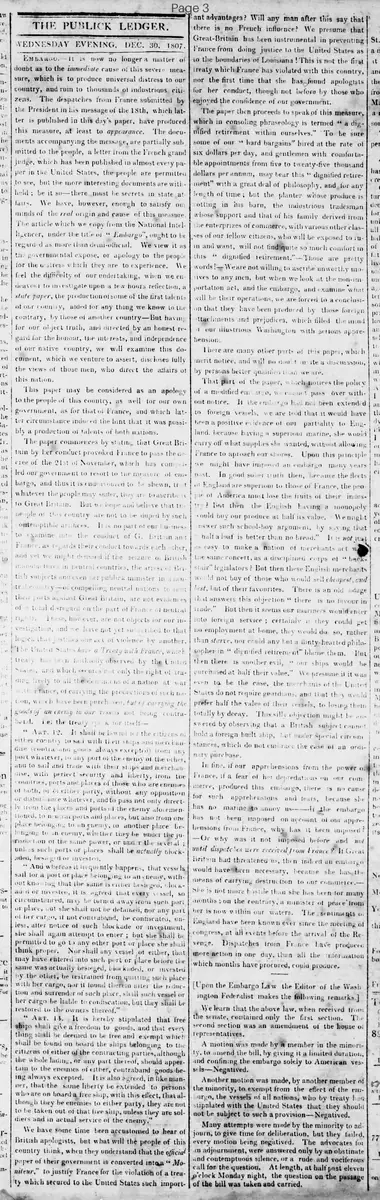
THE PUBLICK LEDGER.
WEDNESDAY EVENING. DEC. 30, 1807.
Embargo.—It is now no longer a matter of doubt as to the immediate cause of this severe measure, which is to produce universal distress to our country, and ruin to thousands of industrious citizens. The despatches from France submitted by the President in his message of the 18th, which latter is published in this day's paper, have produced this measure, at least to appearance. The documents accompanying the message, are partially submitted to the people, a letter from the French grand judge, which has been published in almost every paper in the United States, the people are permitted to see, but the more interesting documents are withheld: be it so—there must be secrets in state affairs. We have, however, enough to satisfy our minds of the real origin and cause of this measure. The article which we copy from the National Intelligencer, under the title of "Embargo", ought to be regarded as more than semi-official. We view it as the governmental expose, or apology to the people for the distress which they are to experience. We feel the difficulty of our undertaking, when we endeavour to investigate upon a few hours reflection, a state paper, the production of some of the first talents of our country, aided for any thing we know to the contrary, by those of another country—But having for our object truth, and directed by an honest regard for the honour, the interests, and independence of our native country, we will examine this document, which we venture to assert, discloses fully the views of those men, who direct the affairs of this nation.
This paper may be considered as an apology to the people of this country, as well for our own government, as for that of France, and which latter circumstance induced the hint that it was possibly a production of talents of both nations.
The paper commences by stating that Great Britain by her conduct provoked France to pass the decree of the 21st of November, which has compelled our government to resort to the measure of embargo, and thus it is endeavoured to be shewn, that whatever the people may suffer, they are to ascribe it to Great Britain. But we hope and believe that the people of this country are not to be duped by such contemptible devices. It is no part of our business to examine into the conduct of G. Britain and France, as regards their conduct towards each other, and yet we might demand if the seizure of British manufactures in neutral countries, the arrest of British subjects and even her publick minister in a neutral country—of compelling neutral nations to shut their ports against Great Britain, are not evidences of a total disregard on the part of France of neutral rights. These, however, are not objects for our investigation, and we have not yet subscribed to that logic which justifies one act of violence by another.
The United States have a Treaty with France, which treaty has been faithfully observed by the United States, and which secures not only the right of trade freely to all the denizens of a nation at war with France, of carrying the productions of such a nation, which have been purchased, but of carrying the goods of an enemy in our vessels (not being contraband). Let the treaty speak for itself—
"Art. 12. It shall be lawful to the citizens of either country to sail with their ships and merchandise (contraband goods always excepted) from any port whatever, to any port of the enemy of the other, and to sail and trade with their ships and merchandise, with perfect security and liberty, from the countries, ports and places of those who are enemies of both, or of either party, without any opposition or disturbance whatever, and to pass not only directly from the places and ports of the enemy aforementioned, to neutral ports and places, but also from one place belonging to an enemy, to another place belonging to an enemy, whether they be under the jurisdiction of the same power, or under the several; unless such ports or places shall be actually blockaded, besieged or invested.
"And whereas it frequently happens, that vessels sail for a port or place belonging to an enemy, without knowing that the same is either besieged, blockaded or invested, it is agreed that every vessel, so circumstanced, may be turned away from such port or place, but she shall not be detained, nor any part of her cargo, if not contraband, be confiscated, unless, after notice of such blockade or investment, she shall again attempt to enter; but she shall be permitted to go to any other port or place she shall think proper. Nor shall any vessel of either, that may have entered into such port or place before the same was actually besieged, blockaded, or invested by the other, be restrained from quitting such place with her cargo, nor if found therein after the reduction and surrender of such place, shall such vessel or her cargo be liable to confiscation, but they shall be restored to the owners thereof."
"Art. 14. It is hereby stipulated that free ships shall give a freedom to goods, and that every thing shall be deemed to be free and exempt which shall be found on board the ships belonging to the citizens of either of the contracting parties, although the whole lading, or any part thereof, should appertain to the enemies of either, contraband goods being always excepted. It is also agreed, in like manner, that the same liberty be extended to persons who are on board a free ship, with this effect, that although they be enemies to either party, they are not to be taken out of that free ship, unless they are soldiers and in actual service of the enemy.
We have some time been accustomed to hear of British apologists, but what will the people of this country think, when they understand that the official paper of their government is converted into a "Monitor," to justify France for the violation of a treaty which secured to the United States such important advantages? Will any man after this say that there is no French influence? We presume that Great-Britain has been instrumental in preventing France from doing justice to the United States as to the boundaries of Louisiana! This is not the first treaty which France has violated with this country, nor the first time that she has found apologists for her conduct, though not before by those who enjoyed the confidence of our government.
The paper then proceeds to speak of this measure, which in consoling phraseology is termed "a dignified retirement within ourselves." To be sure some of our "hard bargains" hired at the rate of six dollars per day, and gentlemen with comfortable appointments from five to twenty-five thousand dollars per annum, may bear this "dignified retirement" with a great deal of philosophy, and for any length of time; but the planter whose produce is rotting in his barn, the industrious tradesman whose support and that of his family derived from the enterprizes of commerce, with various other classes of our fellow citizens, who will be exposed to ruin and want, will not find quite so much comfort in this "dignified retirement."—Those are pretty words!—We are not willing to ascribe unworthy motives to any men, but when we look at the non-importation act, and the embargo, and examine what will be their operations, we are forced to a conclusion that they have been produced by those foreign attachments and prejudices, which filled the mind of our illustrious Washington with serious apprehension.
There are many other parts of this paper, which merit notice, and will no doubt invite a discussion, by persons better qualified than we are. That part of the paper, which notices the policy of a modified embargo, we cannot pass over without notice. If the embargo had not been extended to foreign vessels, we are told that it would have been a positive evidence of our partiality to England, because having a superior marine, she would carry off what supplies she wanted, without allowing France to approach our shores. Upon this principle we might have imposed an embargo many years past. In good sober truth then, because the fleets of England are superior to those of France, the people of America must lose the fruits of their industry? But then the English having a monopoly should buy our produce at half its value. We might answer such school-boy argument, by saying that half a loaf is better than no bread. It is not as easy to make a nation of merchants act with the same concert, as a disciplined corps of "back-stair" legislators? But then these English merchants would not buy of those who would sell cheapest, and best, but of their favourites. There is an old adage that answers this objection "there is no favour in trade." But then it seems our mariners would enter into foreign service; certainly if they could get no employment at home, they would do so, rather than starve, nor could any but a flinty-hearted philosopher in "dignified retirement" blame them. But then there is another evil, "our ships would be purchased at half their value." We presume it if was even to be the case, the merchants of the United States do not require guardians, and that they would prefer half the value of their vessels, to losing them totally by decay. This silly objection might be answered by observing that a British subject cannot hold a foreign built ship, but under special circumstances, which do not embrace the case of an ordinary purchase.
In fine, if our apprehensions from the power of France, if a fear of her depredations on our commerce, produced this embargo, there is no cause for such apprehensions and fears, because she has no marine to annoy us—if the embargo has not been imposed on account of our apprehensions from France, why has it been imposed? -Or why was it not imposed before and not until dispatches were received from France? Great Britain had threatened us, then indeed an embargo would have been necessary, because she has the means of carrying destruction to our commerce.- She is not more hostile than she has been for many months; on the contrary, a minister of peace from her is now within our waters. The Sentiments of England have been known ever since the meeting of congress, at all events before the arrival of the Revenge. Dispatches from France have produced more action in one day, than all the information which months have procured, could produce.
[Upon the Embargo Law the Editor of the Washington Federalist makes the following remarks.]
We learn that the above law, when received from the senate, contained only the first section. The second section was an amendment of the house of representatives.
A motion was made by a member in the minority, to amend the bill, by giving it a limited duration, and confining the embargo solely to American vessels—Negatived.
Another motion was made, by another member of the minority, to exempt from the effect of the embargo, the vessels of all nations, who by treaty had stipulated with the United States that they should not be subject to such a provision—Negatived.
Many attempts were made by the minority to adjourn, to give time for deliberation, but they failed, every motion being negatived. The advocates for an adjournment, were answered only by an obstinate and contemptuous silence, or a rude and vociferous call for the question. At length, at half past eleven o'clock Monday night, the question on the passage of the bill was taken and carried.
WEDNESDAY EVENING. DEC. 30, 1807.
Embargo.—It is now no longer a matter of doubt as to the immediate cause of this severe measure, which is to produce universal distress to our country, and ruin to thousands of industrious citizens. The despatches from France submitted by the President in his message of the 18th, which latter is published in this day's paper, have produced this measure, at least to appearance. The documents accompanying the message, are partially submitted to the people, a letter from the French grand judge, which has been published in almost every paper in the United States, the people are permitted to see, but the more interesting documents are withheld: be it so—there must be secrets in state affairs. We have, however, enough to satisfy our minds of the real origin and cause of this measure. The article which we copy from the National Intelligencer, under the title of "Embargo", ought to be regarded as more than semi-official. We view it as the governmental expose, or apology to the people for the distress which they are to experience. We feel the difficulty of our undertaking, when we endeavour to investigate upon a few hours reflection, a state paper, the production of some of the first talents of our country, aided for any thing we know to the contrary, by those of another country—But having for our object truth, and directed by an honest regard for the honour, the interests, and independence of our native country, we will examine this document, which we venture to assert, discloses fully the views of those men, who direct the affairs of this nation.
This paper may be considered as an apology to the people of this country, as well for our own government, as for that of France, and which latter circumstance induced the hint that it was possibly a production of talents of both nations.
The paper commences by stating that Great Britain by her conduct provoked France to pass the decree of the 21st of November, which has compelled our government to resort to the measure of embargo, and thus it is endeavoured to be shewn, that whatever the people may suffer, they are to ascribe it to Great Britain. But we hope and believe that the people of this country are not to be duped by such contemptible devices. It is no part of our business to examine into the conduct of G. Britain and France, as regards their conduct towards each other, and yet we might demand if the seizure of British manufactures in neutral countries, the arrest of British subjects and even her publick minister in a neutral country—of compelling neutral nations to shut their ports against Great Britain, are not evidences of a total disregard on the part of France of neutral rights. These, however, are not objects for our investigation, and we have not yet subscribed to that logic which justifies one act of violence by another.
The United States have a Treaty with France, which treaty has been faithfully observed by the United States, and which secures not only the right of trade freely to all the denizens of a nation at war with France, of carrying the productions of such a nation, which have been purchased, but of carrying the goods of an enemy in our vessels (not being contraband). Let the treaty speak for itself—
"Art. 12. It shall be lawful to the citizens of either country to sail with their ships and merchandise (contraband goods always excepted) from any port whatever, to any port of the enemy of the other, and to sail and trade with their ships and merchandise, with perfect security and liberty, from the countries, ports and places of those who are enemies of both, or of either party, without any opposition or disturbance whatever, and to pass not only directly from the places and ports of the enemy aforementioned, to neutral ports and places, but also from one place belonging to an enemy, to another place belonging to an enemy, whether they be under the jurisdiction of the same power, or under the several; unless such ports or places shall be actually blockaded, besieged or invested.
"And whereas it frequently happens, that vessels sail for a port or place belonging to an enemy, without knowing that the same is either besieged, blockaded or invested, it is agreed that every vessel, so circumstanced, may be turned away from such port or place, but she shall not be detained, nor any part of her cargo, if not contraband, be confiscated, unless, after notice of such blockade or investment, she shall again attempt to enter; but she shall be permitted to go to any other port or place she shall think proper. Nor shall any vessel of either, that may have entered into such port or place before the same was actually besieged, blockaded, or invested by the other, be restrained from quitting such place with her cargo, nor if found therein after the reduction and surrender of such place, shall such vessel or her cargo be liable to confiscation, but they shall be restored to the owners thereof."
"Art. 14. It is hereby stipulated that free ships shall give a freedom to goods, and that every thing shall be deemed to be free and exempt which shall be found on board the ships belonging to the citizens of either of the contracting parties, although the whole lading, or any part thereof, should appertain to the enemies of either, contraband goods being always excepted. It is also agreed, in like manner, that the same liberty be extended to persons who are on board a free ship, with this effect, that although they be enemies to either party, they are not to be taken out of that free ship, unless they are soldiers and in actual service of the enemy.
We have some time been accustomed to hear of British apologists, but what will the people of this country think, when they understand that the official paper of their government is converted into a "Monitor," to justify France for the violation of a treaty which secured to the United States such important advantages? Will any man after this say that there is no French influence? We presume that Great-Britain has been instrumental in preventing France from doing justice to the United States as to the boundaries of Louisiana! This is not the first treaty which France has violated with this country, nor the first time that she has found apologists for her conduct, though not before by those who enjoyed the confidence of our government.
The paper then proceeds to speak of this measure, which in consoling phraseology is termed "a dignified retirement within ourselves." To be sure some of our "hard bargains" hired at the rate of six dollars per day, and gentlemen with comfortable appointments from five to twenty-five thousand dollars per annum, may bear this "dignified retirement" with a great deal of philosophy, and for any length of time; but the planter whose produce is rotting in his barn, the industrious tradesman whose support and that of his family derived from the enterprizes of commerce, with various other classes of our fellow citizens, who will be exposed to ruin and want, will not find quite so much comfort in this "dignified retirement."—Those are pretty words!—We are not willing to ascribe unworthy motives to any men, but when we look at the non-importation act, and the embargo, and examine what will be their operations, we are forced to a conclusion that they have been produced by those foreign attachments and prejudices, which filled the mind of our illustrious Washington with serious apprehension.
There are many other parts of this paper, which merit notice, and will no doubt invite a discussion, by persons better qualified than we are. That part of the paper, which notices the policy of a modified embargo, we cannot pass over without notice. If the embargo had not been extended to foreign vessels, we are told that it would have been a positive evidence of our partiality to England, because having a superior marine, she would carry off what supplies she wanted, without allowing France to approach our shores. Upon this principle we might have imposed an embargo many years past. In good sober truth then, because the fleets of England are superior to those of France, the people of America must lose the fruits of their industry? But then the English having a monopoly should buy our produce at half its value. We might answer such school-boy argument, by saying that half a loaf is better than no bread. It is not as easy to make a nation of merchants act with the same concert, as a disciplined corps of "back-stair" legislators? But then these English merchants would not buy of those who would sell cheapest, and best, but of their favourites. There is an old adage that answers this objection "there is no favour in trade." But then it seems our mariners would enter into foreign service; certainly if they could get no employment at home, they would do so, rather than starve, nor could any but a flinty-hearted philosopher in "dignified retirement" blame them. But then there is another evil, "our ships would be purchased at half their value." We presume it if was even to be the case, the merchants of the United States do not require guardians, and that they would prefer half the value of their vessels, to losing them totally by decay. This silly objection might be answered by observing that a British subject cannot hold a foreign built ship, but under special circumstances, which do not embrace the case of an ordinary purchase.
In fine, if our apprehensions from the power of France, if a fear of her depredations on our commerce, produced this embargo, there is no cause for such apprehensions and fears, because she has no marine to annoy us—if the embargo has not been imposed on account of our apprehensions from France, why has it been imposed? -Or why was it not imposed before and not until dispatches were received from France? Great Britain had threatened us, then indeed an embargo would have been necessary, because she has the means of carrying destruction to our commerce.- She is not more hostile than she has been for many months; on the contrary, a minister of peace from her is now within our waters. The Sentiments of England have been known ever since the meeting of congress, at all events before the arrival of the Revenge. Dispatches from France have produced more action in one day, than all the information which months have procured, could produce.
[Upon the Embargo Law the Editor of the Washington Federalist makes the following remarks.]
We learn that the above law, when received from the senate, contained only the first section. The second section was an amendment of the house of representatives.
A motion was made by a member in the minority, to amend the bill, by giving it a limited duration, and confining the embargo solely to American vessels—Negatived.
Another motion was made, by another member of the minority, to exempt from the effect of the embargo, the vessels of all nations, who by treaty had stipulated with the United States that they should not be subject to such a provision—Negatived.
Many attempts were made by the minority to adjourn, to give time for deliberation, but they failed, every motion being negatived. The advocates for an adjournment, were answered only by an obstinate and contemptuous silence, or a rude and vociferous call for the question. At length, at half past eleven o'clock Monday night, the question on the passage of the bill was taken and carried.
What sub-type of article is it?
Economic Policy
Foreign Affairs
Partisan Politics
What keywords are associated?
Embargo Act
French Influence
Neutral Rights
Treaty Violation
American Commerce
Partisan Passage
What entities or persons were involved?
France
Great Britain
U.S. Government
President
Washington Federalist
Editorial Details
Primary Topic
Criticism Of The Embargo Act Of 1807 And French Influence
Stance / Tone
Strongly Opposed To The Embargo, Accusing Government Of French Bias And Treaty Violations
Key Figures
France
Great Britain
U.S. Government
President
Washington Federalist
Key Arguments
Embargo Caused By French Dispatches, Not British Threats
Government Paper Apologizes For France's Violation Of U.S. France Treaty
Embargo Ruins American Commerce And Industry
No Justification For Embargo Given France's Weak Navy
Bill Passed Hastily Without Minority Amendments Or Deliberation