Thank you for visiting SNEWPapers!
Sign up free
The New Hampshire Gazette And General Advertiser
Portsmouth, Rockingham County, New Hampshire
What is this article about?
A first-person account of two prisoners' daring escape from the Bastille prison in France on February 15, 1756. Using improvised tools, ladders, and ropes made from clothing, they climb the chimney, descend the tower, breach a wall, and navigate trenches to reach liberty, aided by usquebaugh against the cold.
Merged-components note: This is a continuation of the serialized escape narrative from page 1 to page 2, as indicated by the concluding text flowing directly. Merged into literary as it fits serialized narrative.
Clippings
1 of 2
OCR Quality
Full Text
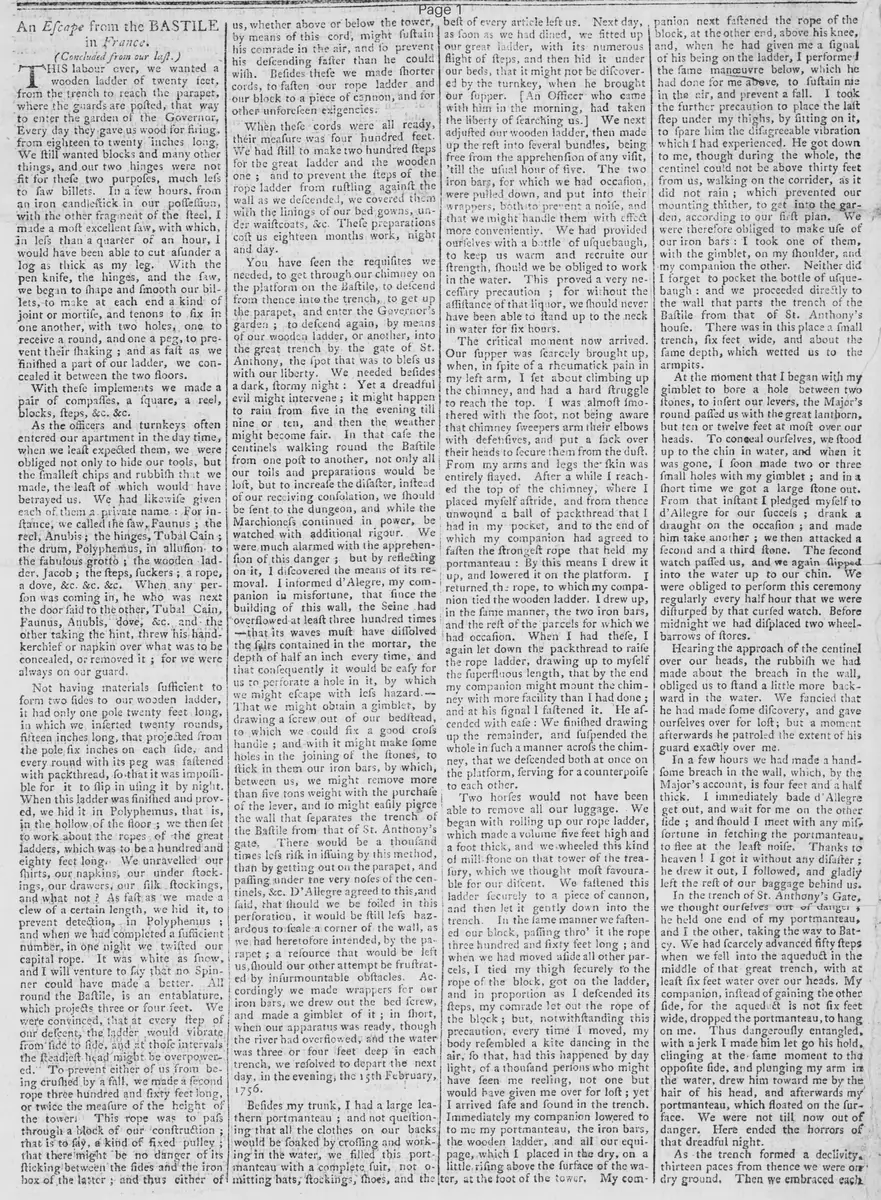
(Concluded from our last.)
His labour over, we wanted a wooden ladder of twenty feet, from the trench to reach the parapet, where the guards are posted, that way to enter the garden of the Governor. Every day they gave us wood for firing, from eighteen to twenty inches long. We still wanted blocks and many other things, and our two hinges were not fit for the two purposes, much less to saw billets. In a few hours, from an iron candlestick in our possession, with the other fragment of the steel, I made a most excellent saw, with which, in less than a quarter of an hour, I would have been able to cut asunder a log as thick as my leg. With the pen knife, the hinges, and the saw, we began to shape and smooth our billets—to make at each end a kind of joint or mortise, and tenons to fix in one another, with two holes, one to receive a round, and one a peg, to prevent their shaking; and as fast as we finished a part of our ladder, we concealed it between the two floors.
With these implements we made a pair of compasses, a square, a rule, blocks, steps, &c. &c. As the officers and turnkeys often entered our apartment in the day time, when we least expected them, we were obliged not only to hide our tools, but the smallest chips and rubbish that we made, the least of which would have betrayed us. We had likewise given each of them a private name: For instance, we called the saw Faunus: the rule, Anubis: the hinges, Tubal Cain; the drum, Polyphemus, in allusion to the fabulous grotto; the wooden ladder, Jacob; the steps, suckers; a rope, a dove, &c. &c. &c. When any person was coming in, he who was next the door said to the other, Tubal Cain, Faunus, Anubis, dove, &c., and the other taking the hint, threw his handkerchief or napkin over what was to be concealed, or removed it: for we were always on our guard.
Not having materials sufficient to form two sides to our wooden ladder, it had only one pole twenty feet long, in which we inserted twenty rounds, fifteen inches long, that projected from the pole six inches on each side, and every round with its peg was fastened with packthread, so that it was impossible for it to slip in using it by night. When this ladder was finished and proved, we hid it in Polyphemus, that is, in the hollow of the floor; we then set to work about the ropes of the great ladders, which was to be a hundred and eighty feet long. We unravelled our shirts, our napkins, our under stockings, our drawers, our silk stockings, and what not? As fast as we made a clew of a certain length, we hid it, to prevent detection, in Polyphemus: and when we had completed a sufficient number, in one night we twisted our capital rope. It was white as snow, and I will venture to say that no Spinner could have made a better. All round the Bastile, is an entablature, which projects three or four feet. We were convinced, that at every step of our descent, the ladder would vibrate from side to side, and at those intervals the steadiest head might be overpowered. To prevent either of us from being crushed by a fall, we made a second rope three hundred and sixty feet long, or twice the measure of the height of the tower! This rope was to pass through a block of our construction; that is to say, a kind of fixed pulley; that there might be no danger of its sticking between the sides and the iron box of the latter; and thus either of us, whether above or below the tower, by means of this cord, might sustain his comrade in the air, and so prevent his descending faster than he could wish. Besides these we made shorter cords, to fasten our rope ladder and our block to a piece of cannon, and for other unforeseen exigencies:
When these cords were all ready, their measure was four hundred feet. We had still to make two hundred steps for the great ladder and the wooden one; and to prevent the steps of the rope ladder from rustling against the wall as we descended, we covered them with the linings of our bed gowns, under waistcoats, &c. These preparations cost us eighteen months work, night and day.
You have seen the requisites we needed, to get through our chimney on the platform on the Bastile, to descend from thence into the trench, to get up the parapet, and enter the Governor's garden; to descend again, by means of our wooden ladder, or another, into the great trench by the gate of St. Anthony, the spot that was to bless us with our liberty. We needed besides a dark, stormy night: Yet a dreadful evil might intervene; it might happen to rain from five in the evening till nine or ten, and then the weather might become fair. In that case the sentinels walking round the Bastile from one post to another, not only all our toils and preparations would be lost, but to increase the disaster, instead of our receiving consolation, we should be sent to the dungeon, and while the Marchioness continued in power, be watched with additional rigour. We were much alarmed with the apprehension of this danger; but by reflecting on it, I discovered the means of its removal. I informed d'Alegre, my companion in misfortune, that since the building of this wall, the Seine had overflowed—at least three hundred times—that its waves must have dissolved the salts contained in the mortar, the depth of half an inch every time, and that consequently it would be easy for us to perforate a hole in it, by which we might escape with less hazard. That we might obtain a gimblet, by drawing a screw out of our bedstead, to which we could fix a good cross handle; and with it might make some holes in the joining of the stones, to stick in them our iron bars, by which, between us, we might remove more than five tons weight with the purchase of the lever, and so might easily pierce the wall that separates the trench of the Bastile from that of St. Anthony's gate. There would be a thousand times less risk in issuing by this method, than by getting out on the parapet, and passing under the very noses of the sentinels, &c. D'Alegre agreed to this, and said, that should we be foiled in this perforation, it would be still less hazardous to scale a corner of the wall, as we had heretofore intended, by the parapet; a resource that would be left us, should our other attempt be frustrated by insurmountable obstacles. Accordingly we made wrappers for our iron bars, we drew out the bed screw, and made a gimblet of it; in short, when our apparatus was ready, though the river had overflowed, and the water was three or four feet deep in each trench, we resolved to depart the next day, in the evening, the 15th February, 1756.
Besides my trunk, I had a large leathern portmanteau; and not questioning that all the clothes on our backs would be soaked by crossing and working in the water, we filled this portmanteau with a complete suit, not omitting hats, stockings, shoes, and the best of every article left us. Next day, as soon as we had dined, we fitted up our great ladder, with its numerous flight of steps, and then hid it under our beds, that it might not be discovered by the turnkey, when he brought our supper. [An Officer who came with him in the morning, had taken the liberty of searching us.] We next adjusted our wooden ladder, then made up the rest into several bundles, being free from the apprehension of any visit, till the usual hour of five. The two iron bars, for which we had occasion, were pulled down, and put into their wrappers, both to prevent a noise, and that we might handle them with effect more conveniently. We had provided ourselves with a bottle of usquebaugh, to keep us warm and recruit our strength, should we be obliged to work in the water. This proved a very necessary precaution; for without the assistance of that liquor, we should never have been able to stand up to the neck in water for six hours.
The critical moment now arrived. Our supper was scarcely brought up, when, in spite of a rheumatick pain in my left arm, I set about climbing up the chimney, and had a hard struggle to reach the top. I was almost smothered with the soot, not being aware that chimney sweepers arm their elbows with defensives, and put a sack over their heads to secure them from the dust. From my arms and legs the skin was entirely flayed. After a while I reached the top of the chimney, where I placed myself astride, and from thence unwound a ball of packthread that I had in my pocket, and to the end of which my companion had agreed to fasten the strongest rope that held my portmanteau: By this means I drew it up, and lowered it on the platform. I returned the rope, to which my companion tied the wooden ladder. I drew up, in the same manner, the two iron bars, and the rest of the parcels for which we had occasion. When I had these, I again let down the packthread to raise the rope ladder, drawing up to myself the superfluous length, that by the end my companion might mount the chimney with more facility than I had done; and at his signal I fastened it. He ascended with ease: We finished drawing up the remainder, and suspended the whole in such a manner across the chimney, that we descended both at once on the platform, serving for a counterpoise to each other.
Two horses would not have been able to remove all our luggage. We began with rolling up our rope ladder, which made a volume five feet high and a foot thick, and we wheeled this kind of mill-stone on that tower of the treasury, which we thought most favourable for our descent. We fastened this ladder securely to a piece of cannon, and then let it gently down into the trench. In the same manner we fastened our block, passing thro' it the rope three hundred and sixty feet long; and when we had moved aside all other parcels, I tied my thigh securely to the rope of the block, got on the ladder, and in proportion as I descended its steps, my comrade let out the rope of the block; but, notwithstanding this precaution, every time I moved, my body resembled a kite dancing in the air. So that, had this happened by day light, of a thousand persons who might have seen me reeling, not one but would have given me over for lost; yet I arrived safe and sound in the trench. Immediately my companion lowered to me my portmanteau, the iron bars, the wooden ladder, and all our equipage, which I placed in the dry, on a little rising above the surface of the water, at the foot of the tower. My companion next fastened the rope of the block, at the other end, above his knee, and, when he had given me a signal of his being on the ladder, I performed the same manœuvre below, which he had done for me above, to sustain me in the air, and prevent a fall. I took the further precaution to place the last step under my thighs, by sitting on it, to spare him the disagreeable vibration which I had experienced. He got down to me, though during the whole, the sentinel could not be above thirty feet from us, walking on the corridor, as it did not rain; which prevented our mounting thither, to get into the garden, according to our first plan. We were therefore obliged to make use of our iron bars: I took one of them, with the gimblet, on my shoulder, and my companion the other. Neither did I forget to pocket the bottle of usquebaugh: and we proceeded directly to the wall that parts the trench of the Bastile from that of St. Anthony's house. There was in this place a small trench, six feet wide, and about the same depth, which wetted us to the armpits.
At the moment that I began with my gimblet to bore a hole between two stones, to insert our levers, the Major's round passed us with the great lanthorn, but ten or twelve feet at most over our heads. To conceal ourselves, we stood up to the chin in water, and when it was gone, I soon made two or three small holes with my gimblet; and in a short time we got a large stone out. From that instant I pledged myself to d'Allegre for our success; drank a draught on the occasion: and made him take another; we then attacked a second and a third stone. The second watch passed us, and we again slipped into the water up to our chin. We were obliged to perform this ceremony regularly every half hour that we were disturbed by that cursed watch. Before midnight we had displaced two wheel-barrows of stones.
Hearing the approach of the sentinel over our heads, the rubbish we had made about the breach in the wall, obliged us to stand a little more backward in the water. We fancied that he had made some discovery, and gave ourselves over for lost; but a moment afterwards he patroled the extent of his guard exactly over me.
In a few hours we had made a handsome breach in the wall, which, by the Major's account, is four feet and a half thick. I immediately bade d'Allegre get out, and wait for me on the other side; and should I meet with any misfortune in fetching the portmanteau, to flee at the least noise. Thanks to heaven! I got it without any disaster; he drew it out, I followed, and gladly left the rest of our baggage behind us. In the trench of St. Anthony's Gate, we thought ourselves out of danger; he held one end of my portmanteau, and I the other, taking the way to Bastille. We had scarcely advanced fifty steps when we fell into the aqueduct in the middle of that great trench, with at least six feet water over our heads. My companion, instead of gaining the other side, for the aqueduct is not six feet wide, dropped the portmanteau, to hang on me. Thus dangerously entangled, with a jerk I made him let go his hold, clinging at the same moment to the opposite side, and plunging my arm in the water, drew him toward me by the hair of his head, and afterwards my portmanteau, which floated on the surface. We were not till now out of danger. Here ended the horrors of that dreadful night.
As the trench formed a declivity, thirteen paces from thence we were on dry ground. Then we embraced each other, and fell on our knees to thank God for the great mercy which he had bestowed on us, that neither of us had been dashed to pieces in the fall, and that he had restored us to liberty.
Our rope ladder was so exact, as not to be a foot too long, nor too short; every part was so well disposed, that not an inch was out of its place. All the clothes on our backs were thoroughly soaked, but we had provided for this inconvenience by those in my portmanteau, which being well covered at top with dirty linen, and carefully packed, were not injured by a drop of water.
Our hands were galled by drawing out the stones to form a breach; and what may be thought surprising is, that we were less cold up to the neck in the water, than on dry ground, when an universal tremor seized us, and we almost lost the use of our hands. I was obliged to be my friend's valet de chambre, and he in return mine. As we mounted the slope, it struck four o'clock. We took the first hackney coach, and went to the house of Mr. Silhouette, Chancellor of the Duke of Orleans.
What sub-type of article is it?
What themes does it cover?
What keywords are associated?
Literary Details
Title
An Escape From The Bastile In France.
Subject
Escape From The Bastille On 15th February, 1756
Form / Style
First Person Narrative Account Of Prison Escape
Key Lines