Thank you for visiting SNEWPapers!
Sign up free
Alexandria Advertiser And Commercial Intelligencer
Alexandria, Virginia
What is this article about?
Dispatches from General Menou and others detail the French Army of Egypt's administrative, scientific, and diplomatic activities, including expeditions to Upper Egypt, treaties with Murad Bey, interactions with Ottoman forces, and positive health and economic developments from September to December 1799.
Clipping
OCR Quality
Full Text
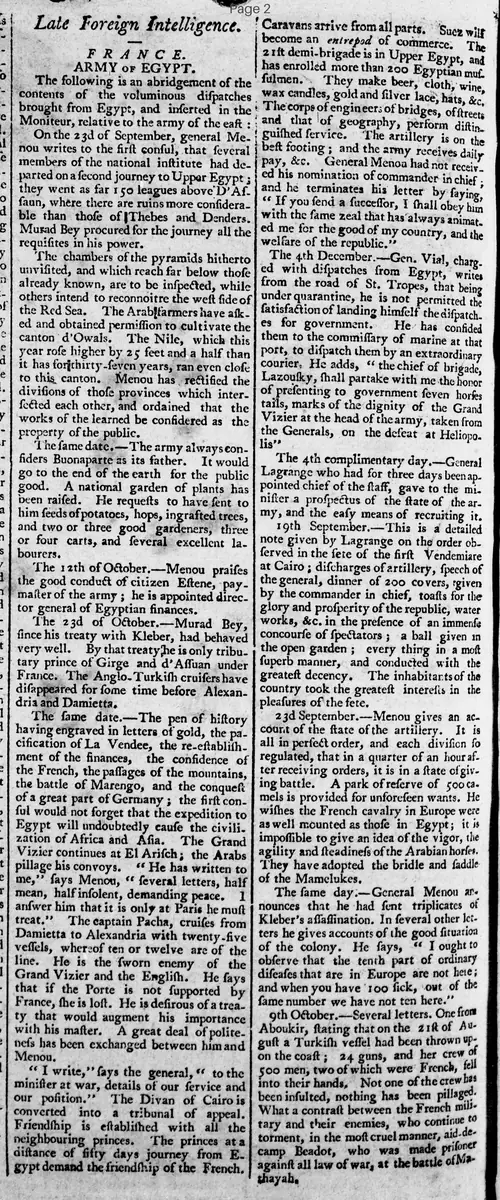
FRANCE.
ARMY OF EGYPT.
The following is an abridgement of the contents of the voluminous dispatches brought from Egypt, and inserted in the Moniteur, relative to the army of the east:
On the 23d of September, general Menou writes to the first consul, that several members of the national institute had departed on a second journey to Upper Egypt: they went as far 150 leagues above D'Esna, where there are ruins more considerable than those of Thebes and Dendera. Murad Bey procured for the journey all the requisites in his power.
The chambers of the pyramids hitherto unvisited, and which reach far below those already known, are to be inspected, while others intend to reconnoitre the west side of the Red Sea. The Arab farmers have asked and obtained permission to cultivate the canton d'Qwalys. The Nile, which this year rose higher by 25 feet and a half than it has for thirty-seven years, ran even close to this canton. Menou has rectified the divisions of those provinces which intersected each other, and ordained that the works of the learned be considered as the property of the public.
The same date.--The army always considers Buonaparte as its father. It would go to the end of the earth for the public good. A national garden of plants has been raised. He requests to have sent to him seeds of potatoes, hops, ingrafted trees, and two or three good gardeners, three or four carts, and several excellent labourers.
The 12th of October.--Menou praises the good conduct of citizen Estève, paymaster of the army; he is appointed director general of Egyptian finances.
The 23d of October.--Murad Bey, since his treaty with Kléber, had behaved very well. By that treaty he is only tributary prince of Girgeh and d'Esna under France: The Anglo-Turkish cruisers have disappeared for some time before Alexandria and Damietta.
The same date.--The pen of history having engraved in letters of gold, the pacification of La Vendée, the re-establishment of the finances, the confidence of the French, the passages of the mountains, the battle of Marengo, and the conquest of a great part of Germany; the first consul would not forget that the expedition to Egypt will undoubtedly cause the civilization of Africa and Asia. The Grand Vizier continues at El Arish: the Arabs pillage his convoys. "He has written to me," says Menou, "several letters, half mean, half insolent, demanding peace. I answer him that it is only at Paris he must treat." The captain Pacha, cruises from Damietta to Alexandria with twenty-five vessels, whereof ten or twelve are of the line. He is the sworn enemy of the Grand Vizier and the English. He says that if the Porte is not supported by France, she is lost. He is desirous of a treaty that would augment his importance with his master. A great deal of politeness has been exchanged between him and Menou.
"I write," says the general, "to the minister at war, details of our service and our position." The Divan of Cairo is converted into a tribunal of appeal. Friendship is established with all the neighbouring princes. The princes at a distance of fifty days journey from Egypt demand the friendship of the French.
Caravans arrive from all parts. Suez will become an entrepôt of commerce. The 21st demi-brigade is in Upper Egypt, and has enrolled more than 200 Egyptian muslims. They make beer, cloth, wine, wax candles, gold and silver lace, hats, &c. The corps of engineers of bridges, of streets and that of geography, perform distinguished service. The artillery is on the best footing; and the army receives daily pay, &c. General Menou had not received his nomination of commander in chief: and he terminates his letter by saying, "If you send a successor, I shall obey him with the same zeal that has always animated me for the good of my country, and the welfare of the republic."
The 4th December.---Gen. Vial, charged with dispatches from Egypt, writes from the road of St. Tropes, that being under quarantine, he is not permitted the satisfaction of landing himself the dispatches for government. He has confided them to the commissary of marine at that port, to dispatch them by an extraordinary courier. He adds, "the chief of brigade, Lazovsky, shall partake with me the honor of presenting to government even horse tails, marks of the dignity of the Grand Vizier at the head of the army, taken from the Generals, on the defeat at Heliopolis."
The 4th complimentary day.--General Lagrange who had for three days been appointed chief of the staff, gave to the minister a prospectus of the state of the army, and the easy means of recruiting it.
19th September.--This is a detailed note given by Lagrange on the order observed in the fete of the first Vendemiaire at Cairo: discharges of artillery, speech of the general, dinner of 200 covers, given by the commander in chief, toasts for the glory and prosperity of the republic, water works, &c. in the presence of an immense concourse of spectators; a ball given in the open garden; every thing in a most superb manner, and conducted with the greatest decency. The inhabitants of the country took the greatest interest in the pleasures of the fete.
23d September.--Menou gives an account of the state of the artillery. It is all in perfect order, and each division so regulated, that in a quarter of an hour after receiving orders, it is in a state of giving battle. A park of reserve of 500 camels is provided for unforeseen wants. He wishes the French cavalry in Europe were as well mounted as those in Egypt; it is impossible to give an idea of the vigor, the agility and steadiness of the Arabian horses. They have adopted the bridle and saddle of the Mamelukes.
The same day:-General Menou announces that he had sent triplicates of Kléber's assassination. In several other letters he gives accounts of the good situation of the colony. He says, "I ought to observe that the tenth part of ordinary diseases that are in Europe are not here; and when you have 100 sick, out of the same number we have not ten here."
9th October.--Several letters. One from Aboukir, stating that on the 21st of August a Turkish vessel had been thrown upon the coast; 24 guns, and her crew of 500 men, two of which were French, fell into their hands. Not one of the crew has been insulted, nothing has been pillaged. What a contrast between the French military and their enemies, who continue to torment, in the most cruel manner, aid-de-camp Beaudot, who was made prisoner against all law of war, at the battle of Mahayab.
What sub-type of article is it?
What keywords are associated?
What entities or persons were involved?
Where did it happen?
Foreign News Details
Primary Location
Egypt
Event Date
From 19th September To 4th December
Key Persons
Outcome
treaty with murad bey as tributary prince; anglo-turkish cruisers disappeared; diplomatic exchanges with captain pacha; horse tails captured from ottoman generals at heliopolis; turkish vessel captured without mistreatment; low disease rates in the army.
Event Details
Dispatches from General Menou report scientific expeditions to Upper Egypt and pyramids, administrative reforms, cultivation permissions, army loyalty to Buonaparte, requests for supplies, appointment of Estève to finances, good behavior of Murad Bey post-treaty, interactions with Grand Vizier and Captain Pacha seeking alliances, establishment of commerce at Suez, enrollment of Egyptian muslims, production of goods, strong artillery and cavalry, low sickness rates, and celebrations in Cairo.