Thank you for visiting SNEWPapers!
Sign up free
The National Intelligencer And Washington Advertiser
Washington, District Of Columbia
What is this article about?
A 1805 London Monthly Register retrospect praises the United States' political blessings: territorial advantages, peace with the world, Louisiana acquisition, amicable Indian relations, rapid economic growth, stable finances, and rapid national debt reduction, highlighting Jefferson's administration amid domestic critics.
Clipping
OCR Quality
Full Text
DEMOCRAT.
From the London "Monthly Magazine."
Half yearly retrospect of American literature.
POLITICS.
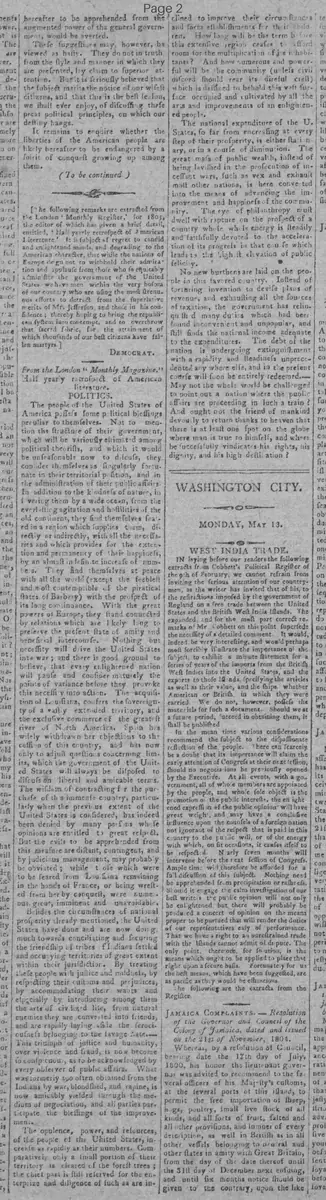
The people of the United States of America possess some political blessings peculiar to themselves. Not to mention the structure of their government, which will be variously estimated among political theorists, and which it would be unreasonable now to discuss, they consider themselves as singularly fortunate in their territorial position, and in the administration of their public affairs. In addition to the kindness of nature, in severing them by a wide ocean, from the everlasting agitation and hostilities of the old continent, they find themselves seated in a region which supplies them, directly or indirectly, with all the necessaries and which provides for the extension and permanency of their happiness, by an almost indefinite increase of numbers. They find themselves at peace with all the world (except the feeblest and most contemptible of the piratical states of Barbary) with the prospect of its long continuance. With the great powers of Europe, they stand connected by relations which are likely long to preserve the present state of amity and beneficial intercourse. Nothing but necessity will drive the United States into war; and there is good ground to believe, that every enlightened nation will pause and consider maturely the points of variance before they provoke this necessity into action. The acquisition of Louisiana, confers the sovereignty of a vastly extended territory, and the exclusive commerce of the greatest river of North America. Spain has wisely withdrawn her objections to the cession of this country, and has now only to adjust questions concerning limits, which the government of the United States will always be disposed to discuss on liberal and amicable terms. The wisdom of contracting for the purchase of this immense country, particularly when the previous extent of the United States is considered, has indeed been denied by many persons whose opinions are entitled to great respect. But the evils to be apprehended from this measure are distant, contingent, and by judicious management, may probably be obviated; while those which were to be feared from Louisiana remaining in the hands of France, or being wrested from her by conquest, were numerous, great, imminent and unavoidable. Besides the circumstances of national prosperity already mentioned, the United States have done and are now doing much towards conciliating and securing the friendship of tribes of Indians settled and occupying territories of great extent within their jurisdiction. By treating these people with justice and mildness, by respecting their customs and prejudices, by accommodating their wants and especially by introducing among them the arts of civilized life, from natural enemies they are converted into friends, and are rapidly laying aside the ferocity belonging to the savage state.-- This triumph of justice and humanity, over violence and fraud, is now become so conspicuous, as to be acknowledged by every observer of public affairs. What was formerly too often obtained from the Indians by war, bloodshed, and rapine, is now amicably yielded through the medium of negotiation, and all parties participate the blessings of the improvement. The opulence, power, and resources, of the people of the United States, increase as rapidly as their numbers. Comparatively only a small portion of their territory is cleared of the forest trees; the chief part is still reserved for the enterprise and diligence of such as are inclined to improve their circumstances and form establishments for their children. How long will be the term before this extensive region ceases to afford room for the multiplication of its inhabitants? And how numerous and powerful will be the community (unless civil discord should rear its direful crest) which is destined to behold this vast surface occupied and cultivated by all the arts and improvements of an enlightened people. The national expenditure of the United States, so far from increasing at every step of their prosperity, is either stationary, or in a course of diminution. The great mass of public wealth, instead of being lavished in the prosecution of incessant wars, such as vex and exhaust almost other nations, is here converted into the means of advancing the improvement and happiness of the community. The eye of philanthropy must dwell with rapture on the prospect of a Country whose whole energy is steadily and faithfully devoted to the acceleration of its progress in that course which leads to the highest elevation of public felicity. No new burdens are laid on the people in this favored country. Instead of torturing invention to devise plans of revenue, and exhausting all the sources of taxation, the government has relinquished many duties which had been found inconvenient and unpopular, and still finds the national income adequate to the expenditures. The debt of the nation is undergoing extinguishment with a rapidity and steadiness unprecedented anywhere else, and in the present course will soon be entirely redeemed.-- May not the whole world be challenged to point out a nation where the public affairs are proceeding in such a train? And ought not the friend of mankind devoutly to return thanks to heaven that there is at least one spot on the globe where man is true to himself, and where he successfully vindicates his rights, his dignity, and his high destination?
What sub-type of article is it?
What keywords are associated?
What entities or persons were involved?
Where did it happen?
Foreign News Details
Primary Location
United States Of America
Event Date
1805
Key Persons
Outcome
acquisition of louisiana; amicable relations with indian tribes; rapid national debt reduction; continued peace and prosperity.
Event Details
The retrospect highlights the US's political blessings including territorial position, peace with the world except Barbary states, relations with European powers, Louisiana purchase despite criticisms, conciliatory policies toward Indians converting enemies to friends, rapid population and resource growth, stationary or diminishing national expenditure, relinquished duties, and unprecedented debt extinguishment.