Thank you for visiting SNEWPapers!
Sign up free
Literary
April 8, 1858
The Greenville Advocate
Greenville, Bond County, Illinois
What is this article about?
Personal narrative of an overland journey from Fort Hall along Snake River to Willamette Valley, Oregon, describing desolate landscapes, encounters with hostile Diggers and Snakes Indians, emigrant hardships crossing Cascade Mountains, and observations on fellow travelers' behaviors upon arrival.
Clipping
OCR Quality
95%
Excellent
Full Text
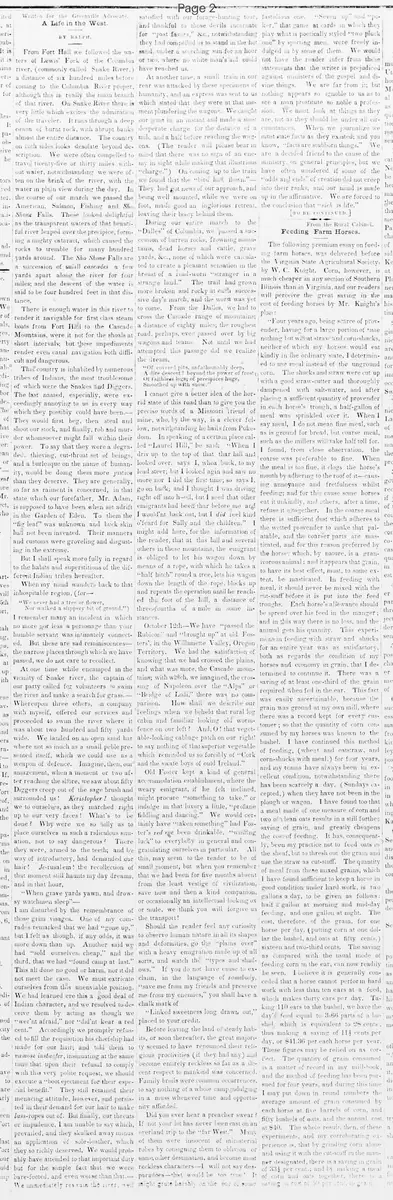
Written for the Greenville Advocate.
A Life in the West.
BY RALPH.
From Fort Hall we followed the waters of Lewis' Fork of the Columbia river, (commonly called Snake River,) a distance of six hundred miles before coming to the Columbia River proper although this is really the main branch of that river. On Snake River there is very little which excites the admiration of the traveler. It runs through a deep canon of burnt rock, with abrupt banks almost the entire distance. The country on both sides looks desolate beyond description. We were often compelled to travel twenty-five or thirty miles without water, notwithstanding we were often on the brink of the river, with the water in plain view during the day. In the course of our march we passed the American, Salmon, Fishing and Shoshone Falls. These looked delightful as the transparent waters of that beautiful river leaped over the precipice, forming a mighty cataract, which caused the rocks to tremble for many hundred yards around. The Shoshone Falls are a succession of small cascades a few yards apart along the river for four or five miles; and the descent of the water is said to be four hundred feet in that distance.
There is enough water in this river to render it navigable for first class steam boats from Fort Hall to the Cascade Mountains, were it not for the shoals at short intervals; but these impediments render even canal navigation both difficult and dangerous.
This country is inhabited by numerous tribes of Indians, the most troublesome of which were the Snakes and Diggers. The last named, especially, were exceedingly annoying to us in every way which they possibly could have been. They would first beg, then steal and shoot our stock, and finally, rob and murder whomsoever might fall within their power. To say that they were a degraded, thieving, cut-throat set of beings and a burlesque on the name of humanity, would be doing them more justice than they deserve. They are generally, so far as raiment is concerned, in that state which our forefather, Mr. Adam is supposed to have been when set adrift in the Garden of Eden. To them the "fig leaf" was unknown and buck skin had not been invented. Their manners and customs were groveling and disgusting in the extreme.
But I shall speak more fully in regard to the habits and superstitions of the different Indian tribes hereafter.
When my mind wanders back to that inhospitable region, (for
"We never had a tree or flower,
Nor walked a slippery bit of ground."
I remember many an incident in which no more nor less a personage than your humble servant was intimately connected. But these are sad reminiscences— the narrow places through which we have passed, we do not care to recollect.
At one time while encamped in the vicinity of Snake river, the captain of our party called for volunteers to swim the river and make a search for grass.— Whereupon three others, in company with myself, offered our services and proceeded to swim the river where it was about two hundred and fifty yards wide. We landed on an open sand bar where not so much as a small pebble presented itself, which we could use as a weapon of defence. Imagine, then, our amazement, when a moment or two after reaching the shore, we saw about fifty Diggers creep out of the sage brush and surrounded us! Keristopher! thought we to ourselves, as they marched right up to our very faces! What's to be done? Why were we so silly as to place ourselves in such a ridiculous situation, not to say dangerous? There they were, armed to the teeth; and by way of introductory, had demanded our hair! Je-rusalem! the recollection of that moment still haunts my day dreams. and in that hour,
"When grave yards yawn, and drowsy watchmen sleep"
—
I am disturbed by the remembrance of those grim visages. One of my comrades remarked that we had "gone up," but I felt as though, if any odds, it was more down than up. Another said we had "sold ourselves cheap," and the third, that we had "found camp at last." This all done no good or harm, nor it did not meet the case. We must extricate ourselves from this unenviable position.
We had learned ere this a good deal of Indian character, and we resolved to deceive them by acting as though we "wer'nt afraid." nor "did'nt keer a red cent." Accordingly we promptly refused to fill the requisition his chiefship had made for our hair; and told them to vamose instanter, insinuating at the same time that upon their refusal to comply with this very polite request, we should execute a "boot ejectment for their especial benefit." They still retained their menacing attitude, however, and persisted in their demand for our hair to make lass-ropes out of. But finally, our threats or impudence, I am unable to say which, prevailed, and they skulked away minus an application of sole-leather, which they so richly deserved. We would probably have attended to that important duty but for the simple fact that we were bare-footed, and even worse than that.— We immediately re-swam the river, satisfied with our forage-hunting tour and thankful to those devils incarnate for "past favors," &c., notwithstanding they had compelled us to stand in the hot sand, under a scorching sun for an hour or two. where no white man's aid could have reached us.
At another time, a small train in our rear was attacked by these specimens of humanity, and an express was sent to us which stated that they were at that moment plundering the wagons. We caught our guns in an instant and made a most desperate charge for the distance of a mile and a half before reaching the wagons. (The reader will please bear in mind that there was no sign of an enemy in sight while making that illustrious "charge.") On coming up to the train we found that the "bird had flown."— They had got news of our approach, and being well mounted, while we were on foot, made good an inglorious retreat leaving their booty behind them.
During our entire march to the "Dalles" of Columbia, we passed a succession of barren rocks, frowning mountains, dead horses and cattle, grave yards, &c., none of which were calculated to create a pleasant sensation in the breast of a road-worn "stranger in a strange land." The trail had grown more broken and rocky at each successive day's march, and the worst was yet to come. From the Dalles, we had to cross the Cascade range of mountains a distance of eighty miles; the roughest road, perhaps, ever passed over by big wagons and teams. Not until we had attempted this passage did we realize the dream,
"Of covered pits, unfathomably deep,
A dire descent! beyond the power of frost
Of faithless logs; of precipices huge,
Smoothed up with snow."
I cannot give a better idea of the horrid state of this road than to give you the precise words of a Missouri friend of mine, who, by the way, is a clever fellow, notwithstanding he hails from Pukedom. In speaking of a certain place called "Laurel Hill," he said: "When I driv up to the top of that thar hill and looked over, says I, whoa buck, to my lead steer; but I looked agin and saw no more nor I did the first time; so says I go on buck; and I thought I was driving right off mto h-ll. but I seed that other emigrants had been thar before me_ and I would'nt back out, but I did feel kind o'feard for Sally and the children." I might add here, for the information of the reader, that at this hill and several others in these mountains, the emigrant is obliged to let his wagon down by means of a rope, with which he takes a "half hitch" round a tree, lets his wagon down the length of the rope, blocks up and repeats the operation until he reached the foot of the hill, a distance of three fourths of a mile in some instances.
October 12th—We have "passed the Rubicon" and "brought up" at old Fosters', in the Willamette Valley, Oregon Territory. We had the satisfaction of knowing that we had crossed the plains, and what was more, the Cascade mountains; with which, we imagined, the crossing of Napoleon over the "Alps" or "Bridge of Lodi," there was no comparison. How shall we describe our feelings when we beheld that rural log cabin and familiar looking old worm-fence on our left? And, O! that vegetable-looking cabbage patch on our right to say nothing of that superior vegetable which reminded us so forcibly of "Cork and the swate boys of ould Ireland."
Old Foster kept a kind of general accommodation establishment, where the weary emigrant, if he felt inclined might procure "something to take," or indulge in that luxury a little, "profane fiddling and dancing." We would certainly have "taken something" had Foster's red eye been drinkable, "wishing luck" to everybody in general and congratulating ourselves in particular. All this, may seem to the reader to be of small moment, but when you remember that we had been for five months absent from the least vestige of civilization save now and then a kind companion or occasionally an intellectual looking ox or mule, we think you will forgive us the transport!
Should the reader feel any curiosity to observe human nature in all its shapes and deformities, go the "plains over" with a heavy emigration made up of all sorts, and watch the "types and shadows." If you do not have cause to exclaim, in the language of somebody "save me from my friends and preserve me from my enemies," you shall have a chalk mark of "Linked sweetness long drawn out," placed to your credit.
Before leaving the land of steady habits, or soon thereafter, the great majority seemed to have renounced their religious proclivities (if they had any) and become entirely reckless so far as a decent respect to mankind was concerned Family broils were common occurrences to say nothing of a whole camp indulging in a muss whenever time and opportunity afforded.
Did you ever hear a preacher swear If not your lot has never been cast on an overland trip to the "far West." Many of them were innocent of ministerial robes by consigning them to oblivion or some other destination, and become most reckless characters--I will not say desperadoes-that would be too true' I might grate harshly on the ear of some fastidious one. "Seven up" and "poker." that game at cards in which the play what is poetically styled "two pluck one" by sporting men, were freely indulged in by some of them. We would not have the reader infer from these statements that the writer is prejudiced against ministers of the gospel and divine things. We are far from it; but nothing appears so ignoble to us as to see a man prostitute so noble a profession. We must look at things as they are, not as they should be under all circumstances. When we journalize we must state facts as they existed; and you know, "facts are stubborn things." We are a decided friend to the cause of the ministry, on general principles, but we have often wondered if some of the "odds and ends" of creation did not creep into their ranks, and our mind is made up in the affirmative. We are forced to the conclusion that "sich is life."
[TO BE CONTINUED.]
A Life in the West.
BY RALPH.
From Fort Hall we followed the waters of Lewis' Fork of the Columbia river, (commonly called Snake River,) a distance of six hundred miles before coming to the Columbia River proper although this is really the main branch of that river. On Snake River there is very little which excites the admiration of the traveler. It runs through a deep canon of burnt rock, with abrupt banks almost the entire distance. The country on both sides looks desolate beyond description. We were often compelled to travel twenty-five or thirty miles without water, notwithstanding we were often on the brink of the river, with the water in plain view during the day. In the course of our march we passed the American, Salmon, Fishing and Shoshone Falls. These looked delightful as the transparent waters of that beautiful river leaped over the precipice, forming a mighty cataract, which caused the rocks to tremble for many hundred yards around. The Shoshone Falls are a succession of small cascades a few yards apart along the river for four or five miles; and the descent of the water is said to be four hundred feet in that distance.
There is enough water in this river to render it navigable for first class steam boats from Fort Hall to the Cascade Mountains, were it not for the shoals at short intervals; but these impediments render even canal navigation both difficult and dangerous.
This country is inhabited by numerous tribes of Indians, the most troublesome of which were the Snakes and Diggers. The last named, especially, were exceedingly annoying to us in every way which they possibly could have been. They would first beg, then steal and shoot our stock, and finally, rob and murder whomsoever might fall within their power. To say that they were a degraded, thieving, cut-throat set of beings and a burlesque on the name of humanity, would be doing them more justice than they deserve. They are generally, so far as raiment is concerned, in that state which our forefather, Mr. Adam is supposed to have been when set adrift in the Garden of Eden. To them the "fig leaf" was unknown and buck skin had not been invented. Their manners and customs were groveling and disgusting in the extreme.
But I shall speak more fully in regard to the habits and superstitions of the different Indian tribes hereafter.
When my mind wanders back to that inhospitable region, (for
"We never had a tree or flower,
Nor walked a slippery bit of ground."
I remember many an incident in which no more nor less a personage than your humble servant was intimately connected. But these are sad reminiscences— the narrow places through which we have passed, we do not care to recollect.
At one time while encamped in the vicinity of Snake river, the captain of our party called for volunteers to swim the river and make a search for grass.— Whereupon three others, in company with myself, offered our services and proceeded to swim the river where it was about two hundred and fifty yards wide. We landed on an open sand bar where not so much as a small pebble presented itself, which we could use as a weapon of defence. Imagine, then, our amazement, when a moment or two after reaching the shore, we saw about fifty Diggers creep out of the sage brush and surrounded us! Keristopher! thought we to ourselves, as they marched right up to our very faces! What's to be done? Why were we so silly as to place ourselves in such a ridiculous situation, not to say dangerous? There they were, armed to the teeth; and by way of introductory, had demanded our hair! Je-rusalem! the recollection of that moment still haunts my day dreams. and in that hour,
"When grave yards yawn, and drowsy watchmen sleep"
—
I am disturbed by the remembrance of those grim visages. One of my comrades remarked that we had "gone up," but I felt as though, if any odds, it was more down than up. Another said we had "sold ourselves cheap," and the third, that we had "found camp at last." This all done no good or harm, nor it did not meet the case. We must extricate ourselves from this unenviable position.
We had learned ere this a good deal of Indian character, and we resolved to deceive them by acting as though we "wer'nt afraid." nor "did'nt keer a red cent." Accordingly we promptly refused to fill the requisition his chiefship had made for our hair; and told them to vamose instanter, insinuating at the same time that upon their refusal to comply with this very polite request, we should execute a "boot ejectment for their especial benefit." They still retained their menacing attitude, however, and persisted in their demand for our hair to make lass-ropes out of. But finally, our threats or impudence, I am unable to say which, prevailed, and they skulked away minus an application of sole-leather, which they so richly deserved. We would probably have attended to that important duty but for the simple fact that we were bare-footed, and even worse than that.— We immediately re-swam the river, satisfied with our forage-hunting tour and thankful to those devils incarnate for "past favors," &c., notwithstanding they had compelled us to stand in the hot sand, under a scorching sun for an hour or two. where no white man's aid could have reached us.
At another time, a small train in our rear was attacked by these specimens of humanity, and an express was sent to us which stated that they were at that moment plundering the wagons. We caught our guns in an instant and made a most desperate charge for the distance of a mile and a half before reaching the wagons. (The reader will please bear in mind that there was no sign of an enemy in sight while making that illustrious "charge.") On coming up to the train we found that the "bird had flown."— They had got news of our approach, and being well mounted, while we were on foot, made good an inglorious retreat leaving their booty behind them.
During our entire march to the "Dalles" of Columbia, we passed a succession of barren rocks, frowning mountains, dead horses and cattle, grave yards, &c., none of which were calculated to create a pleasant sensation in the breast of a road-worn "stranger in a strange land." The trail had grown more broken and rocky at each successive day's march, and the worst was yet to come. From the Dalles, we had to cross the Cascade range of mountains a distance of eighty miles; the roughest road, perhaps, ever passed over by big wagons and teams. Not until we had attempted this passage did we realize the dream,
"Of covered pits, unfathomably deep,
A dire descent! beyond the power of frost
Of faithless logs; of precipices huge,
Smoothed up with snow."
I cannot give a better idea of the horrid state of this road than to give you the precise words of a Missouri friend of mine, who, by the way, is a clever fellow, notwithstanding he hails from Pukedom. In speaking of a certain place called "Laurel Hill," he said: "When I driv up to the top of that thar hill and looked over, says I, whoa buck, to my lead steer; but I looked agin and saw no more nor I did the first time; so says I go on buck; and I thought I was driving right off mto h-ll. but I seed that other emigrants had been thar before me_ and I would'nt back out, but I did feel kind o'feard for Sally and the children." I might add here, for the information of the reader, that at this hill and several others in these mountains, the emigrant is obliged to let his wagon down by means of a rope, with which he takes a "half hitch" round a tree, lets his wagon down the length of the rope, blocks up and repeats the operation until he reached the foot of the hill, a distance of three fourths of a mile in some instances.
October 12th—We have "passed the Rubicon" and "brought up" at old Fosters', in the Willamette Valley, Oregon Territory. We had the satisfaction of knowing that we had crossed the plains, and what was more, the Cascade mountains; with which, we imagined, the crossing of Napoleon over the "Alps" or "Bridge of Lodi," there was no comparison. How shall we describe our feelings when we beheld that rural log cabin and familiar looking old worm-fence on our left? And, O! that vegetable-looking cabbage patch on our right to say nothing of that superior vegetable which reminded us so forcibly of "Cork and the swate boys of ould Ireland."
Old Foster kept a kind of general accommodation establishment, where the weary emigrant, if he felt inclined might procure "something to take," or indulge in that luxury a little, "profane fiddling and dancing." We would certainly have "taken something" had Foster's red eye been drinkable, "wishing luck" to everybody in general and congratulating ourselves in particular. All this, may seem to the reader to be of small moment, but when you remember that we had been for five months absent from the least vestige of civilization save now and then a kind companion or occasionally an intellectual looking ox or mule, we think you will forgive us the transport!
Should the reader feel any curiosity to observe human nature in all its shapes and deformities, go the "plains over" with a heavy emigration made up of all sorts, and watch the "types and shadows." If you do not have cause to exclaim, in the language of somebody "save me from my friends and preserve me from my enemies," you shall have a chalk mark of "Linked sweetness long drawn out," placed to your credit.
Before leaving the land of steady habits, or soon thereafter, the great majority seemed to have renounced their religious proclivities (if they had any) and become entirely reckless so far as a decent respect to mankind was concerned Family broils were common occurrences to say nothing of a whole camp indulging in a muss whenever time and opportunity afforded.
Did you ever hear a preacher swear If not your lot has never been cast on an overland trip to the "far West." Many of them were innocent of ministerial robes by consigning them to oblivion or some other destination, and become most reckless characters--I will not say desperadoes-that would be too true' I might grate harshly on the ear of some fastidious one. "Seven up" and "poker." that game at cards in which the play what is poetically styled "two pluck one" by sporting men, were freely indulged in by some of them. We would not have the reader infer from these statements that the writer is prejudiced against ministers of the gospel and divine things. We are far from it; but nothing appears so ignoble to us as to see a man prostitute so noble a profession. We must look at things as they are, not as they should be under all circumstances. When we journalize we must state facts as they existed; and you know, "facts are stubborn things." We are a decided friend to the cause of the ministry, on general principles, but we have often wondered if some of the "odds and ends" of creation did not creep into their ranks, and our mind is made up in the affirmative. We are forced to the conclusion that "sich is life."
[TO BE CONTINUED.]
What sub-type of article is it?
Journey Narrative
Essay
What themes does it cover?
Nature
War Peace
Social Manners
What keywords are associated?
Oregon Trail
Snake River
Digger Indians
Cascade Mountains
Emigrant Hardships
Willamette Valley
What entities or persons were involved?
By Ralph
Literary Details
Title
A Life In The West
Author
By Ralph
Subject
Overland Journey To Oregon Territory
Form / Style
Personal Travel Memoir In Prose
Key Lines
We Never Had A Tree Or Flower, Nor Walked A Slippery Bit Of Ground.
When Grave Yards Yawn, And Drowsy Watchmen Sleep
Of Covered Pits, Unfathomably Deep, A Dire Descent! Beyond The Power Of Frost Of Faithless Logs; Of Precipices Huge, Smoothed Up With Snow.
When I Driv Up To The Top Of That Thar Hill And Looked Over, Says I, Whoa Buck, To My Lead Steer; But I Looked Agin And Saw No More Nor I Did The First Time; So Says I Go On Buck; And I Thought I Was Driving Right Off Mto H Ll. But I Seed That Other Emigrants Had Been Thar Before Me And I Would'nt Back Out, But I Did Feel Kind O'feard For Sally And The Children.