Thank you for visiting SNEWPapers!
Sign up free
Literary
September 22, 1825
The Wilmingtonian, And Delaware Register
Wilmington, New Castle County, Delaware
What is this article about?
Descriptive essay on the Ceylon crow, highlighting its size, cunning, usefulness in scavenging to prevent disease in the tropical climate, familiarity with humans, predatory habits, and amusing anecdotes of its behavior and interactions.
Clipping
OCR Quality
95%
Excellent
Full Text
NATURAL HISTORY
From the London Wesleyan Magazine.
THE CEYLON CROW.
The name of this bird in Tamul is an evident attempt to imitate the noise which it makes, Kaaham, or Kaa-kai: and this attempt is often made by the Tamullee with considerable success. The crow, in size, resembles the English Jackdaw, but it is far more cunning and useful. In Ceylon there is perhaps no animal of the same size that is of equal importance; a wise and kind Providence having evidently sent it to prevent fever and disease. In such a climate, where putrid substances so soon taint the air, its great value may, in some degree, be appreciated, as it scarcely allows any impure substance to remain long on the ground: and there is no animal, except its own species, on which it will not prey. The crows of Ceylon, instead of taking up their abodes in fields and woods, live in villages and towns, and are as familiar with us as common sparrows are in England. In the jungle we now and then see a straggler, particularly if there be a dead elephant or any other animal near. There are few things which excite more of the attention of a newly arrived Englishman than these birds, perched on the doors or windows, or entering into the houses in search of food. An English sailor, who is not very delicate about his conduct in the streets, no sooner sees them than he commences an attack; but the crow is far too active and cunning for him. It has often been said, that a certain number occupy as a kind of right, one person's premises, and I know that one crow, with a broken beak, was a daily visitor for more than twelve months at the Mission House of Trincomalee. The natives of Ceylon generally carry their burdens on the head, thus when they return from market with fish, rice, or fruit, they take a stick in one hand to keep off these impudent depredators, or they would have nothing left before they arrive at home.--Young chickens and ducks are with them an easy prey; they pounce down upon them, and carry them off like a hawk; and there is nothing weaker than themselves that they will not attack, and, if possible, destroy. In the wet season, there are hundreds of frogs croaking on every hand; and these reptiles often come into the house in great numbers: but to them also the crow is a formidable enemy. When the frog perceives his foe approaching, he bloats himself with wind, and endeavours to secure amongst the grass those parts which are most penetrable; but the crow hops round the victim, and every now and then gives a peck, until he has perforated the skin; after this, the frog, by fruitless attempts to inflate himself, becomes exhausted, and the crow carries off his prey to the top of a tree. The instinct of this bird seems occasionally to border on reason as its actions are apparently adapted to circumstances of an accidental nature. If there be any plot suspected, an old crow lights upon the eave of the verandah, puts his head so far down as to be able to discover what is going forward, and if there be any thing new, any thing he cannot comprehend, the alarm is given, and they all betake themselves to a place of safety. It is truly amusing to see them assist each other to get rid of the insects which live in their down: one crow bows his head, and the other takes them out with his bill.-- I once remember to have seen some of these cunning creatures, greatly overreached, and in a way quite novel to them. A gentleman who had been preparing the skins of some beautiful birds, in order to send them home, after having deposited the necessary drugs to preserve them from insects, placed them in the sun to dry. In the course of an hour he returned, but his skins were gone.-The gardner was called, and accused of taking them away.
"No sir," said the poor man.
"they are there;" pointing to a tree where the crows were pulling them to pieces.-
Stones were thrown at them; but it was too late; the feathers were all gone. The gentleman said, "I will punish you for this."
He went into the house, and mixed a large quantity of tartar emetic with some boiled rice and milk, which he placed in the garden and the crows, after some hesitation, consumed it. In the course of a few minutes they began to look at each other, seeming to think that all was not right, and then became dreadfully sick, but after drinking plentifully of water, they soon recovered.-
This lesson made a deep impression on them, and, for a few days, nothing could induce them to come near the house. At last, however, hunger overcame all their scruples, and they resumed their former practices; and I doubt not, but that if other skins had been placed there, they would have met the same fate. But cunning as this bird is, there is not perhaps a greater coward in creation. The least thing imaginable excites his suspicion and fear. I have seen a bird about the size of a sparrow make him fly off with the greatest precipitation. The sympathy they bear for each other is really striking. If one of their number be wounded or shot, or in the possession of a man; vast numbers will come from every quarter, and disturb the whole neighborhood.
From the London Wesleyan Magazine.
THE CEYLON CROW.
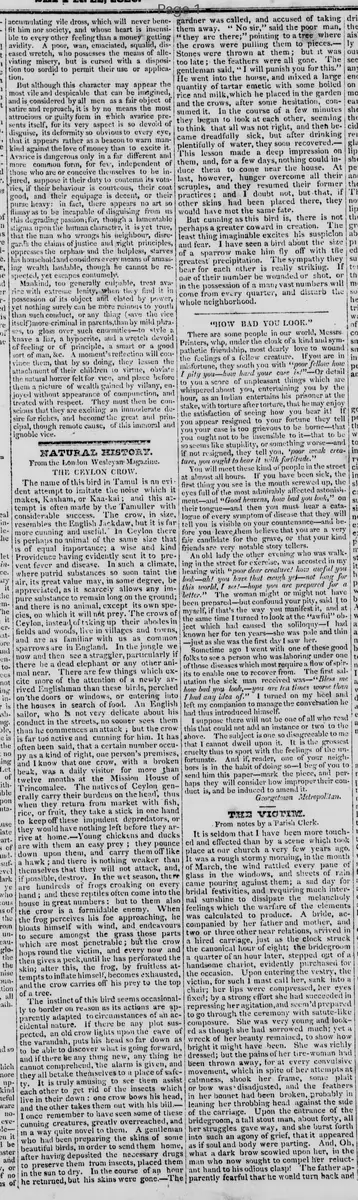
The name of this bird in Tamul is an evident attempt to imitate the noise which it makes, Kaaham, or Kaa-kai: and this attempt is often made by the Tamullee with considerable success. The crow, in size, resembles the English Jackdaw, but it is far more cunning and useful. In Ceylon there is perhaps no animal of the same size that is of equal importance; a wise and kind Providence having evidently sent it to prevent fever and disease. In such a climate, where putrid substances so soon taint the air, its great value may, in some degree, be appreciated, as it scarcely allows any impure substance to remain long on the ground: and there is no animal, except its own species, on which it will not prey. The crows of Ceylon, instead of taking up their abodes in fields and woods, live in villages and towns, and are as familiar with us as common sparrows are in England. In the jungle we now and then see a straggler, particularly if there be a dead elephant or any other animal near. There are few things which excite more of the attention of a newly arrived Englishman than these birds, perched on the doors or windows, or entering into the houses in search of food. An English sailor, who is not very delicate about his conduct in the streets, no sooner sees them than he commences an attack; but the crow is far too active and cunning for him. It has often been said, that a certain number occupy as a kind of right, one person's premises, and I know that one crow, with a broken beak, was a daily visitor for more than twelve months at the Mission House of Trincomalee. The natives of Ceylon generally carry their burdens on the head, thus when they return from market with fish, rice, or fruit, they take a stick in one hand to keep off these impudent depredators, or they would have nothing left before they arrive at home.--Young chickens and ducks are with them an easy prey; they pounce down upon them, and carry them off like a hawk; and there is nothing weaker than themselves that they will not attack, and, if possible, destroy. In the wet season, there are hundreds of frogs croaking on every hand; and these reptiles often come into the house in great numbers: but to them also the crow is a formidable enemy. When the frog perceives his foe approaching, he bloats himself with wind, and endeavours to secure amongst the grass those parts which are most penetrable; but the crow hops round the victim, and every now and then gives a peck, until he has perforated the skin; after this, the frog, by fruitless attempts to inflate himself, becomes exhausted, and the crow carries off his prey to the top of a tree. The instinct of this bird seems occasionally to border on reason as its actions are apparently adapted to circumstances of an accidental nature. If there be any plot suspected, an old crow lights upon the eave of the verandah, puts his head so far down as to be able to discover what is going forward, and if there be any thing new, any thing he cannot comprehend, the alarm is given, and they all betake themselves to a place of safety. It is truly amusing to see them assist each other to get rid of the insects which live in their down: one crow bows his head, and the other takes them out with his bill.-- I once remember to have seen some of these cunning creatures, greatly overreached, and in a way quite novel to them. A gentleman who had been preparing the skins of some beautiful birds, in order to send them home, after having deposited the necessary drugs to preserve them from insects, placed them in the sun to dry. In the course of an hour he returned, but his skins were gone.-The gardner was called, and accused of taking them away.
"No sir," said the poor man.
"they are there;" pointing to a tree where the crows were pulling them to pieces.-
Stones were thrown at them; but it was too late; the feathers were all gone. The gentleman said, "I will punish you for this."
He went into the house, and mixed a large quantity of tartar emetic with some boiled rice and milk, which he placed in the garden and the crows, after some hesitation, consumed it. In the course of a few minutes they began to look at each other, seeming to think that all was not right, and then became dreadfully sick, but after drinking plentifully of water, they soon recovered.-
This lesson made a deep impression on them, and, for a few days, nothing could induce them to come near the house. At last, however, hunger overcame all their scruples, and they resumed their former practices; and I doubt not, but that if other skins had been placed there, they would have met the same fate. But cunning as this bird is, there is not perhaps a greater coward in creation. The least thing imaginable excites his suspicion and fear. I have seen a bird about the size of a sparrow make him fly off with the greatest precipitation. The sympathy they bear for each other is really striking. If one of their number be wounded or shot, or in the possession of a man; vast numbers will come from every quarter, and disturb the whole neighborhood.
What sub-type of article is it?
Essay
What themes does it cover?
Nature
Religious
What keywords are associated?
Ceylon Crow
Bird Behavior
Providence
Scavenging
Cunning Animals
Tropical Wildlife
What entities or persons were involved?
From The London Wesleyan Magazine
Literary Details
Title
The Ceylon Crow
Author
From The London Wesleyan Magazine
Subject
Natural History Of The Ceylon Crow
Form / Style
Descriptive Prose Observation
Key Lines
A Wise And Kind Providence Having Evidently Sent It To Prevent Fever And Disease.
The Instinct Of This Bird Seems Occasionally To Border On Reason As Its Actions Are Apparently Adapted To Circumstances Of An Accidental Nature.
The Sympathy They Bear For Each Other Is Really Striking. If One Of Their Number Be Wounded Or Shot, Or In The Possession Of A Man; Vast Numbers Will Come From Every Quarter, And Disturb The Whole Neighborhood.