Thank you for visiting SNEWPapers!
Sign up free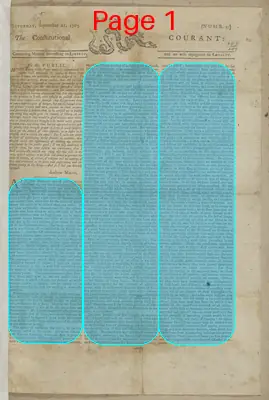
Letter to Editor
September 21, 1765
The Constitutional Courant
Woodbridge, Middlesex County, New Jersey
What is this article about?
This anonymous letter passionately opposes the Stamp Act as a violation of British constitutional rights and colonial liberties, arguing against taxation without representation. It urges Americans to petition the king for redress through united colonial representations and condemns those enforcing the act as traitors to their country.
Clipping
OCR Quality
95%
Excellent
Full Text
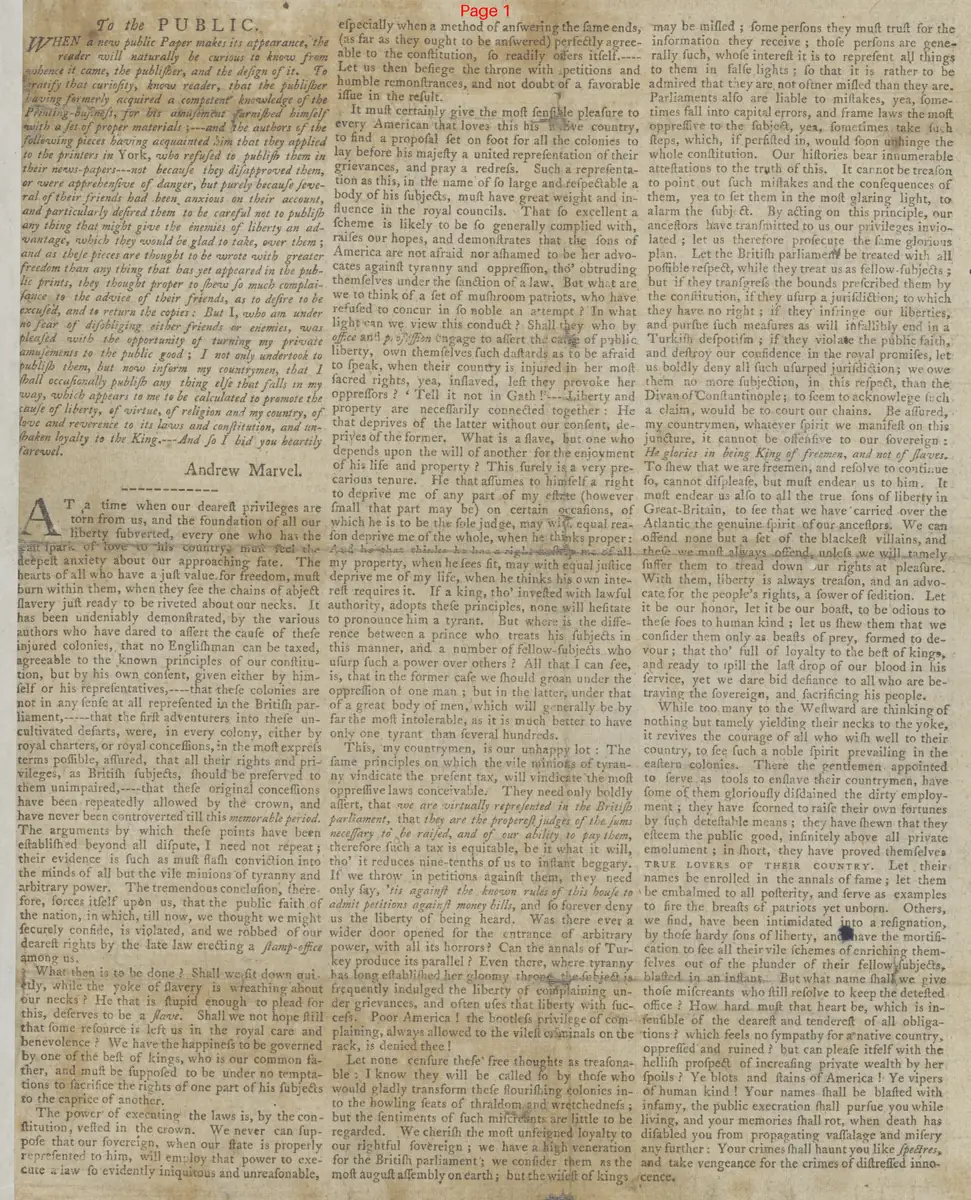
At a time when our dearest privileges are torn from us, and the foundation of all our liberty subverted, every one who has the least spark of love to his country, must feel the deepest anxiety about our approaching fate. The hearts of all who have a just value for freedom, must burn within them, when they see the chains of abject slavery just ready to be riveted about our necks. It has been undeniably demonstrated, by the various authors who have dared to assert the cause of these injured colonies, that no Englishman can be taxed, agreeable to the known principles of our constitution, but by his own consent, given either by himself or his representatives, ---- that these colonies are not in any sense at all represented in the British parliament, ---- that the first adventurers into these uncultivated deserts, were, in every colony, either by royal charters, or royal concessions, in the most express terms possible, assured, that all their rights and privileges, as British subjects, should be preserved to them unimpaired, ---- that these original concessions have been repeatedly allowed by the crown, and have never been controverted till this memorable period. The arguments by which these points have been established beyond all dispute, I need not repeat ; their evidence is such as must flash conviction into the minds of all but the vile minions of tyranny and arbitrary power. The tremendous conclusion, therefore, forces itself upon us, that the public faith of the nation, in which, till now, we thought we might securely confide, is violated, and we robbed of our dearest rights by the late law erecting a stamp-office among us.
What then is to be done ? Shall we sit down quietly, while the yoke of slavery is wreathing about our necks ? He that is stupid enough to plead for this, deserves to be a slave. Shall we not hope till that some resource is left us in the royal care and benevolence ? We have the happiness to be governed by one of the best of kings, who is our common father, and must be supposed to be under no temptation to sacrifice the rights of one part of his subjects to the caprice of another. The power of executing the laws is, by the constitution, vested in the crown. We never can suppose that our sovereign, when our state is properly represented to him, will employ that power to execute a law so evidently iniquitous and unreasonable, especially when a method of answering the same ends, (as far as they ought to be answered) perfectly agreeable to the constitution, so readily offers itself. ---- Let us then besiege the throne with petitions and humble remonstrances, and not doubt of a favorable issue in the result.
It must certainly give the most sensible pleasure to every American that loves this his native country, to find a proposal set on foot for all the colonies to lay before his majesty a united representation of their grievances, and pray a redress. Such a representation as this, in the name of so large and respectable a body of his subjects, must have great weight and influence in the royal councils. That so excellent a scheme is likely to be so generally complied with, raises our hopes, and demonstrates that the sons of America are not afraid nor ashamed to be her advocates against tyranny and oppression, tho' obtruding themselves under the sanction of a law. But what are we to think of a set of mushroom patriots, who have refused to concur in so noble an attempt ? In what light can we view this conduct ? Shall they who by office and profession engage to assert the cause of public liberty, own themselves such dastards as to be afraid to speak, when their country is injured in her most sacred rights, yea, enslaved, lest they provoke her oppressors ? Tell it not in Gath!' --- Liberty and property are necessarily connected together : He that deprives of the latter without our consent, deprives of the former. What is a slave, but one who depends upon the will of another for the enjoyment of his life and property ? This surely is a very precarious tenure. He that assumes to himself a right to deprive me of any part of my estate (however small that part may be) on certain occasions, of which he is to be the sole judge, may with equal reason deprive me of the whole, when he thinks proper: And he that thinks he has a right so to do of all my property, when he sees it, may with equal justice deprive me of my life, when he thinks his own interest requires it. If a king, tho' invested with lawful authority, adopts these principles, none will hesitate to pronounce him a tyrant. But where is the difference between a prince who treats his subjects in this manner, and a number of fellow-subjects who usurp such a power over others ? All that I can see, is, that in the former case we should groan under the oppression of one man ; but in the latter, under that of a great body of men, which will generally be by far the most intolerable, as it is much better to have only one tyrant than several hundreds.
This, my countrymen, is our unhappy lot : The same principles on which the vile minions of tyranny vindicate the present tax, will vindicate the most oppressive laws conceivable. They need only boldly assert, that we are virtually represented in the British parliament, that they are the properest judges of the sums necessary to be raised, and of our ability to pay them, therefore such a tax is equitable, be it what it will, tho' it reduces nine-tenths of us to instant beggary. If we throw in petitions against them, they need only say, 'tis against the known rules of this house to admit petitions against money bills, and so forever deny us the liberty of being heard. Was there ever a wider door opened for the entrance of arbitrary power, with all its horrors? Can the annals of Turkey produce its parallel? Even there, where tyranny has long established her gloomy throne the subject is frequently indulged the liberty of complaining under grievances, and often uses that liberty with success. Poor America! the bootless privilege of complaining, always allowed to the vilest criminals on the rack, is denied thee!
Let none censure these free thoughts as treasonable : I know they will be called so by those who would gladly transform these flourishing colonies into the howling wastes of thraldom and wretchedness ; but the sentiments of such miscreants are little to be regarded. We cherish the most unfeigned loyalty to our rightful sovereign ; we have a high veneration for the British parliament; we consider them as the most august assembly on earth; but the wisest of kings may be misled ; some persons they must trust for the information they receive ; those persons are generally such, whose interest it is to represent all things to them in false lights ; so that it is rather to be admired that they are not oftener misled than they are. Parliaments also are liable to mistakes, yea, sometimes fall into capital errors, and frame laws the most oppressive to the subject, yea, sometimes take such steps, which, if persisted in, would soon unhinge the whole constitution. Our histories bear innumerable attestations to the truth of this. It cannot be treason to point out such mistakes and the consequences of them, yea to set them in the most glaring light, to alarm the subject. By acting on this principle, our ancestors have transmitted to us our privileges inviolated : let us therefore prosecute the same glorious plan. Let the British parliament be treated with all possible respect, while they treat us as fellow-subjects ; but if they transgress the bounds prescribed them by the constitution, if they usurp a jurisdiction to which they have no right ; if they infringe our liberties, and pursue such measures as will infallibly end in a Turkish despotism ; if they violate the public faith, and destroy our confidence in the royal promises, let us boldly deny all such usurped jurisdiction; we owe them no more subjection, in this respect, than the Divan of Constantinople; to seem to acknowledge such a claim, would be to court our chains. Be assured, my countrymen, whatever spirit we manifest on this juncture, it cannot be offensive to our sovereign : He glories in being King of freemen, and not of slaves. To shew that we are freemen, and resolve to continue so, cannot displease, but must endear us to him. It must endear us also to all the true sons of liberty in Great-Britain, to see that we have carried over the Atlantic the genuine spirit of our ancestors. We can offend none but a set of the blackest villains, and these we must always offend, unless we will tamely suffer them to tread down our rights at pleasure. With them, liberty is always treason, and an advocate for the people's rights, a sower of sedition. Let it be our honor, let it be our boast, to be odious to these foes to human kind ; let us shew them that we consider them only as beasts of prey, formed to devour; that tho' full of loyalty to the best of kings, and ready to spill the last drop of our blood in his service, yet we dare bid defiance to all who are betraying the sovereign, and sacrificing his people.
While too many to the Westward are thinking of nothing but tamely yielding their necks to the yoke, it revives the courage of all who wish well to their country, to see such a noble spirit prevailing in the eastern colonies. There the gentlemen appointed to serve as tools to enslave their countrymen, have some of them gloriously disdained the dirty employment ; they have scorned to raise their own fortunes by such detestable means ; they have shewn that they esteem the public good, infinitely above all private emolument; in short, they have proved themselves TRUE LOVERS OF THEIR COUNTRY. Let their names be enrolled in the annals of fame; let them be embalmed to all posterity, and serve as examples to fire the breasts of patriots yet unborn. Others, we find, have been intimidated into a resignation, by those hardy sons of liberty, and have the mortification to see all their vile schemes of enriching themselves out of the plunder of their fellow subjects, blasted in an instant. But what name shall we give those miscreants who still resolve to keep the detested office ? How hard must that heart be, which is insensible of the dearest and tenderest of all obligations ? which feels no sympathy for a native country, oppressed and ruined ? but can please itself with the hellish prospect of increasing private wealth by her spoils ? Ye blots and stains of America ! Ye vipers of human kind ! Your names shall be blasted with infamy, the public execration shall pursue you while living, and your memories shall rot, when death has disabled you from propagating vassalage and misery any further: Your crimes shall haunt you like spectres, and take vengeance for the crimes of distressed innocence.
What then is to be done ? Shall we sit down quietly, while the yoke of slavery is wreathing about our necks ? He that is stupid enough to plead for this, deserves to be a slave. Shall we not hope till that some resource is left us in the royal care and benevolence ? We have the happiness to be governed by one of the best of kings, who is our common father, and must be supposed to be under no temptation to sacrifice the rights of one part of his subjects to the caprice of another. The power of executing the laws is, by the constitution, vested in the crown. We never can suppose that our sovereign, when our state is properly represented to him, will employ that power to execute a law so evidently iniquitous and unreasonable, especially when a method of answering the same ends, (as far as they ought to be answered) perfectly agreeable to the constitution, so readily offers itself. ---- Let us then besiege the throne with petitions and humble remonstrances, and not doubt of a favorable issue in the result.
It must certainly give the most sensible pleasure to every American that loves this his native country, to find a proposal set on foot for all the colonies to lay before his majesty a united representation of their grievances, and pray a redress. Such a representation as this, in the name of so large and respectable a body of his subjects, must have great weight and influence in the royal councils. That so excellent a scheme is likely to be so generally complied with, raises our hopes, and demonstrates that the sons of America are not afraid nor ashamed to be her advocates against tyranny and oppression, tho' obtruding themselves under the sanction of a law. But what are we to think of a set of mushroom patriots, who have refused to concur in so noble an attempt ? In what light can we view this conduct ? Shall they who by office and profession engage to assert the cause of public liberty, own themselves such dastards as to be afraid to speak, when their country is injured in her most sacred rights, yea, enslaved, lest they provoke her oppressors ? Tell it not in Gath!' --- Liberty and property are necessarily connected together : He that deprives of the latter without our consent, deprives of the former. What is a slave, but one who depends upon the will of another for the enjoyment of his life and property ? This surely is a very precarious tenure. He that assumes to himself a right to deprive me of any part of my estate (however small that part may be) on certain occasions, of which he is to be the sole judge, may with equal reason deprive me of the whole, when he thinks proper: And he that thinks he has a right so to do of all my property, when he sees it, may with equal justice deprive me of my life, when he thinks his own interest requires it. If a king, tho' invested with lawful authority, adopts these principles, none will hesitate to pronounce him a tyrant. But where is the difference between a prince who treats his subjects in this manner, and a number of fellow-subjects who usurp such a power over others ? All that I can see, is, that in the former case we should groan under the oppression of one man ; but in the latter, under that of a great body of men, which will generally be by far the most intolerable, as it is much better to have only one tyrant than several hundreds.
This, my countrymen, is our unhappy lot : The same principles on which the vile minions of tyranny vindicate the present tax, will vindicate the most oppressive laws conceivable. They need only boldly assert, that we are virtually represented in the British parliament, that they are the properest judges of the sums necessary to be raised, and of our ability to pay them, therefore such a tax is equitable, be it what it will, tho' it reduces nine-tenths of us to instant beggary. If we throw in petitions against them, they need only say, 'tis against the known rules of this house to admit petitions against money bills, and so forever deny us the liberty of being heard. Was there ever a wider door opened for the entrance of arbitrary power, with all its horrors? Can the annals of Turkey produce its parallel? Even there, where tyranny has long established her gloomy throne the subject is frequently indulged the liberty of complaining under grievances, and often uses that liberty with success. Poor America! the bootless privilege of complaining, always allowed to the vilest criminals on the rack, is denied thee!
Let none censure these free thoughts as treasonable : I know they will be called so by those who would gladly transform these flourishing colonies into the howling wastes of thraldom and wretchedness ; but the sentiments of such miscreants are little to be regarded. We cherish the most unfeigned loyalty to our rightful sovereign ; we have a high veneration for the British parliament; we consider them as the most august assembly on earth; but the wisest of kings may be misled ; some persons they must trust for the information they receive ; those persons are generally such, whose interest it is to represent all things to them in false lights ; so that it is rather to be admired that they are not oftener misled than they are. Parliaments also are liable to mistakes, yea, sometimes fall into capital errors, and frame laws the most oppressive to the subject, yea, sometimes take such steps, which, if persisted in, would soon unhinge the whole constitution. Our histories bear innumerable attestations to the truth of this. It cannot be treason to point out such mistakes and the consequences of them, yea to set them in the most glaring light, to alarm the subject. By acting on this principle, our ancestors have transmitted to us our privileges inviolated : let us therefore prosecute the same glorious plan. Let the British parliament be treated with all possible respect, while they treat us as fellow-subjects ; but if they transgress the bounds prescribed them by the constitution, if they usurp a jurisdiction to which they have no right ; if they infringe our liberties, and pursue such measures as will infallibly end in a Turkish despotism ; if they violate the public faith, and destroy our confidence in the royal promises, let us boldly deny all such usurped jurisdiction; we owe them no more subjection, in this respect, than the Divan of Constantinople; to seem to acknowledge such a claim, would be to court our chains. Be assured, my countrymen, whatever spirit we manifest on this juncture, it cannot be offensive to our sovereign : He glories in being King of freemen, and not of slaves. To shew that we are freemen, and resolve to continue so, cannot displease, but must endear us to him. It must endear us also to all the true sons of liberty in Great-Britain, to see that we have carried over the Atlantic the genuine spirit of our ancestors. We can offend none but a set of the blackest villains, and these we must always offend, unless we will tamely suffer them to tread down our rights at pleasure. With them, liberty is always treason, and an advocate for the people's rights, a sower of sedition. Let it be our honor, let it be our boast, to be odious to these foes to human kind ; let us shew them that we consider them only as beasts of prey, formed to devour; that tho' full of loyalty to the best of kings, and ready to spill the last drop of our blood in his service, yet we dare bid defiance to all who are betraying the sovereign, and sacrificing his people.
While too many to the Westward are thinking of nothing but tamely yielding their necks to the yoke, it revives the courage of all who wish well to their country, to see such a noble spirit prevailing in the eastern colonies. There the gentlemen appointed to serve as tools to enslave their countrymen, have some of them gloriously disdained the dirty employment ; they have scorned to raise their own fortunes by such detestable means ; they have shewn that they esteem the public good, infinitely above all private emolument; in short, they have proved themselves TRUE LOVERS OF THEIR COUNTRY. Let their names be enrolled in the annals of fame; let them be embalmed to all posterity, and serve as examples to fire the breasts of patriots yet unborn. Others, we find, have been intimidated into a resignation, by those hardy sons of liberty, and have the mortification to see all their vile schemes of enriching themselves out of the plunder of their fellow subjects, blasted in an instant. But what name shall we give those miscreants who still resolve to keep the detested office ? How hard must that heart be, which is insensible of the dearest and tenderest of all obligations ? which feels no sympathy for a native country, oppressed and ruined ? but can please itself with the hellish prospect of increasing private wealth by her spoils ? Ye blots and stains of America ! Ye vipers of human kind ! Your names shall be blasted with infamy, the public execration shall pursue you while living, and your memories shall rot, when death has disabled you from propagating vassalage and misery any further: Your crimes shall haunt you like spectres, and take vengeance for the crimes of distressed innocence.
What sub-type of article is it?
Persuasive
Political
Provocative
What themes does it cover?
Constitutional Rights
Taxation
Politics
What keywords are associated?
Stamp Act
Taxation Without Representation
Colonial Liberties
Petitions To King
United Representation
British Constitution
Royal Benevolence
What entities or persons were involved?
The Printer
Letter to Editor Details
Recipient
The Printer
Main Argument
the stamp act violates colonial rights by imposing taxation without representation, contrary to british constitutional principles and royal assurances; colonists should petition the king through united representations for redress and resist enforcement.
Notable Details
References To Royal Charters And Concessions Preserving British Rights
Urges Petitions And Remonstrances To The Throne
Condemns Stamp Office Enforcers As Traitors
Compares British Parliament's Actions To Turkish Despotism