Thank you for visiting SNEWPapers!
Sign up free
Story
November 30, 1827
Richmond Enquirer
Richmond, Richmond County, Virginia
What is this article about?
A farmer in Amelia reports on neighbor Mr. P.'s method of cultivating 60 acres of old corn land to yield at least 5 barrels per acre with minimal work, no hand-hoeing, and specific plowing and harrowing techniques, dated October 17, 1827.
Clipping
OCR Quality
95%
Excellent
Full Text
COMMUNICATIONS:
FOR
THE ENQUIRER.
TO MAKE MORE CORN WITH LESS WORK.
My neighbor, Mr. P. has cultivated this year about sixty acres of land in corn. The land was originally good, but is now old, having been cultivated at least sixty years or more: parts of it have been occasionally manured; parts not at all.
From a view of the crop a few days ago, it is estimated it will average at least five barrels to the acre. The following is his mode of cultivation:
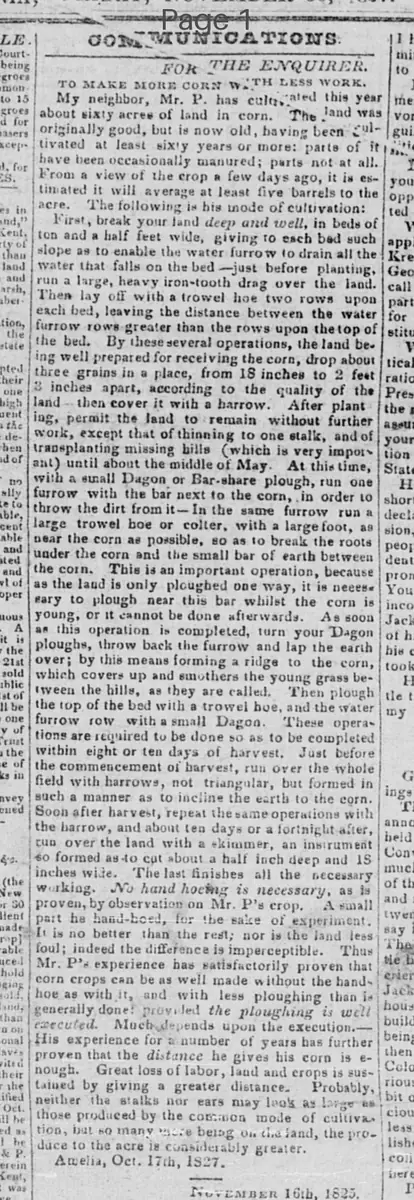
First, break your land deep and well, in beds of ten and a half feet wide, giving to each bed such slope as to enable the water furrow to drain all the water that falls on the bed—just before planting, run a large, heavy iron-tooth drag over the land. Then lay off with a trowel hoe two rows upon each bed, leaving the distance between the water furrow rows greater than the rows upon the top of the bed. By these several operations, the land being well prepared for receiving the corn, drop about three grains in a place, from 18 inches to 2 feet 3 inches apart, according to the quality of the land—then cover it with a harrow. After planting, permit the land to remain without further work, except that of thinning to one stalk, and of transplanting missing hills (which is very important until about the middle of May. At this time, with a small Dragon or Bar-share plough, run one furrow with the bar next to the corn, in order to throw the dirt from it—In the same furrow run a large trowel hoe or colter, with a large foot, as near the corn as possible, so as to break the roots under the corn and the small bar of earth between the corn. This is an important operation, because as the land is only ploughed one way, it is necessary to plough near this bar whilst the corn is young, or it cannot be done afterwards. As soon as this operation is completed, turn your Dragon ploughs, throw back the furrow and lap the earth over; by this means forming a ridge to the corn, which covers up and smothers the young grass between the hills, as they are called. Then plough the top of the bed with a trowel hoe, and the water furrow row with a small Dragon. These operations are required to be done so as to be completed within eight or ten days of harvest. Just before the commencement of harvest, run over the whole field with harrows, not triangular, but formed in such a manner as to incline the earth to the corn. Soon after harvest, repeat the same operations with the harrow, and about ten days or a fortnight after, run over the land with a skimmer, an instrument so formed as to cut about a half inch deep and 18 inches wide. The last finishes all the necessary working. No hand-hoeing is necessary, as is proven, by observation on Mr. P's crop. A small part he hand-hoed, for the sake of experiment. It is no better than the rest; nor is the land less foul; indeed the difference is imperceptible. Thus Mr. P.'s experience has satisfactorily proven that corn crops can be as well made without the hand-hoe as with it, and with less ploughing than is generally done: provided the ploughing is well executed. Much depends upon the execution.— His experience for a number of years has further proven that the distance he gives his corn is enough. Great loss of labor, land and crops is sustained by giving a greater distance. Probably, neither the stalks nor ears may look as large as those produced by the common mode of cultivation, but so many are being on the land, the produce to the acre is considerably greater.
Amelia, Oct. 17th, 1827.
FOR
THE ENQUIRER.
TO MAKE MORE CORN WITH LESS WORK.
My neighbor, Mr. P. has cultivated this year about sixty acres of land in corn. The land was originally good, but is now old, having been cultivated at least sixty years or more: parts of it have been occasionally manured; parts not at all.
From a view of the crop a few days ago, it is estimated it will average at least five barrels to the acre. The following is his mode of cultivation:
First, break your land deep and well, in beds of ten and a half feet wide, giving to each bed such slope as to enable the water furrow to drain all the water that falls on the bed—just before planting, run a large, heavy iron-tooth drag over the land. Then lay off with a trowel hoe two rows upon each bed, leaving the distance between the water furrow rows greater than the rows upon the top of the bed. By these several operations, the land being well prepared for receiving the corn, drop about three grains in a place, from 18 inches to 2 feet 3 inches apart, according to the quality of the land—then cover it with a harrow. After planting, permit the land to remain without further work, except that of thinning to one stalk, and of transplanting missing hills (which is very important until about the middle of May. At this time, with a small Dragon or Bar-share plough, run one furrow with the bar next to the corn, in order to throw the dirt from it—In the same furrow run a large trowel hoe or colter, with a large foot, as near the corn as possible, so as to break the roots under the corn and the small bar of earth between the corn. This is an important operation, because as the land is only ploughed one way, it is necessary to plough near this bar whilst the corn is young, or it cannot be done afterwards. As soon as this operation is completed, turn your Dragon ploughs, throw back the furrow and lap the earth over; by this means forming a ridge to the corn, which covers up and smothers the young grass between the hills, as they are called. Then plough the top of the bed with a trowel hoe, and the water furrow row with a small Dragon. These operations are required to be done so as to be completed within eight or ten days of harvest. Just before the commencement of harvest, run over the whole field with harrows, not triangular, but formed in such a manner as to incline the earth to the corn. Soon after harvest, repeat the same operations with the harrow, and about ten days or a fortnight after, run over the land with a skimmer, an instrument so formed as to cut about a half inch deep and 18 inches wide. The last finishes all the necessary working. No hand-hoeing is necessary, as is proven, by observation on Mr. P's crop. A small part he hand-hoed, for the sake of experiment. It is no better than the rest; nor is the land less foul; indeed the difference is imperceptible. Thus Mr. P.'s experience has satisfactorily proven that corn crops can be as well made without the hand-hoe as with it, and with less ploughing than is generally done: provided the ploughing is well executed. Much depends upon the execution.— His experience for a number of years has further proven that the distance he gives his corn is enough. Great loss of labor, land and crops is sustained by giving a greater distance. Probably, neither the stalks nor ears may look as large as those produced by the common mode of cultivation, but so many are being on the land, the produce to the acre is considerably greater.
Amelia, Oct. 17th, 1827.
What sub-type of article is it?
Agricultural Guide
Farming Method
What keywords are associated?
Corn Cultivation
Farming Method
High Yield
Ploughing
Harrowing
No Hand Hoeing
Amelia
1827
What entities or persons were involved?
Mr. P.
Where did it happen?
Amelia
Story Details
Key Persons
Mr. P.
Location
Amelia
Event Date
1827
Story Details
Neighbor Mr. P. cultivates 60 acres of old corn land using deep breaking, specific bed formation, planting at close distances, minimal plowing with Dragon ploughs and harrows, no hand-hoeing, achieving high yields of at least 5 barrels per acre with less work than usual.