Thank you for visiting SNEWPapers!
Sign up free
The New Hampshire Gazette
Portsmouth, Rockingham County, New Hampshire
What is this article about?
Historical reflection on British kings: James I and Charles I as Scotchmen; Charles II's coin inscription claiming to be the first English king; the 150-year-old Union treaty abolishing distinctions, making all Britons; current Majesty as first Briton king.
Clipping
OCR Quality
Full Text
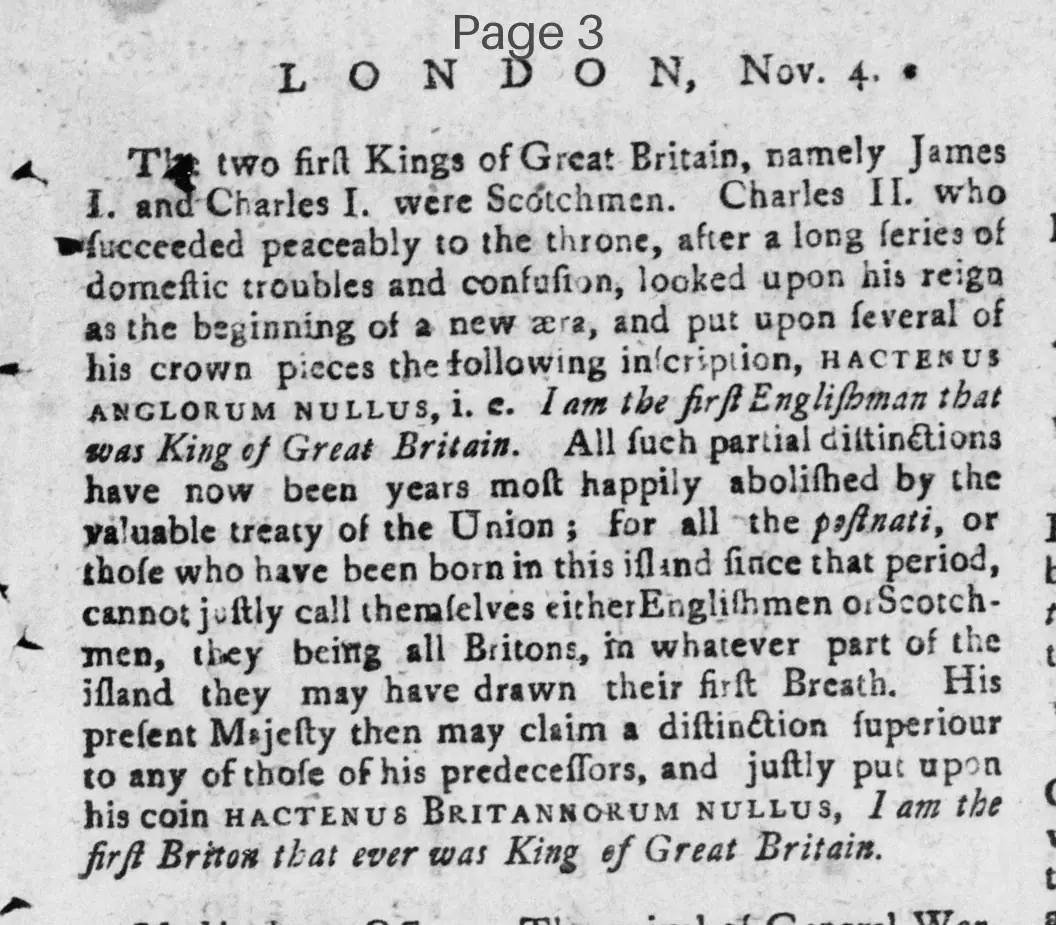
The two first Kings of Great Britain, namely James I. and Charles I. were Scotchmen. Charles II. who succeeded peaceably to the throne, after a long series of domestic troubles and confusion, looked upon his reign as the beginning of a new æra, and put upon several of his crown pieces the following inscription, Hactenus Anglorum Nullus, i. e. I am the first Englishman that was King of Great Britain. All such partial distinctions have now been 150 years most happily abolished by the valuable treaty of the Union; for all the natives, or those who have been born in this island since that period, cannot justly call themselves either Englishmen or Scotchmen, they being all Britons, in whatever part of the island they may have drawn their first Breath. His present Majesty then may claim a distinction superior to any of those of his predecessors, and justly put upon his coin Hactenus Britannorum Nullus, I am the first Briton that ever was King of Great Britain.
What sub-type of article is it?
What keywords are associated?
What entities or persons were involved?
Where did it happen?
Foreign News Details
Primary Location
Great Britain
Key Persons
Outcome
all partial distinctions abolished by the union treaty 150 years ago; natives now all britons.
Event Details
The two first Kings of Great Britain, James I. and Charles I., were Scotchmen. Charles II., succeeding after domestic troubles, inscribed his crown pieces 'Hactenus Anglorum Nullus' meaning 'I am the first Englishman that was King of Great Britain.' The Union treaty 150 years ago abolished such distinctions, making all island-born natives Britons. His present Majesty may claim to be the first Briton king, inscribing 'Hactenus Britannorum Nullus.'