Thank you for visiting SNEWPapers!
Sign up free
Editorial
October 5, 1954
Atlanta Daily World
Atlanta, Fulton County, Georgia
What is this article about?
The editorial analyzes the inconclusive Maine election, where a Republican senator won but the governor lost, advising both parties to campaign intensely for midterms. It details close Senate and House races and highlights Eisenhower's sustained popularity versus Truman's decline.
Clipping
OCR Quality
98%
Excellent
Full Text
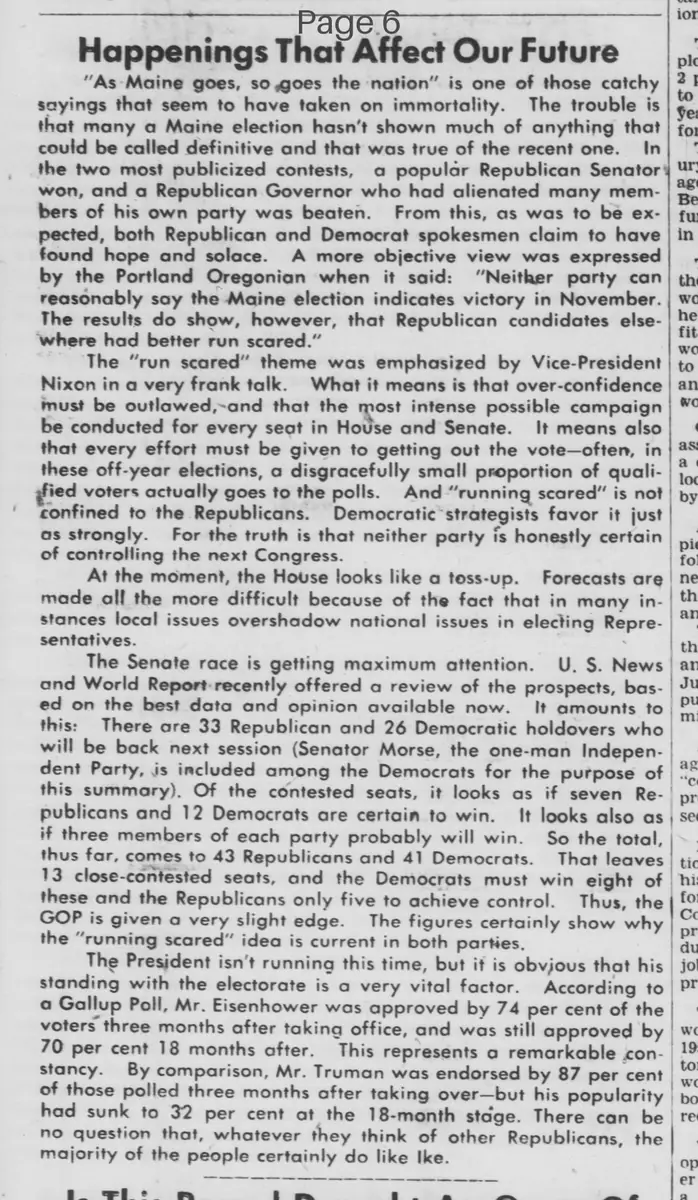
Happenings That Affect Our Future
"As Maine goes, so goes the nation" is one of those catchy sayings that seem to have taken on immortality. The trouble is that many a Maine election hasn't shown much of anything that could be called definitive and that was true of the recent one. In the two most publicized contests, a popular Republican Senator won, and a Republican Governor who had alienated many members of his own party was beaten. From this, as was to be expected, both Republican and Democrat spokesmen claim to have found hope and solace. A more objective view was expressed by the Portland Oregonian when it said: "Neither party can reasonably say the Maine election indicates victory in November. The results do show, however, that Republican candidates elsewhere had better run scared."
The "run scared" theme was emphasized by Vice-President Nixon in a very frank talk. What it means is that over-confidence must be outlawed, and that the most intense possible campaign be conducted for every seat in House and Senate. It means also that every effort must be given to getting out the vote-often, in these off-year elections, a disgracefully small proportion of qualified voters actually goes to the polls. And "running scared" is not confined to the Republicans. Democratic strategists favor it just as strongly. For the truth is that neither party is honestly certain of controlling the next Congress.
At the moment, the House looks like a toss-up. Forecasts are made all the more difficult because of the fact that in many instances local issues overshadow national issues in electing Representatives.
The Senate race is getting maximum attention. U. S. News and World Report recently offered a review of the prospects, based on the best data and opinion available now. It amounts to this: There are 33 Republican and 26 Democratic holdovers who will be back next session (Senator Morse, the one-man Independent Party, is included among the Democrats for the purpose of this summary). Of the contested seats, it looks as if seven Republicans and 12 Democrats are certain to win. It looks also as if three members of each party probably will win. So the total, thus far, comes to 43 Republicans and 41 Democrats. That leaves 13 close-contested seats, and the Democrats must win eight of these and the Republicans only five to achieve control. Thus, the GOP is given a very slight edge. The figures certainly show why the "running scared" idea is current in both parties.
The President isn't running this time, but it is obvious that his standing with the electorate is a very vital factor. According to a Gallup Poll, Mr. Eisenhower was approved by 74 per cent of the voters three months after taking office, and was still approved by 70 per cent 18 months after. This represents a remarkable constancy. By comparison, Mr. Truman was endorsed by 87 per cent of those polled three months after taking over—but his popularity had sunk to 32 per cent at the 18-month stage. There can be no question that, whatever they think of other Republicans, the majority of the people certainly do like Ike.
"As Maine goes, so goes the nation" is one of those catchy sayings that seem to have taken on immortality. The trouble is that many a Maine election hasn't shown much of anything that could be called definitive and that was true of the recent one. In the two most publicized contests, a popular Republican Senator won, and a Republican Governor who had alienated many members of his own party was beaten. From this, as was to be expected, both Republican and Democrat spokesmen claim to have found hope and solace. A more objective view was expressed by the Portland Oregonian when it said: "Neither party can reasonably say the Maine election indicates victory in November. The results do show, however, that Republican candidates elsewhere had better run scared."
The "run scared" theme was emphasized by Vice-President Nixon in a very frank talk. What it means is that over-confidence must be outlawed, and that the most intense possible campaign be conducted for every seat in House and Senate. It means also that every effort must be given to getting out the vote-often, in these off-year elections, a disgracefully small proportion of qualified voters actually goes to the polls. And "running scared" is not confined to the Republicans. Democratic strategists favor it just as strongly. For the truth is that neither party is honestly certain of controlling the next Congress.
At the moment, the House looks like a toss-up. Forecasts are made all the more difficult because of the fact that in many instances local issues overshadow national issues in electing Representatives.
The Senate race is getting maximum attention. U. S. News and World Report recently offered a review of the prospects, based on the best data and opinion available now. It amounts to this: There are 33 Republican and 26 Democratic holdovers who will be back next session (Senator Morse, the one-man Independent Party, is included among the Democrats for the purpose of this summary). Of the contested seats, it looks as if seven Republicans and 12 Democrats are certain to win. It looks also as if three members of each party probably will win. So the total, thus far, comes to 43 Republicans and 41 Democrats. That leaves 13 close-contested seats, and the Democrats must win eight of these and the Republicans only five to achieve control. Thus, the GOP is given a very slight edge. The figures certainly show why the "running scared" idea is current in both parties.
The President isn't running this time, but it is obvious that his standing with the electorate is a very vital factor. According to a Gallup Poll, Mr. Eisenhower was approved by 74 per cent of the voters three months after taking office, and was still approved by 70 per cent 18 months after. This represents a remarkable constancy. By comparison, Mr. Truman was endorsed by 87 per cent of those polled three months after taking over—but his popularity had sunk to 32 per cent at the 18-month stage. There can be no question that, whatever they think of other Republicans, the majority of the people certainly do like Ike.
What sub-type of article is it?
Partisan Politics
What keywords are associated?
Maine Election
Midterm Elections
Congressional Prospects
Party Control
Eisenhower Popularity
Run Scared Campaign
What entities or persons were involved?
Maine Election
Republican Senator
Republican Governor
Vice President Nixon
Portland Oregonian
U. S. News And World Report
Senator Morse
President Eisenhower
Gallup Poll
Mr. Truman
Editorial Details
Primary Topic
Analysis Of Maine Election Implications For Midterm Congressional Races
Stance / Tone
Objective Analysis Urging Vigilance
Key Figures
Maine Election
Republican Senator
Republican Governor
Vice President Nixon
Portland Oregonian
U. S. News And World Report
Senator Morse
President Eisenhower
Gallup Poll
Mr. Truman
Key Arguments
Maine Election Results Are Ambiguous And Not Definitive For National Trends
Both Parties Claim Hope From Maine But Should Run Scared
Intense Campaigning Needed For Every Seat And To Boost Voter Turnout
House Control Is A Toss Up Due To Local Issues
Senate Race Is Close With Gop Slight Edge; 13 Contested Seats Decisive
Eisenhower Maintains High Approval Ratings Unlike Truman