Thank you for visiting SNEWPapers!
Sign up free
Alexandria Daily Gazette, Commercial & Political
Alexandria, Virginia
What is this article about?
In Letter III from the Virginia Gazette, 'A.B.' addresses Wilson G. Nicholas, defending U.S. moderation in Anglo-American relations, criticizing rejection of the Monroe-Pinckney treaty despite concessions, and refuting claims of British aggression amid French trade interdictions. (214 characters)
Clipping
OCR Quality
Full Text
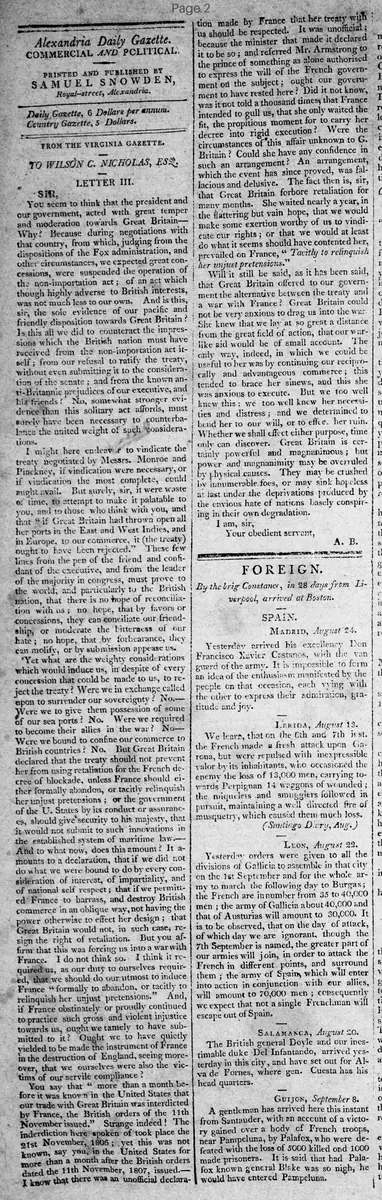
TO WILSON G. NICHOLAS, ESQ.
LETTER III.
SIR,
You seem to think that the president and our government, acted with great temper and moderation towards Great Britain— Why? Because during negotiations with that country, from which, judging from the dispositions of the Fox administration, and other circumstances, we expected great concessions, were suspended the operation of the non-importation act; of an act which though highly adverse to British interests, was not much less to our own. And is this, sir, the sole evidence of our pacific and friendly disposition towards Great Britain? Is this all we did to counteract the impressions which the British nation must have received from the non-importation act itself; from our refusal to ratify the treaty, without even submitting it to the consideration of the senate; and from the known anti-Britannic prejudices of our executive, and his friends? No, somewhat stronger evidence than this solitary act affords, must surely have been necessary to counterbalance the united weight of such considerations.
I might here endeavour to vindicate the treaty negotiated by Messrs. Monroe and Pinckney, if vindication were necessary, or if vindication the most complete, could avail. But surely, sir, it were waste of time, to attempt to make it palatable to you, and to those who think with you, and that "if Great Britain had thrown open all her ports in the East and West Indies, and in Europe, to our commerce, it (the treaty) ought to have been rejected." These few lines from the pen of the friend and confidant of the executive, and from the leader of the majority in congress, must prove to the world, and particularly to the British nation, that there is no hope of reconciliation with us; no hope, that by favors or concessions, they can conciliate our friendship, or moderate the bitterness of our hate; no hope, that by forbearance, they can mollify, or by submission appease us.
Yet what are the weighty considerations which would induce us, in despite of every concession that could be made to us, to reject the treaty? Were we in exchange called upon to surrender our sovereignty? No.— Were we to give them possession of some of our sea ports? No. Were we required to become their allies in the war? No— Were we bound to confine our commerce to British countries? No. But Great Britain declared that the treaty should not prevent her from using retaliation for the French decree of blockade, unless France should either formally abandon, or tacitly relinquish her unjust pretensions; or the government of the U. States by its conduct or assurances, should give security to his majesty, that it would not submit to such innovations in the established system of maritime law.— And to what now, does this amount? It amounts to a declaration, that if we did not do what we were bound to do by every consideration of interest, of impartiality, and of national self respect; that if we permitted France to harass, and destroy British commerce in an oblique way, not having the power otherwise to effect her design; that Great Britain would not, in such case, resign the right of retaliation. But you affirm that this was forcing us into a war with France. I do not think so. I think it required us, as our duty to ourselves required, that we should do our utmost to induce France "formally to abandon, or tacitly to relinquish her unjust pretensions." And, if France obstinately or proudly continued to practice such gross and violent injustice towards us, ought we tamely to have submitted to it? Ought we to have quietly yielded to be made the instrument of France in the destruction of England, seeing moreover, that we ourselves were also the victims of our servile compliance?
You say that "more than a month before it was known in the United States that our trade with Great Britain was interdicted by France, the British orders of the 11th November issued." Strange indeed! The interdiction here spoken of took place the 21st November, 1806; yet this was not known, say you, in the United States for more than a month after the British orders dated the 11th November, 1807, issued.— I know that there was an unofficial declaration made by France that her treaty with us should be respected. It was unofficial; because the minister that made it declared it to be so; and referred Mr. Armstrong to the prince of something as alone authorised to express the will of the French government to have rested here? Did it not know, was it not told a thousand times, that France intended to gull us, that she only waited the fit, the propitious moment for to carry her decree into rigid execution? Were the circumstances of this affair unknown to G. Britain? Could she have any confidence in such an arrangement? An arrangement, which the event has since proved, was fallacious and delusive. The fact then is, sir, that Great Britain forbore retaliation for many months. She waited nearly a year, in the flattering but vain hope, that we would make some exertion worthy of us to vindicate our rights; or that we would at least do what it seems should have contented her. prevailed on France, "Tacitly to relinquish her unjust pretensions."
Will it still be said, as it has been said, that Great Britain offered to our government the alternative between the treaty and a war with France? Great Britain could not be very anxious to drag us into the war. She knew that we lay at so great a distance from the great field of action, that our warlike aid would be of small account. The only way, indeed, in which we could be useful to her was by continuing our reciprocally and advantageous commerce; this tended to brace her sinews, and this she was anxious to secure. But we too well knew this: we too well knew her necessities and distress; and we determined to bend her to our will, or to effect her ruin. Whether we shall effect either purpose, time only can discover. Great Britain is certainly powerful and magnanimous; but power and magnanimity may be overruled by physical causes. They may be crushed by innumerable foes, or may sink hopeless at last under the deprivations produced by the envious hate of nations basely conspiring in their own degradation.
I am, sir,
Your obedient servant,
A. B.
What sub-type of article is it?
What themes does it cover?
What keywords are associated?
What entities or persons were involved?
Letter to Editor Details
Author
A. B.
Recipient
Wilson G. Nicholas, Esq.
Main Argument
the writer defends the u.s. government's temperate actions toward britain, including suspending the non-importation act during negotiations, and argues that rejecting the monroe-pinckney treaty despite british concessions demonstrates irreconcilable american hostility; counters claims that british orders forced war with france, asserting britain forbore retaliation in hopes of u.s. efforts against french pretensions.
Notable Details