Thank you for visiting SNEWPapers!
Sign up free
Editorial
November 22, 1799
Gazette Of The United States, & Philadelphia Daily Advertiser
Philadelphia, Philadelphia County, Pennsylvania
What is this article about?
Editorial reflections on attacks against Mr. Fenno, lamenting French Revolution's damage to liberty via licentious press, warning Americans to resist threats to press freedom, and defending the Sedition Act's distinctions between free and seditious writings.
Clipping
OCR Quality
95%
Excellent
Full Text
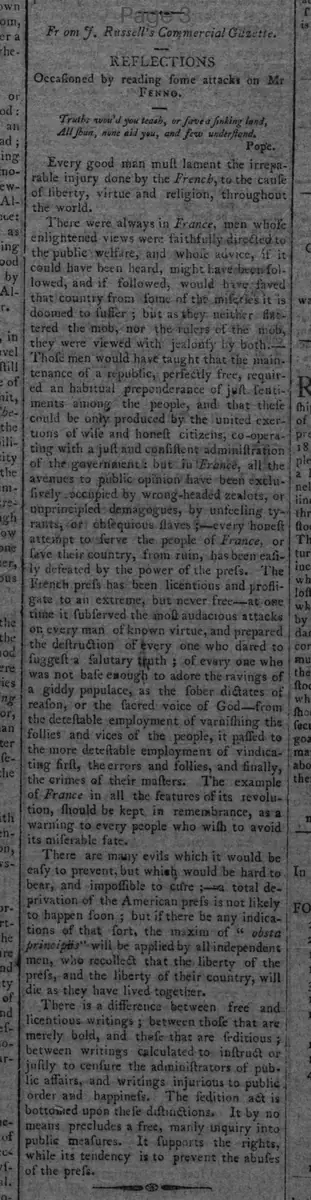
From F. Russell's Commercial Gazette.
REFLECTIONS Occasioned by reading some attacks on Mr Fenno.
Truths rous'd you teach, or save a sinking land,
All hate, none aid you, and few understand.
Pope.
Every good man must lament the irreparable injury done by the French, to the cause of liberty, virtue and religion, throughout the world. There were always in France, men whose enlightened views were faithfully directed to the public welfare, and whose advice, if it could have been heard, might have been followed, and if followed, would have saved that country from some of the miseries it is doomed to suffer; but as they neither flattered the mob, nor the rulers of the mob, they were viewed with jealousy by both. Those men would have taught that the maintenance of a republic, perfectly free, required an habitual preponderance of just sentiments among the people, and that these could be only produced by the united exertions of wise and honest citizens, co-operating with a just and consistent administration of the government: but in France, all the avenues to public opinion have been exclusively occupied by wrong-headed zealots, or unprincipled demagogues, by unfeeling tyrants, or obsequious slaves; every honest attempt to serve the people of France, or save their country, from ruin, has been easily defeated by the power of the press. The French press has been licentious and profligate to an extreme, but never free--at some time it sub served the most audacious attacks on every man of known virtue, and prepared the destruction of every one who dared to suggest a salutary truth; of every one who was not base enough to adore the ravings of a giddy populace, as the sober dictates of reason, or the sacred voice of God--from the detestable employment of varnishing the follies and vices of the people, it passed to the more detestable employment of vindicating first, the errors and follies, and finally, the crimes of their masters. The example of France in all the features of its revolution, should be kept in remembrance, as a warning to every people who wish to avoid its miserable fate.
There are many evils which it would be easy to prevent, but which would be hard to bear, and impossible to cure;--a total deprivation of the American press is not likely to happen soon; but if there be any indications of that sort, the maxim of "obsta principüs" will be applied by all independent men, who recollect that the liberty of the press, and the liberty of their country, will die as they have lived together.
There is a difference between free and licentious writings; between those that are merely bold, and those that are seditious; between writings calculated to instruct or justly to censure the administrators of public affairs, and writings injurious to public order and happiness. The sedition act is bottomed upon these distinctions. It by no means precludes a free, manly inquiry into public measures. It supports the rights, while its tendency is to prevent the abuses of the press.
REFLECTIONS Occasioned by reading some attacks on Mr Fenno.
Truths rous'd you teach, or save a sinking land,
All hate, none aid you, and few understand.
Pope.
Every good man must lament the irreparable injury done by the French, to the cause of liberty, virtue and religion, throughout the world. There were always in France, men whose enlightened views were faithfully directed to the public welfare, and whose advice, if it could have been heard, might have been followed, and if followed, would have saved that country from some of the miseries it is doomed to suffer; but as they neither flattered the mob, nor the rulers of the mob, they were viewed with jealousy by both. Those men would have taught that the maintenance of a republic, perfectly free, required an habitual preponderance of just sentiments among the people, and that these could be only produced by the united exertions of wise and honest citizens, co-operating with a just and consistent administration of the government: but in France, all the avenues to public opinion have been exclusively occupied by wrong-headed zealots, or unprincipled demagogues, by unfeeling tyrants, or obsequious slaves; every honest attempt to serve the people of France, or save their country, from ruin, has been easily defeated by the power of the press. The French press has been licentious and profligate to an extreme, but never free--at some time it sub served the most audacious attacks on every man of known virtue, and prepared the destruction of every one who dared to suggest a salutary truth; of every one who was not base enough to adore the ravings of a giddy populace, as the sober dictates of reason, or the sacred voice of God--from the detestable employment of varnishing the follies and vices of the people, it passed to the more detestable employment of vindicating first, the errors and follies, and finally, the crimes of their masters. The example of France in all the features of its revolution, should be kept in remembrance, as a warning to every people who wish to avoid its miserable fate.
There are many evils which it would be easy to prevent, but which would be hard to bear, and impossible to cure;--a total deprivation of the American press is not likely to happen soon; but if there be any indications of that sort, the maxim of "obsta principüs" will be applied by all independent men, who recollect that the liberty of the press, and the liberty of their country, will die as they have lived together.
There is a difference between free and licentious writings; between those that are merely bold, and those that are seditious; between writings calculated to instruct or justly to censure the administrators of public affairs, and writings injurious to public order and happiness. The sedition act is bottomed upon these distinctions. It by no means precludes a free, manly inquiry into public measures. It supports the rights, while its tendency is to prevent the abuses of the press.
What sub-type of article is it?
Press Freedom
Moral Or Religious
Foreign Affairs
What keywords are associated?
Press Freedom
French Revolution
Sedition Act
Licentious Press
American Liberty
Mr Fenno
What entities or persons were involved?
Mr Fenno
French
Pope
Editorial Details
Primary Topic
Reflections On Attacks On Mr Fenno And Lessons From French Revolution For American Press Liberty
Stance / Tone
Defensive Of Principled Press Freedom, Warning Against Licentiousness, Supportive Of Sedition Act
Key Figures
Mr Fenno
French
Pope
Key Arguments
French Revolution Harmed Liberty, Virtue, And Religion Worldwide
Honest French Voices Were Silenced By Mob And Rulers
French Press Was Licentious, Not Free, Attacking Virtue And Enabling Tyranny
France's Revolution Warns Against Similar Press Abuses
Resist Early Threats To American Press Liberty
Distinction Exists Between Free Writings And Seditious Ones
Sedition Act Prevents Press Abuses While Supporting Rights