Thank you for visiting SNEWPapers!
Sign up free
Keowee Courier
Walhalla, Pickens, Oconee County, Pickens County, South Carolina
What is this article about?
In July-August 1878, U.S. officials discussed compromising South Carolina internal revenue cases to avoid federal-state conflict. Commissioner Raum instructed agents on peaceful enforcement of distilling laws and assured leniency for surrendering illicit distillers.
Merged-components note: These components form a continued article on internal revenue enforcement, including Commissioner Raum's instructions and assurances to distillers.
Clipping
OCR Quality
Full Text
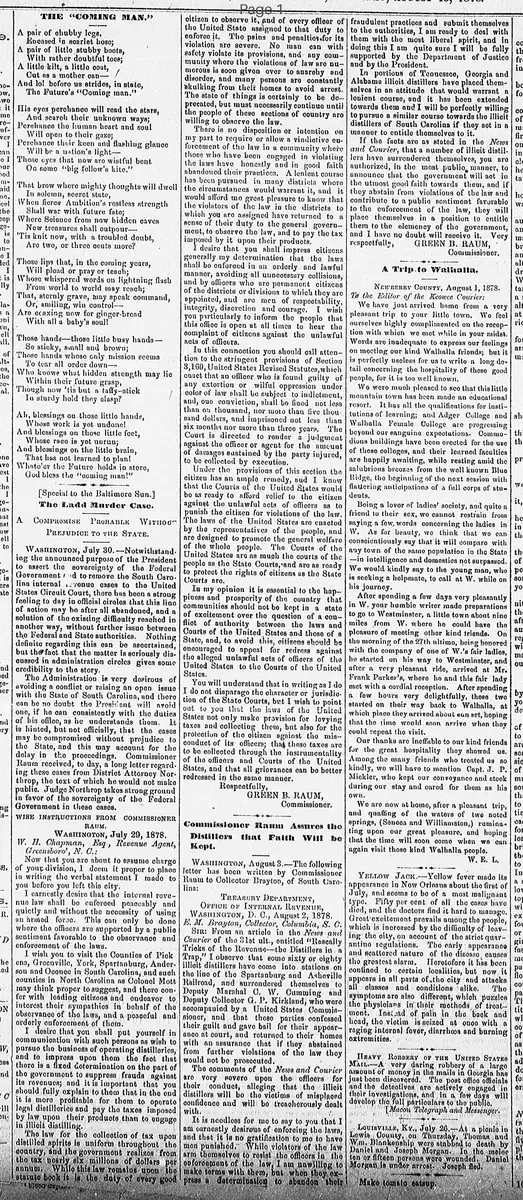
The Ladd Murder Case,
A
COMPROMISE
PROBABLE
WITHOUT
PREJUDICE TO THE STATE.
WASHINGTON, July 30.--Notwithstanding the announced purpose of the President to assert the sovereignty of the Federal Government and to remove the South Carolina internal revenue cases to the United States Circuit Court, there has been a strong feeling to-day in official circles that this line of action may be after all abandoned, and a solution of the existing difficulty reached in another way, without further issue between the Federal and State authorities. Nothing definite regarding this can be ascertained, but the fact that the matter is seriously discussed in administration circles gives some credibility to the story. The Administration is very desirous of avoiding a conflict or raising an open issue with the State of South Carolina, and there can be no doubt the President will avoid one, if he can consistently with the duties of his office, as he understands them. It is hinted, but not officially, that the cases may be compromised without prejudice to the State, and this may account for the delay in the proceedings. Commissioner Raum received, to-day, a long letter regarding these cases from District Attorney Northrop, the text of which he would not make public. Judge Northrop takes strong ground in favor of the sovereignty of the Federal Government in these cases.
WISE INSTRUCTIONS FROM
COMMISSIONER
RAUM.
WASHINGTON, July 29, 1878.
W. L. Chapman, Esq., Revenue Agent,
Greensboro, N. C.:
Now that you are about to assume charge of your division, I deem it proper to place in writing the verbal statement I made to you before you left this city. I earnestly desire that the internal revenue law shall be enforced peaceably and quietly and without the necessity of using an armed force. This can only be done where the officers are supported by a public sentiment favorable to the observance and enforcement of the laws. I wish you to visit the Counties of Pickens, Greenville, York, Spartanburg, Anderson and Oconee in South Carolina, and such counties in North Carolina as Colonel Mott may think proper to suggest, and there confer with leading citizens and endeavor to interest their sympathies in behalf of the observance of the laws, and a peaceful and orderly enforcement of them. I desire that you shall put yourself in communication with such persons as wish to pursue the business of operating distilleries, and to impress upon them the fact that there is a fixed determination on the part of the government to suppress frauds against its revenues; and it is important that you should fully explain to them that in the end it is more profitable for them to operate legal distilleries and pay the taxes imposed by law upon their products than to engage in illicit distilling. The law for the collection of tax upon distilled spirits is uniform throughout the country, and the government realizes from the tax nearly six millions of dollars per annum. While this law remains upon the statute book it is the duty of every good citizen to observe it, and of every officer of the United States assigned to that duty to enforce it. The pains and penalties for its violation are severe. No man can with safety violate its provisions, and any community where the violations of law are numerous is soon given over to anarchy and disorder, and many persons are constantly skulking from their homes to avoid arrest. The state of things is certainly to be deprecated, but must necessarily continue until the people of these sections of country are willing to observe the law. There is no disposition or intention on my part to require or allow a vindictive enforcement of the law in a community where those who have been engaged in violating the laws have honestly and in good faith abandoned their practices. A lenient course has been pursued in many districts where the circumstances would warrant it, and it would afford us great pleasure to know that the violators of the law in the districts to which you are assigned have returned to a sense of their duty to the general government, to observe the law, and to pay the tax imposed by it upon their products. I desire that you shall impress citizens generally my determination that the laws shall be enforced in an orderly and lawful manner, avoiding all unnecessary collisions, and by officers who are permanent citizens of the districts or divisions to which they are appointed, and are men of respectability, integrity, discretion and courage. I wish you particularly to inform the people that this office is open at all times to hear the complaint of citizens against the unlawful acts of officers. In this connection you should call attention to the stringent provisions of Section 3,169, United States Revised Statutes, which enact that an officer who is found guilty of any extortion or wilful oppression under color of law shall be subject to indictment, and, on conviction, shall be fined not less than one thousand, nor more than five thousand dollars, and imprisoned not less than six months nor more than three years. The Court is directed to render a judgment against the officer or agent for the amount of damages sustained by the party injured, to be collected by execution. Under the provisions of this section the citizen has an ample remedy, and I know that the Courts of the United States would be as ready to afford relief to the citizen against the unlawful acts of officers as to punish the citizen for violations of the law. The laws of the United States are enacted by the representatives of the people, and are designed to promote the general welfare of the whole people. The Courts of the United States are as much the courts of the people as the State Courts, and are as ready to protect the rights of citizens as the State Courts are. In my opinion it is essential to the happiness and prosperity of the country that communities should not be kept in a state of excitement over the question of a conflict of authority between the laws and Courts of the United States and those of a State, and, to avoid this, citizens should be encouraged to appeal for redress against the alleged unlawful acts of officers of the United States to the Courts of the United States. You will understand that in writing as I do I do not disparage the character or jurisdiction of the State Courts, but I wish to point out to you that the laws of the United States not only make provision for levying taxes and collecting them, but also for the protection of the citizen against the misconduct of its officers; that these taxes are to be collected through the instrumentality of the officers and Courts of the United States, and that all grievances can be better redressed in the same manner.
Respectfully,
GREEN B. RAUM,
Commissioner.
Commissioner Raum Assures the
Distillers
that Law Will
be
Kept.
WASHINGTON, August 3.--The following letter has been written by Commissioner Raum to Collector Brayton, of South Carolina:
TREASURY DEPARTMENT,
OFFICE OF INTERNAL REVENUE,
WASHINGTON, D. C., August 2, 1878.
E. M. Brayton, Collector, Columbia, S. C.
SIR: From an article in the News and Courier of the 31st ult., entitled "Rascally Tricks of the Revenue--the Distillers in a Trap," I observe that some sixty or eighty illicit distillers have come into stations on the line of the Spartanburg and Asheville Railroad, and surrendered themselves to Deputy Marshal C. W. Cumming and Deputy Collector G. P. Kirkland, who were accompanied by a United States Commissioner, and that those parties confessed their guilt and gave bail for their appearance at court, and returned to their homes with an assurance that if they abstained from further violations of the law they would not be prosecuted. The comments of the News and Courier are very severe upon the officers for their conduct, alleging that the illicit distillers will be the victims of misplaced confidence and will be treacherously dealt with.
It is needless for me to say to you that I am earnestly desirous of enforcing the laws, and that it is no gratification to me to have men punished. While violators of the law arm themselves to resist the officers in the enforcement of the law I am unwilling to make terms with them, but when they express a determination to abandon their fraudulent practices and submit themselves to the authorities, I am ready to deal with them with the most liberal spirit, and in doing this I am quite sure I will be fully supported by the Department of Justice and by the President. In portions of Tennessee, Georgia and Alabama illicit distillers have placed themselves in an attitude that would warrant a lenient course, and it has been extended towards them and I will be perfectly willing to pursue a similar course towards the illicit distillers of South Carolina if they act in a manner to entitle themselves to it. If the facts are as stated in the News and Courier, that a number of illicit distillers have surrendered themselves, you are authorized, in the most public manner, to announce that the government will act in the utmost good faith towards them, and if they abstain from violations of the law and contribute to a public sentiment favorable to the enforcement of the law, they will place themselves in a position to entitle them to the clemency of the government, and I have no doubt will receive it.
Very respectfully,
GREEN B. RAUM,
Commissioner.
What sub-type of article is it?
What keywords are associated?
What entities or persons were involved?
Where did it happen?
Domestic News Details
Primary Location
South Carolina
Event Date
July 29 August 3, 1878
Key Persons
Outcome
possible compromise in internal revenue cases without prejudice to the state; assurances of leniency and non-prosecution for illicit distillers who surrender and abstain from violations.
Event Details
Discussions in Washington official circles about abandoning federal removal of South Carolina internal revenue cases to U.S. Circuit Court in favor of a compromise to avoid conflict with state authorities. Commissioner Raum issues instructions to revenue agent Chapman for peaceful enforcement in specified South Carolina and North Carolina counties, emphasizing legal distilling over illicit and protections against officer misconduct. Raum assures Collector Brayton of good faith towards surrendering illicit distillers along Spartanburg and Asheville Railroad, promising clemency if they comply with the law.