Thank you for visiting SNEWPapers!
Sign up free
Story
September 20, 1917
The Seward Gateway And The Alaska Evening Post
Seward, Seward County, Alaska
What is this article about?
Historical lore of American Lake near Tacoma, Washington, site of Camp Lewis. Named 'American' by Captain Wilkes during the first Pacific coast Fourth of July celebration in 1841 at Fort Nisqually, part of a scientific expedition; includes Indian superstitions and monument placement.
Clipping
OCR Quality
98%
Excellent
Full Text
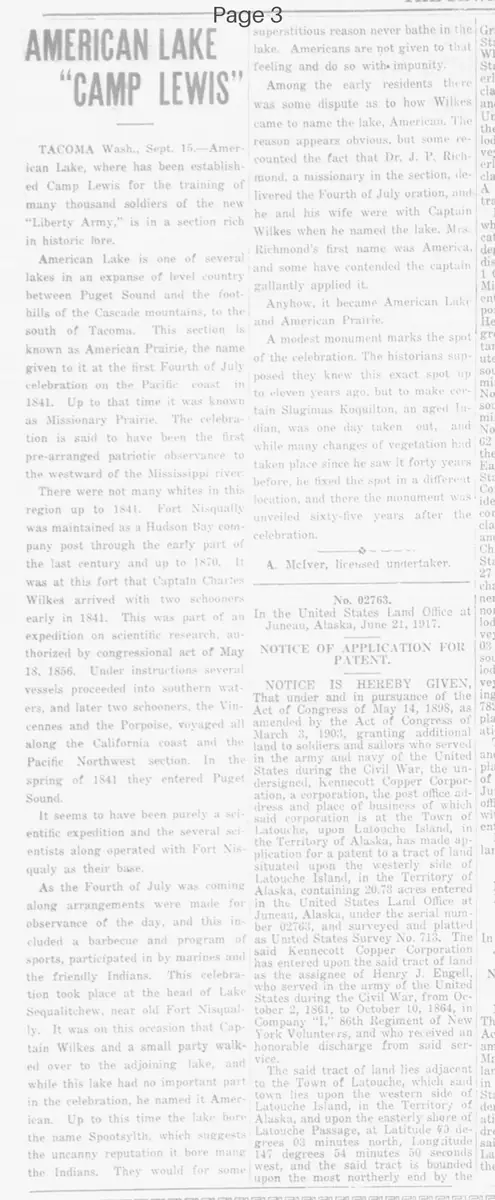
AMERICAN LAKE
"CAMP LEWIS"
TACOMA, Wash., Sept. 16.—American Lake, where has been established Camp Lewis for the training of many thousand soldiers of the new "Liberty Army," is in a section rich in historic lore.
American Lake is one of several lakes in an expanse of level country between Puget Sound and the foothills of the Cascade mountains, to the south of Tacoma. This section is known as American Prairie, the name given to it at the first Fourth of July celebration on the Pacific coast in 1841. Up to that time it was known as Missionary Prairie. The celebration is said to have been the first pre-arranged patriotic observance to the westward of the Mississippi river.
There were not many whites in this region up to 1841. Fort Nisqually was maintained as a Hudson Bay company post through the early part of the last century and up to 1870. It was at this fort that Captain Charles Wilkes arrived with two schooners early in 1841. This was part of an expedition on scientific research, authorized by congressional act of May 18, 1836. Under instructions several vessels proceeded into southern waters, and later two schooners, the Vincennes and the Porpoise, voyaged all along the California coast and the Pacific Northwest section. In the spring of 1841 they entered Puget Sound.
It seems to have been purely a scientific expedition and the several scientists along operated with Fort Nisqually as their base.
As the Fourth of July was coming along arrangements were made for observance of the day, and this included a barbecue and program of sports, participated in by marines and the friendly Indians. This celebration took place at the head of Lake Sequalitchew, near old Fort Nisqually. It was on this occasion that Captain Wilkes and a small party walked over to the adjoining lake and while this lake had no important part in the celebration, he named it American. Up to this time the lake bore the name Spootsylth, which suggests the uncanny reputation it bore among the Indians. They would for some superstitious reason never bathe in the lake. Americans are not given to that feeling and do so with impunity.
Among the early residents there was some dispute as to how Wilkes came to name the lake American. The reason appears obvious, but some recounted the fact that Dr. J. P. Richmond, a missionary in the section, delivered the Fourth of July oration, and he and his wife were with Captain Wilkes when he named the lake. Mrs. Richmond's first name was America, and some have contended the captain gallantly applied it.
Anyhow, it became American Lake and American Prairie.
A modest monument marks the spot of the celebration. The historians supposed they knew this exact spot up to eleven years ago, but to make certain Slugimas Koguilton, an aged Indian, was one day taken out, and while many changes of vegetation had taken place since he saw it forty years before he fixed the spot in a different location, and there the monument was unveiled sixty-five years after the celebration.
"CAMP LEWIS"
TACOMA, Wash., Sept. 16.—American Lake, where has been established Camp Lewis for the training of many thousand soldiers of the new "Liberty Army," is in a section rich in historic lore.
American Lake is one of several lakes in an expanse of level country between Puget Sound and the foothills of the Cascade mountains, to the south of Tacoma. This section is known as American Prairie, the name given to it at the first Fourth of July celebration on the Pacific coast in 1841. Up to that time it was known as Missionary Prairie. The celebration is said to have been the first pre-arranged patriotic observance to the westward of the Mississippi river.
There were not many whites in this region up to 1841. Fort Nisqually was maintained as a Hudson Bay company post through the early part of the last century and up to 1870. It was at this fort that Captain Charles Wilkes arrived with two schooners early in 1841. This was part of an expedition on scientific research, authorized by congressional act of May 18, 1836. Under instructions several vessels proceeded into southern waters, and later two schooners, the Vincennes and the Porpoise, voyaged all along the California coast and the Pacific Northwest section. In the spring of 1841 they entered Puget Sound.
It seems to have been purely a scientific expedition and the several scientists along operated with Fort Nisqually as their base.
As the Fourth of July was coming along arrangements were made for observance of the day, and this included a barbecue and program of sports, participated in by marines and the friendly Indians. This celebration took place at the head of Lake Sequalitchew, near old Fort Nisqually. It was on this occasion that Captain Wilkes and a small party walked over to the adjoining lake and while this lake had no important part in the celebration, he named it American. Up to this time the lake bore the name Spootsylth, which suggests the uncanny reputation it bore among the Indians. They would for some superstitious reason never bathe in the lake. Americans are not given to that feeling and do so with impunity.
Among the early residents there was some dispute as to how Wilkes came to name the lake American. The reason appears obvious, but some recounted the fact that Dr. J. P. Richmond, a missionary in the section, delivered the Fourth of July oration, and he and his wife were with Captain Wilkes when he named the lake. Mrs. Richmond's first name was America, and some have contended the captain gallantly applied it.
Anyhow, it became American Lake and American Prairie.
A modest monument marks the spot of the celebration. The historians supposed they knew this exact spot up to eleven years ago, but to make certain Slugimas Koguilton, an aged Indian, was one day taken out, and while many changes of vegetation had taken place since he saw it forty years before he fixed the spot in a different location, and there the monument was unveiled sixty-five years after the celebration.
What sub-type of article is it?
Historical Event
Curiosity
What themes does it cover?
Exploration
What keywords are associated?
American Lake
Camp Lewis
Fourth Of July 1841
Captain Wilkes
Fort Nisqually
Indian Superstition
Scientific Expedition
What entities or persons were involved?
Captain Charles Wilkes
Dr. J. P. Richmond
Mrs. Richmond
Slugimas Koguilton
Where did it happen?
American Lake, Near Tacoma, Washington; Fort Nisqually; Puget Sound
Story Details
Key Persons
Captain Charles Wilkes
Dr. J. P. Richmond
Mrs. Richmond
Slugimas Koguilton
Location
American Lake, Near Tacoma, Washington; Fort Nisqually; Puget Sound
Event Date
Fourth Of July, 1841
Story Details
Captain Wilkes' scientific expedition celebrated the first Fourth of July on the Pacific coast at Fort Nisqually in 1841, naming nearby lake American during the event amid local history and Indian superstitions; monument later placed with Indian guidance.