Thank you for visiting SNEWPapers!
Sign up free
Story
December 8, 1894
The Arizona Sentinel
Yuma, Arizona City, Yuma County, Arizona
What is this article about?
From the New York Times: Lists maximum ages of tree species including elm (300 years), yew (3200 years), and others. Explains age determination through annual wood deposits forming rings in exogens, with growth rates varying by age and species.
Clipping
OCR Quality
95%
Excellent
Full Text
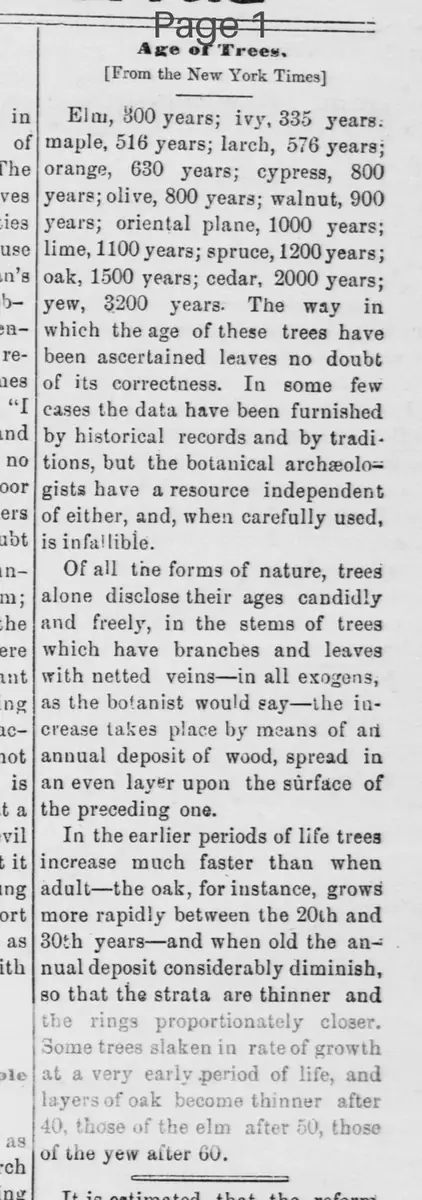
Age of Trees,
[From the New York Times]
Elm, 300 years; ivy, 335 years.
maple, 516 years; larch, 576 years;
orange, 630 years; cypress, 800
years; olive, 800 years; walnut, 900
years; oriental plane, 1000 years;
lime, 1100 years; spruce, 1200 years;
oak, 1500 years; cedar, 2000 years;
yew, 3200 years. The way
in which the age of these trees have
been ascertained leaves no doubt
of its correctness. In some few
cases the data have been furnished
by historical records and by traditions,
but the botanical archaeologists
have a resource independent
of either, and, when carefully used,
is infallible.
Of all the forms of nature, trees
alone disclose their ages candidly
and freely, in the stems of trees
which have branches and leaves
with netted veins-in all exogens,
as the botanist would say-the increase
takes place by means of an
annual deposit of wood, spread in
an even layer upon the surface of
the preceding one.
In the earlier periods of life trees
increase much faster than when
adult-the oak, for instance, grows
more rapidly between the 20th and
30th years-and when old the annual deposit considerably diminish,
so that the strata are thinner and
the rings proportionately closer.
Some trees slacken in rate of growth
at a very early period of life, and
layers of oak become thinner after
40, those of the elm after 50, those
of the yew after 60.
[From the New York Times]
Elm, 300 years; ivy, 335 years.
maple, 516 years; larch, 576 years;
orange, 630 years; cypress, 800
years; olive, 800 years; walnut, 900
years; oriental plane, 1000 years;
lime, 1100 years; spruce, 1200 years;
oak, 1500 years; cedar, 2000 years;
yew, 3200 years. The way
in which the age of these trees have
been ascertained leaves no doubt
of its correctness. In some few
cases the data have been furnished
by historical records and by traditions,
but the botanical archaeologists
have a resource independent
of either, and, when carefully used,
is infallible.
Of all the forms of nature, trees
alone disclose their ages candidly
and freely, in the stems of trees
which have branches and leaves
with netted veins-in all exogens,
as the botanist would say-the increase
takes place by means of an
annual deposit of wood, spread in
an even layer upon the surface of
the preceding one.
In the earlier periods of life trees
increase much faster than when
adult-the oak, for instance, grows
more rapidly between the 20th and
30th years-and when old the annual deposit considerably diminish,
so that the strata are thinner and
the rings proportionately closer.
Some trees slacken in rate of growth
at a very early period of life, and
layers of oak become thinner after
40, those of the elm after 50, those
of the yew after 60.
What sub-type of article is it?
Curiosity
What themes does it cover?
Nature
What keywords are associated?
Tree Ages
Annual Rings
Botanical Archaeology
Exogens
Oak Growth
Yew Longevity
Story Details
Story Details
Lists ages of various trees from elm at 300 years to yew at 3200 years, verified by historical records or annual rings. Explains tree growth via annual wood layers in exogens, with faster growth in youth and slowing in age, leading to thinner rings.