Thank you for visiting SNEWPapers!
Sign up free
State Journal
Montpelier, Washington County, Vermont
What is this article about?
Political correspondence from 1836 defends General William Henry Harrison against slanderous claims that he supported selling white men or debtors into servitude, citing his opposition to imprisonment for debt and clarifying a misunderstood vote on criminal punishment in Ohio's 1821 legislature.
Clipping
OCR Quality
Full Text
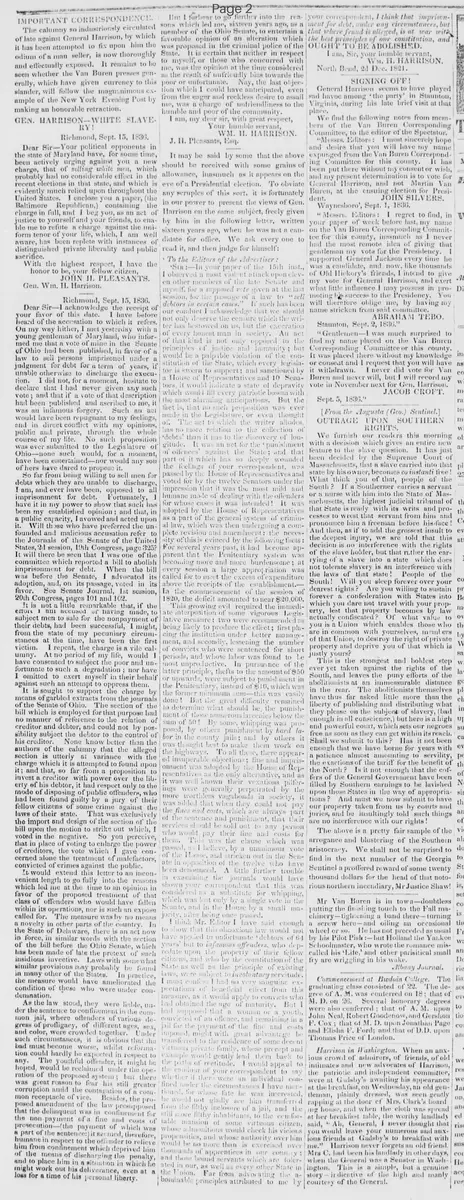
The calumny so industriously circulated of late against General Harrison, by which it has been attempted to fix upon him the odium of a man-seller, is now thoroughly and effectually exposed. It remains to be seen whether the Van Buren presses generally, which have given currency to this slander, will follow the magnanimous example of the New York Evening Post by making an honorable retraction.
GEN. HARRISON--WHITE SLAVE.
Richmond, Sept. 15, 1836.
Dear Sir—Your political opponents in the state of Maryland have, for some time, been actively urging against you a new charge, that of selling white men, which probably had no considerable effect in the recent elections in that state, and which is evidently much relied upon throughout the United States. I enclose you a paper, (the Baltimore Republican,) containing the charge in full, and I beg you, as an act of justice to yourself and your friends, to enable me to refute a charge against the uniform tenor of your life, which, I am well aware, has been replete with instances of distinguished private liberality and public sacrifice.
With the highest respect, I have the honor to be, your fellow citizen,
JOHN H. PLEASANTS.
Gen. Wm. H. Harrison.
Richmond, Sept. 15, 1836.
Dear Sir—I acknowledge the receipt of your favor of this date. I have before heard of the accusation to which it refers. On my way hither, I met yesterday with a young gentleman of Maryland, who informed me that a vote of mine in the Senate of Ohio had been published, in favor of a law to sell persons imprisoned under a judgment for debt for a term of years, if unable otherwise to discharge the execution. I did not, for a moment, hesitate to declare that I had never given any such vote; and that if a vote of that description had been published and ascribed to me, it was an infamous forgery. Such an act would have been repugnant to my feelings, and in direct conflict with my opinions, public and private, through the whole course of my life. No such proposition was ever submitted to the Legislature of Ohio—none such would, for a moment, have been entertained—nor would any son of hers have dared to propose it.
So far from being willing to sell men for debts which they are unable to discharge, I am, and ever have been, opposed to all imprisonment for debt. Fortunately, I have it in my power to show that such has been my established opinion: and that, in a public capacity, I avowed and acted upon it. Will those who have preferred the unfounded and malicious accusation refer to the Journals of the Senate of the United States, 2d session, 19th Congress, page 325? It will there be seen that I was one of the committee which reported a bill to abolish imprisonment for debt. When the bill was before the Senate, I advocated its adoption, and, on its passage, voted in its favor. See Senate Journal, 1st session, 20th Congress, pages 101 and 102.
It is not a little remarkable that, if the effort I am accused of having made, to subject men to sale for the nonpayment of their debts, had been successful, I might, from the state of my pecuniary circumstances at the time, have been the first victim. I repeat, the charge is a vile calumny. At no period of my life, would I have consented to subject the poor and unfortunate to such a degradation; nor have I omitted to exert myself in their behalf against such an attempt to oppress them.
It is sought to support the charge by means of garbled extracts from the journals of the Senate of Ohio. The section of the bill which is employed for that purpose had no manner of reference to the relation of creditor and debtor, and could not by possibility subject the debtor to the control of his creditor. None know better than the authors of the calumny that the alleged section is utterly at variance with the charge which it is attempted to found upon it; and that, so far from a proposition to invest a creditor with power over the liberty of his debtor, it had respect only to the mode of disposing of public offenders, who had been found guilty by a jury of their fellow citizens of some crime against the laws of their state. That was exclusively the import and design of the section of the bill upon the motion to strike out which, I voted in the negative. So you perceive, that in place of voting to enlarge the power of creditors, the vote which I gave concerned alone the treatment of malefactors, convicted of crimes against the public.
It would extend this letter to an inconvenient length to go fully into the reasons which led me at the time to an opinion in favor of the proposed treatment of that class of offenders who would have fallen within its operations, nor is such an expose called for. The measure was by no means a novelty in other parts of the country. In the State of Delaware, there is an act now in force, in similar words with the section of the bill before the Ohio Senate, which has been made of late the pretext of such insidious invective. Laws with somewhat similar provisions may probably be found in many other of the States. In practice, the measure would have ameliorated the condition of those who were under condemnation.
As the law stood, they were liable, under the sentence to confinement in the common jail, where offenders of various degrees of profligacy, of different ages, sex, and color, were crowded together. Under such circumstances, it is obvious that the bad must become worse, whilst reformation could hardly be expected in respect to any. The youthful offender, it might be hoped, would be reclaimed under the operation of the proposed system; but there was great reason to fear his still greater corruption amid the contagion of a common receptacle of vice. Besides, the proposed amendment of the law presupposed that the delinquent was in confinement for the non-payment of a fine and costs of prosecution—(the payment of which was a part of the sentence:) it seemed, therefore, humane in respect to the offender to relieve him from confinement which deprived him of the means of discharging the penalty, and to place him in a situation in which he might work out his deliverance, even at a loss for a time of his personal liberty.
But I forbear to go further into the reasons which led me, sixteen years ago, as a member of the Ohio Senate, to entertain a favorable opinion of an alteration which was proposed in the criminal police of the State. It is certain that neither in respect to myself, or those who concurred with me, was the opinion at the time considered as the result of unfriendly bias towards the poor or unfortunate. Nay, the last objection which I could have anticipated, even from the eager and reckless desire to assail me, was a charge of unfriendliness to the humble and poor of the community.
I am, my dear sir, with great respect,
Your humble servant,
WM. H. HARRISON.
J. H. Pleasants, Esq.
It may be said by some that the above should be received with some grains of allowance, inasmuch as it appears on the eve of a Presidential election. To obviate any scruples of this sort, it is fortunately in our power to present the views of Gen. Harrison on the same subject, freely given by him in the following letter, written sixteen years ago, when he was not a candidate for office. We ask every one to read it, and then judge for himself:
To the Editors of the Advertiser:
Sir:—In your paper of the 15th inst. I observed a most violent attack upon eleven other members of the Leg. Senate and myself, for a supposed vote given at the last session, for the passage of a law to "sell debtors in certain cases." If such has been our conduct I acknowledge that we should not only deserve the censure which the writer has bestowed on us, but the execration of every honest man in society. An act of that kind is not only opposed to the principles of justice and humanity; but would be a palpable violation of the constitution of the State, which every legislator is sworn to support; and sanctioned by a House of Representatives and 10 Senators, it would indicate a state of depravity which would fill every patriotic bosom with the most alarming anticipations. But the fact is, that no such proposition was ever made in the Legislature, or even thought of. The act to which the writer alludes, has no more relation to the collection of debts than it has to the discovery of longitude. It was an act for the 'punishment of offences' against the State; and that part of it which has so deeply wounded the feelings of your correspondent, was passed by the House of Representatives and voted for by the twelve Senators under the impression that it was the most mild and humane mode of dealing with the offenders for whose cases it was intended! It was adopted by the House of Representatives as a part of the general system of criminal law, which was then undergoing a complete revision and amendment: the necessity of this is evinced by the following facts:
For several years past, it had become apparent that the Penitentiary system was becoming more and more burdensome; at every session a large appropriation was called for to meet the excess of expenditure above the receipts of the establishment.—In the commencement of the session of 1820, the deficit amounted to near $20,000. This growing evil required the immediate interposition of some vigorous Legislative measure: two were recommended as being likely to produce the effect; first placing the institution under better management, and secondly, lessening the number of convicts who were sentenced for short periods, and whose labor was found to be most unproductive. In pursuance of the latter principle, thefts to the amount of $50 or upwards, were subject to punishment in the Penitentiary, instead of $20, which was the former minimum sum—this was easily done! But the great difficulty remained to determine what should be the punishment of those numerous larcenies below the sum of $50! By some, whipping was proposed, by others, punishment by hard labor in the county jails; and by others it was thought best to make them work on the highways. To all these, there appeared insuperable objections; fine and imprisonment was adopted by the House of Representatives as the only alternative, and as it was well known their vexatious pilferings were generally perpetrated by the more worthless vagrants in society, it was added that when they could not pay the fines and costs, which are always part of the sentence and punishment, that their services should be sold out to any person who would pay their fine and costs for them. This was the clause which was passed, as I believe, by a unanimous vote of the House, and stricken out in the Senate in opposition of the twelve who have been denounced. A little further trouble in examining the journals would have shown your correspondent that this was considered as a substitute for whipping, which was lost only by a single vote in the Senate, and in the House by a small majority, after being once passed.
I think Mr. Editor I have said enough to show that this obnoxious law would not have applied to unfortunate 'debtors of 64 years' but to infamous offenders, who depredate upon the property of their fellow citizens, and who by the constitution of the State as well as the principle of existing laws, were subject to involuntary servitude.
I must confess I had no very sanguine expectations of beneficial effect from this measure, as it would apply to convicts who had obtained the age of maturity. But I had supposed that a woman or a youth, convicted of an offence, and remaining in a jail for the payment of the fine and costs imposed, might with great advantage be transferred to the residence of some decent virtuous private family, whose precept and example would gently lead them back to the paths of rectitude. I would appeal to the candor of your correspondent to say whether if there were an individual confined under the circumstances I have mentioned, for whose fate he was interested, he would not gladly see him transferred from the filthy inclosure of a jail, and the still more filthy inhabitants, to the comfortable mansion of some virtuous citizen, whose admonitions would check his vicious propensities, and whose authority over him would be no more than is exercised over thousands of apprentices in our country; and those bound servants which are tolerated in our, as well as every other State in the Union. Far from advocating the abominable principles attributed to me by your correspondent, I think that imprisonment for debt, under any circumstances, but where fraud is alleged, is at war with the best principles of our constitution, and OUGHT TO BE ABOLISHED.
I am, Sir, your humble servant,
WM. H. HARRISON.
North Bend, 2d Dec. 1821.
What sub-type of article is it?
What themes does it cover?
What keywords are associated?
What entities or persons were involved?
Where did it happen?
Story Details
Key Persons
Location
Richmond, Ohio, North Bend
Event Date
Sept. 15, 1836; Dec. 2, 1821
Story Details
John H. Pleasants writes to Harrison about slanderous charges of supporting debtor sales; Harrison refutes it in a letter, explaining his opposition to imprisonment for debt and clarifying a 1821 Ohio Senate vote on criminal punishment for petty offenders as humane reform, not debtor servitude.