Thank you for visiting SNEWPapers!
Sign up free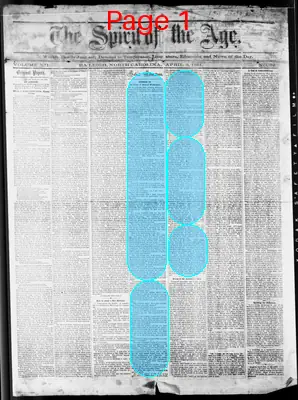
Spirit Of The Age
Raleigh, Wake County, North Carolina
What is this article about?
Fictionalized biography of young George Washington's pivotal decision, guided by his father's letters, to reject the British navy and embrace American independence, leading to his role as revolutionary leader, president, and peaceful retirement at Mount Vernon until his death.
Clipping
OCR Quality
Full Text
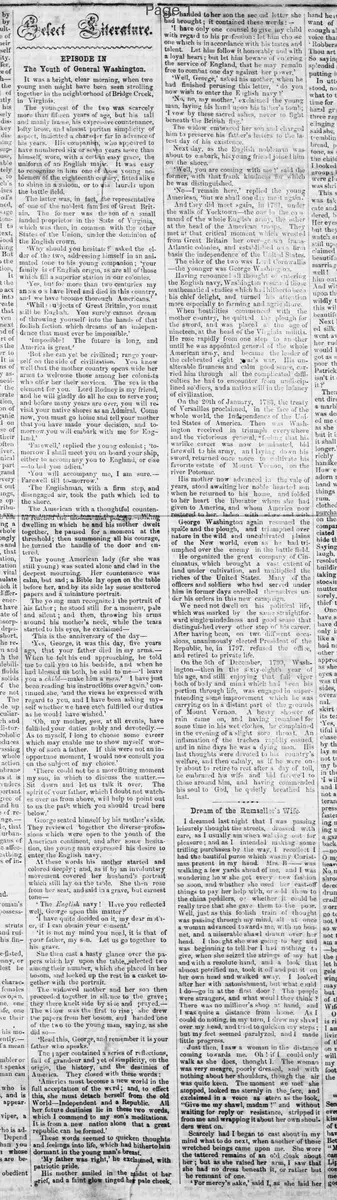
EPISODE IN
The Youth of General Washington.
It was a bright, clear morning, when two young men might have been seen strolling together in the neighborhood of Bridge Creek, in Virginia.
The youngest of the two was scarcely more than fifteen years of age, but his tall and manly frame, his expressive countenance, lofty brow, and almost puritan simplicity of aspect, indicated a character far in advance of his years.
His companion, who appeared to have numbered six or seven years more than himself, wore, with a certain easy grace, the uniform of an English major. It was easy to recognize in him one of those young noblemen of the eighteenth century, fitted alike to shine in a saloon, or to win laurels upon the battle field.
The latter was, in fact, the representative of one of the noblest families of Great Britain. The former was the son of a small landed proprietor in the State of Virginia, which was then, in common with the other States of the Union, under the dominion of the English crown.
'Why should you hesitate?' asked the elder of the two, addressing himself in an animated tone to his young companion; 'your family is of English origin, as are all of those which fill a superior station in our colonies. Yes, but for more than two centuries my ancestors have lived and died in this country, and we have become thorough Americans.'
'While subjects of Great Britain, you must still be English. You surely cannot dream of throwing yourself into the hands of that foolish faction which dreams of an independence that must ever be impossible.'
'Impossible! The future is long, and America is great.'
'But she can yet be civilized; range yourself on the side of civilization.' 'You know well that the mother country opens wide her arms to welcome those among her colonists who offer her their services. The sea is the element for you. Lord Rodney is my friend, and he will gladly do all he can to serve you; and before many years are over, you will revisit your native shores as an Admiral. Come now, you must go home and tell your mother that you have made your decision, and tomorrow you will embark with me for England.'
'Farewell,' replied the young colonist; 'tomorrow I shall meet you on board your ship, either to accompany you to England, or else - to bid you adieu.'
'You will accompany me, I am sure. Farewell till to-morrow.'
The Englishman, with a firm step, and disengaged air, took the path which led to the shore.
The American with a thoughtful countenance reached the dwelling in which he and his mother dwelt together, he paused for a moment at the threshold; then summoning all his courage, he turned the handle of the door and entered.
The young American lady (for she was still young) was seated alone and clad in the deepest mourning. Her countenance was calm, but sad; a Bible lay open on the table before her, and by its side lay some scattered papers and a miniature portrait.
The young man recognized the portrait of his father; he stood still for a moment, pale and silent; and then, throwing his arms around his mother's neck, while the tears started to his eyes, he exclaimed -
This is the anniversary of the day -
Yes, George, it was this day, five years ago, that your father died in my arms. When he felt his end approaching, he told me to call you to his bedside, and when he had blessed us both, he said to me - 'I leave you a child - make him a man.' I have just been reading his instructions over again,' continued she, 'and the views he expressed with regard to you, and I have been asking myself whether we have each fulfilled our duties as he would have wished.'
'Oh, my mother, you, at all events, have fulfilled your duties nobly and devotedly. As to myself, I long to choose some career which may enable me to show myself worthy of such a father. If this were not an inopportune moment, I would now consult you on the subject of my choice.'
There could not be a more fitting moment, my son, in which to discuss the matter. Sit down and let us talk it over. The spirit of your father, which I doubt not watches over us from above, will help to point out to us the path which you should tread here below.'
George seated himself by his mother's side. They reviewed together the diverse professions which were open to the youth of the American continent, and after some hesitation, the young man expressed his desire to enter the English navy.
At these words his mother started and colored deeply; and, as if by an involuntary movement covered her husband's portrait which still lay on the table. She then rose from her seat, and said in a grave, but earnest tone -
The English navy! Have you reflected well, George upon this matter?
'I have quite decided on it, my dear mother, if I can obtain your consent.'
'It is not my mind you need, it is that of your father, my Son. Let us go together to his grave.'
She then cast a hasty glance over the papers which lay upon the table, selected two among their number, which she placed in her bosom, and locked up the rest in a casket together with the portrait.
The widowed mother and her son then proceeded together in silence to the grave; they there knelt side by side and prayed. The widow was the first to rise; she drew the papers from her bosom, and handed one of the two to the young man, saying, as she did so -
'Read this, George, and remember it is your father who speaks.'
The paper contained a series of reflections full of grandeur and yet of simplicity, on the origin, the history, and the destinies of America. They closed with these words:
'America must become a new world in the full acceptation of the word; and, to effect this, she must detach herself from the old World - Independent and a Republic. All her future destinies lie in these two words, which I commend to my son's meditations. It is from a new nation alone that a great republic can be formed.'
These words seemed to quicken thoughts and feelings into life, which had hitherto lain dormant in the young man's breast.
'My father was right,' he exclaimed, with patriotic pride.
His mother smiled in the midst of her grief, and a faint glow tinged her pale cheek.
She then handed him the second paper which she had brought; it contained these words: --
'I have only one counsel to give my child with regard to his profession: let him choose one which is in accordance with his tastes and talent. Let him follow it honorably and with a loyal heart; but let him beware of entering the service of England, that he may remain free to combat one day against her power.'
'Well, George,' asked his mother, when he had finished perusing this letter, 'do you now wish to enter the English navy?'
No, no, my mother.' exclaimed the young man, laying his hand upon his father's tomb; 'I vow by these sacred ashes, never to fight beneath the British flag.'
The widow embraced her son and charged him to preserve his father's letters to the latest day of his existence.
Next day, as the English nobleman was about to embark, his young friend joined him on the shore.
Well, you are coming with me?' said the former, with that frank kindness for which he was distinguished.
No - I remain here,' replied the young American, 'but we shall one day meet again.'
And they did meet again, in 1781, under the walls of Yorktown - the one in the command of the whole English army, the other at the head of the American troops. They met at that critical moment which wrested from Great Britain her overgrown trans-Atlantic colonies, and established on a firm basis the independence of the United States.
The elder of the two was Lord Cornwallis - the younger was George Washington.
Having renounced all thought of entering the English navy, Washington resumed those mathematical studies which had hitherto been his chief delight, and turned his attention more especially to farming and agriculture.
When hostilities commenced with the mother country, he quitted the plough for the sword, and was placed at the age of nineteen, at the head of the Virginia militia. He rose rapidly from one step to another until he was appointed general of the whole American army, and became the leader of the celebrated eight years' war.
His unalterable firmness and calm good sense, carried him through all the complicated difficulties he had to encounter from undisciplined soldiers, and a nation still in the infancy of civilization.
On the 20th of January, 1783, the treaty of Versailles proclaimed, in the face of the whole world, the Independence of the United States of America. Then was Washington received in triumph everywhere and the victorious general, feeling that his warlike career was now terminated, bid farewell to his army, and laying down his sword, returned once more to cultivate his favorite estate of Mount Vernon, on the river Potomac.
His mother now advanced in the vale of years, stood awaiting her noble hearted son when he returned to his home, and folded to her heart the liberator whom she had given to America, and whom America now restored to her, laden with glory and with honor.
George Washington again resumed the spade and the plough, and triumphed over nature in the wild and uncultivated plains of the New world, even as he had triumphed over the enemy in the battle field.
He organized the great company of Cincinnatus, which brought a vast extent of land under cultivation, and multiplied the riches of the United States. Many of the officers and soldiers who had served under him in former days enrolled themselves under his orders in this new campaign.
We need not dwell on his political life, which was marked by the same straightforward singleness of mind and good sense that distinguished every other step of his career. After having been, on two different occasions, unanimously elected President of the Republic, he, in 1797, refused the office, and retired to private life.
On the 5th of December, 1799, Washington - then in the sixty-eighth year of his age, and still enjoying that full vigor both of body and mind which had been his portion through life, was engaged in superintending some improvement which he was carrying on in a distant part of the grounds of Mount Vernon. A heavy shower of rain came on, and having remained for some time in his wet clothes, he complained in the evening of a slight sore throat. An inflammation of the trachea rapidly ensued, and in nine days he was a dying man.
His last thoughts were devoted to his country's welfare, and then calmly, as if he were only about to retire to rest after a day of toil, he embraced his wife and bid farewell to those around him, and having commended his soul to God, he quietly breathed his last.
What sub-type of article is it?
What themes does it cover?
What keywords are associated?
What entities or persons were involved?
Where did it happen?
Story Details
Key Persons
Location
Bridge Creek, Virginia; Mount Vernon, Potomac; Yorktown
Event Date
1781; 20th Of January, 1783; 1797; 5th Of December, 1799
Story Details
Young George Washington, influenced by his father's letters advocating American independence and avoiding British service, rejects an offer to join the English navy from a British nobleman (future Lord Cornwallis). He later leads the American Revolution, defeats Cornwallis at Yorktown in 1781, becomes president, retires to Mount Vernon, and dies in 1799.