Thank you for visiting SNEWPapers!
Sign up free
Story
November 5, 1818
Daily National Intelligencer
Washington, District Of Columbia
What is this article about?
German astronomer Schroeter calculates the tail of the 1811 comet at 13,185,200 geographical miles, over half the Earth-Sun distance, due to luminous matter around the sun and repulsive forces in comets, drawing from 1807 and 1811 observations.
Clipping
OCR Quality
98%
Excellent
Full Text
The Comet of 1811.
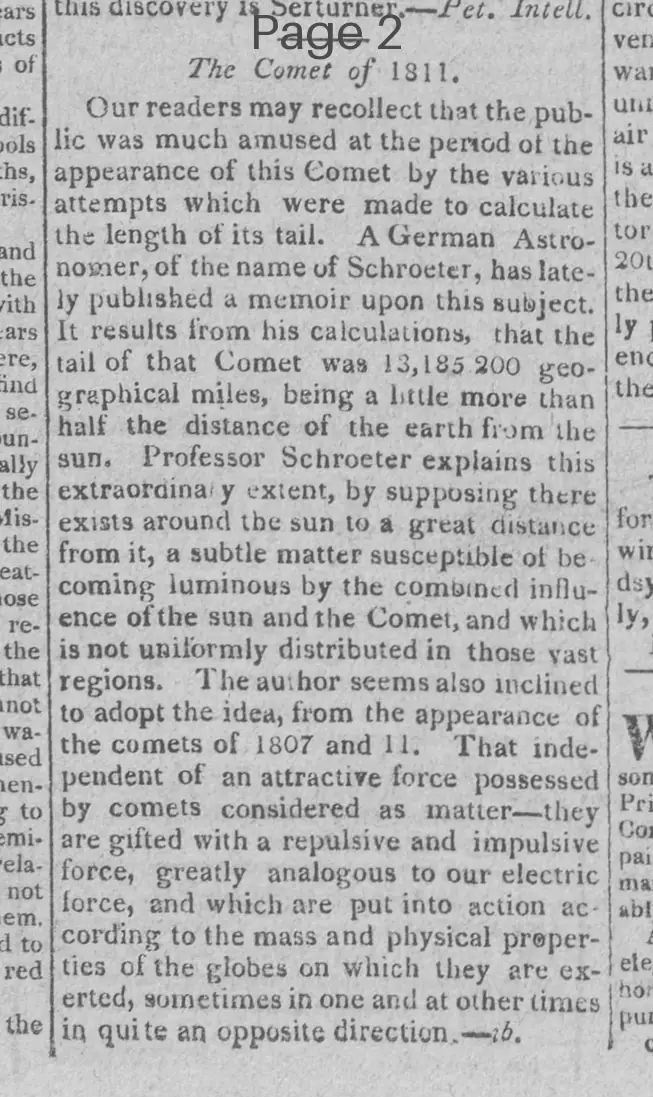
Our readers may recollect that the public was much amused at the period of the appearance of this Comet by the various attempts which were made to calculate the length of its tail. A German Astronomer, of the name of Schroeter, has lately published a memoir upon this subject.
It results from his calculations, that the tail of that Comet was 13,185,200 geographical miles, being a little more than half the distance of the earth from the sun. Professor Schroeter explains this extraordinary extent, by supposing there exists around the sun to a great distance from it, a subtle matter susceptible of becoming luminous by the combined influence of the sun and the Comet, and which is not uniformly distributed in those vast regions. The author seems also inclined to adopt the idea, from the appearance of the comets of 1807 and 11. That independent of an attractive force possessed by comets considered as matter—they are gifted with a repulsive and impulsive force, greatly analogous to our electric force, and which are put into action according to the mass and physical properties of the globes on which they are exerted, sometimes in one and at other times in quite an opposite direction.—b.
Our readers may recollect that the public was much amused at the period of the appearance of this Comet by the various attempts which were made to calculate the length of its tail. A German Astronomer, of the name of Schroeter, has lately published a memoir upon this subject.
It results from his calculations, that the tail of that Comet was 13,185,200 geographical miles, being a little more than half the distance of the earth from the sun. Professor Schroeter explains this extraordinary extent, by supposing there exists around the sun to a great distance from it, a subtle matter susceptible of becoming luminous by the combined influence of the sun and the Comet, and which is not uniformly distributed in those vast regions. The author seems also inclined to adopt the idea, from the appearance of the comets of 1807 and 11. That independent of an attractive force possessed by comets considered as matter—they are gifted with a repulsive and impulsive force, greatly analogous to our electric force, and which are put into action according to the mass and physical properties of the globes on which they are exerted, sometimes in one and at other times in quite an opposite direction.—b.
What sub-type of article is it?
Curiosity
Extraordinary Event
Historical Event
What themes does it cover?
Nature
Exploration
What keywords are associated?
Comet 1811
Tail Length
Schroeter
Astronomy
Repulsive Force
Luminous Matter
What entities or persons were involved?
Schroeter
Professor Schroeter
Story Details
Key Persons
Schroeter
Professor Schroeter
Event Date
1811
Story Details
Public amusement over tail length calculations for the 1811 comet; Schroeter's memoir estimates tail at 13,185,200 geographical miles, explained by luminous subtle matter around the sun and comets' repulsive forces analogous to electricity, based on 1807 and 1811 comets.