Thank you for visiting SNEWPapers!
Sign up free
Editorial
March 14, 1858
The Washington Union
Washington, District Of Columbia
What is this article about?
Editorial praises Senator Kennedy's independent support for the Kansas admission bill, highlighting non-intervention and state rights principles. It rebukes Democrats aligning with Republicans and asserts a binary partisan divide on this vital constitutional issue.
Clipping
OCR Quality
98%
Excellent
Full Text
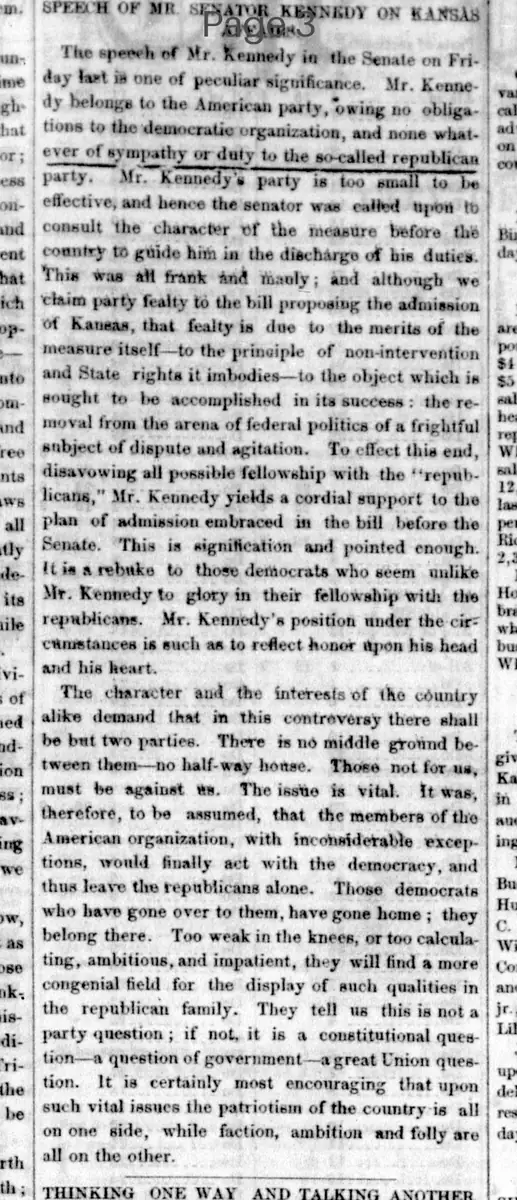
The speech of Mr. Kennedy in the Senate on Friday last is one of peculiar significance. Mr. Kennedy belongs to the American party, owing no obligations to the democratic organization, and none whatever of sympathy or duty to the so-called republican party. Mr. Kennedy's party is too small to be effective, and hence the senator was called upon to consult the character of the measure before the country to guide him in the discharge of his duties.
This was all frank and manly; and although we claim party fealty to the bill proposing the admission of Kansas, that fealty is due to the merits of the measure itself—to the principle of non-intervention and State rights it embodies—to the object which is sought to be accomplished in its success: the removal from the arena of federal politics of a frightful subject of dispute and agitation. To effect this end, disavowing all possible fellowship with the "republicans," Mr. Kennedy yields a cordial support to the plan of admission embraced in the bill before the Senate. This is signification and pointed enough.
It is a rebuke to those democrats who seem unlike Mr. Kennedy to glory in their fellowship with the republicans. Mr. Kennedy's position under the circumstances is such as to reflect honor upon his head and his heart.
The character and the interests of the country alike demand that in this controversy there shall be but two parties. There is no middle ground between them—no half-way house. Those not for us, must be against us. The issue is vital. It was, therefore, to be assumed, that the members of the American organization, with inconsiderable exceptions, would finally act with the democracy, and thus leave the republicans alone. Those democrats who have gone over to them, have gone home; they belong there. Too weak in the knees, or too calculating, ambitious, and impatient, they will find a more congenial field for the display of such qualities in the republican family. They tell us this is not a party question; if not, it is a constitutional question—a question of government—a great Union question. It is certainly most encouraging that upon such vital issues the patriotism of the country is all on one side, while faction, ambition and folly are all on the other.
This was all frank and manly; and although we claim party fealty to the bill proposing the admission of Kansas, that fealty is due to the merits of the measure itself—to the principle of non-intervention and State rights it embodies—to the object which is sought to be accomplished in its success: the removal from the arena of federal politics of a frightful subject of dispute and agitation. To effect this end, disavowing all possible fellowship with the "republicans," Mr. Kennedy yields a cordial support to the plan of admission embraced in the bill before the Senate. This is signification and pointed enough.
It is a rebuke to those democrats who seem unlike Mr. Kennedy to glory in their fellowship with the republicans. Mr. Kennedy's position under the circumstances is such as to reflect honor upon his head and his heart.
The character and the interests of the country alike demand that in this controversy there shall be but two parties. There is no middle ground between them—no half-way house. Those not for us, must be against us. The issue is vital. It was, therefore, to be assumed, that the members of the American organization, with inconsiderable exceptions, would finally act with the democracy, and thus leave the republicans alone. Those democrats who have gone over to them, have gone home; they belong there. Too weak in the knees, or too calculating, ambitious, and impatient, they will find a more congenial field for the display of such qualities in the republican family. They tell us this is not a party question; if not, it is a constitutional question—a question of government—a great Union question. It is certainly most encouraging that upon such vital issues the patriotism of the country is all on one side, while faction, ambition and folly are all on the other.
What sub-type of article is it?
Partisan Politics
Constitutional
What keywords are associated?
Kansas Admission
Mr Kennedy Speech
American Party
Non Intervention
State Rights
Partisan Divide
Republicans Rebuke
What entities or persons were involved?
Mr. Kennedy
American Party
Democratic Organization
Republican Party
Senate
Editorial Details
Primary Topic
Support For Kansas Admission Bill And Mr. Kennedy's Speech
Stance / Tone
Supportive Of Democratic Position And Rebuke To Republicans
Key Figures
Mr. Kennedy
American Party
Democratic Organization
Republican Party
Senate
Key Arguments
Mr. Kennedy's Independent Support For Kansas Bill Due To Its Merits In Non Intervention And State Rights
Bill Aims To Remove Slavery Dispute From Federal Politics
Rebuke To Democrats Aligning With Republicans
Binary Partisan Divide: No Middle Ground On Vital Issue
Patriotism Aligns With Democrats Against Republican Factionalism