Thank you for visiting SNEWPapers!
Sign up free
Wheeling Sunday Register
Wheeling, Ohio County, West Virginia
What is this article about?
Ohio County faces judicial backlog and delays in criminal cases, frustrating public and bar. Overworked judges like ill Judge Campbell exacerbate issues. Proposals for reform include a new monthly Criminal Court to handle crimes, relieve circuit courts, and ensure speedy trials, supported by leading lawyers.
Clipping
OCR Quality
Full Text
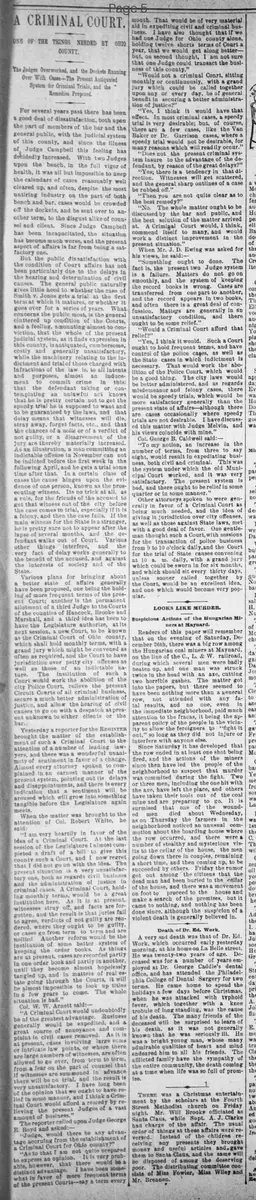
ONE OF THE THINGS NEEDED BY OHIO COUNTY.
The Judges Overworked, and the Dockets Running Over With Cases—The Present Antiquated System for Criminal Trials, and the Remedies Proposed.
For several years past there has been a good deal of dissatisfaction, both upon the part of members of the bar and the general public, with the judicial system of this county, and since the illness of Judge Campbell this feeling has decidedly increased. With two Judges upon the bench, in the full vigor of health, it was all but impossible to keep the calendars of cases reasonably well cleared up, and often, despite the most untiring industry on the part of both bench and bar, cases would be crowded off the dockets, and be sent over to another term, to the disgust alike of counsel and client. Since Judge Campbell has been incapacitated, the situation has become much worse, and the present aspect of affairs is far from being a satisfactory one.
But the public dissatisfaction with the condition of Court affairs has not been particularly due to the delays in the hearing and determination of civil causes. The general public naturally gives little heed to whether the case of Smith v. Jones gets a trial at the first term at which it matures, or whether it goes over for a series of years. What concerns the public most, is the general cluttered up condition of the Courts, and a feeling, amounting almost to conviction, that the whole of the present judicial system, as it finds expression in this county, is antiquated, cumbersome, costly and generally unsatisfactory, while the machinery relating to the indictment and trial of those charged with infractions of the law is, to all intents and purposes, almost an inducement to commit crime. In this: that the defendant taking or contemplating an unlawful act knows that he is pretty certain not to get the speedy trial he is supposed to want and to be guaranteed by the laws, and that delay means that witnesses will die, stray away, forget facts, etc., and that the chances of a nolle or of a verdict of not guilty, or a disagreement of the jury are thereby materially increased.
As an illustration, a man committing an indictable offense in November can not be indicted before the first week in the following April, and he gets a trial some time after that. In a certain class of cases the cause hinges upon the evidence of one person, known as the prosecuting witness. It's no trick at all, as a rule, for the friends of the accused to get that witness out of the city before the case comes to trial, especially if it is a felony, and then the case falls. If the main witness for the State is a stranger, he is pretty sure not to appear after the lapse of several months, and the defendant walks out of Court. Various other things interfere, and the very fact of delay works generally to the benefit of the accused, and against the interests of society and of the State.
Various plans for bringing about a better state of affairs generally have been proposed, one being the holding of more frequent terms of the present Court; another is the permanent allotment of a third Judge to the Courts of the counties of Hancock, Brooke and Marshall, and a third idea has been to have the Legislature authorize, at its next session, a new Court, to be known as the Criminal Court of Ohio county, which shall hold monthly terms, with a grand jury which might be convened as often as required, and the Court to have jurisdiction over petty city offenses as well as those of an indictable nature. The institution of such a Court would work the abolition of the city Police Court, relieve the present Circuit Courts of all criminal business, secure a much better administration of justice, and allow the hearing of civil causes to go on with a despatch at present unknown to either clients or the bar.
Yesterday a reporter for the Register brought the matter of the establishment of such a Criminal Court to the attention of a number of leading lawyers, and there was a wonderful unanimity of sentiment in favor of a change. Almost every attorney spoken to complained in an earnest manner of the present system, pointing out its delays and disappointments, and there is every indication that a sentiment will be aroused which will grow into something tangible before the Legislature again meets.
When the matter was brought to the attention of Col. Robert White, he said:
"I am very heartily in favor of the idea of a Criminal Court. At the last session of the Legislature I almost completed a draft of a bill to give this county such a Court, and I now regret that I did not go on with the idea. The present situation is a very unsatisfactory one, both as regards civil business and the administration of justice in criminal cases. A Criminal Court, holding monthly terms, would be a great institution here. As it is at present, witnesses stray off, and facts are forgotten, and the result is that juries fail to agree, verdicts of not guilty are rendered, or cases go from term to term and are nolle prossed. Another reform would be the institution of some better system of keeping the order books. As things are at present, cases are recorded partly in one order book and partly in another, until they become almost hopelessly tangled up, and in matters of real estate going through the Courts, it will be almost impossible to look up titles in a few years to come. The whole situation is bad."
Col. W. W. Arnett said:
"A Criminal Court would undoubtedly be of the greatest advantage. Business generally would be expedited, and a great source of annoyance and complaint in civil cases removed. As it is at present, cases involving large sums or intricate law points, or where there are large numbers of witnesses, are often allowed to go over from term to term, from a fear on the part of counsel that there will be no trial, and the result is very unsatisfactory. I have long been of the opinion that we ought to have relief in some manner, and I think a Criminal Court would afford a remedy by relieving the present Judges of a vast amount of business."
The reporter called upon Judge George E. Boyd and asked:
"Judge, would there be any advantage accruing from the establishment of a Criminal Court for Ohio county?"
"As to that I am not quite prepared to express an opinion. It is very probable, however, that there would be a distinct advantage. I have been somewhat in favor of more frequent terms of the present Courts—say a term every month. That would be of very material aid in expediting civil and criminal business. I have also thought that if we had one Judge for Ohio county alone, holding twelve short terms of Court a year, that we would get along better—but, on second thought, I am not sure that one Judge could transact the business of this county."
"Would not a criminal Court, sitting monthly or continuously, with a grand jury which could be called together upon any or every day, be of general benefit in securing a better administration of justice?"
"Yes, I think it would have that effect. In most criminal cases, a speedy trial is very desirable; but, of course, there are a few cases, like the Van Baker or Dr. Garrison cases, where a speedy trial would not be desirable, for many reasons which will readily occur."
"Does not the present criminal system insure to the advantage of the defendant, by reason of the great delays?"
"Yes; there is a tendency in that direction. Witnesses will get scattered, and the general sharp outlines of a case be rubbed off."
"Then you are not quite clear as to the best remedy?"
"No. The whole matter ought to be discussed by the bar and public, and the best solution of the matter arrived at. A Criminal Court would, I think, commend itself to many, and would work a distinct improvement in the present situation."
When Mr. J. D. Ewing was asked for his views, he said:
"Something ought to be done. The fact is, the present two Judge system is a failure. Matters do not go on smoothly, and the system of keeping the record books is wrong. Cases are transferred from one part to another, and the record appears in two books, and often there is a great deal of confusion. Matters are generally in an unsatisfactory condition, and there ought to be some relief."
"Would a Criminal Court afford that relief?"
"Yes, I think it would. Such a Court ought to hold frequent terms, and have control of the police cases, as well as the State cases in which indictment is necessary. That would work the abolition of the Police Court, which would be a good thing. The city laws would be better administered, and as regards misdemeanor and felony cases, there would be speedy trials, which would be more satisfactory generally than the present state of affairs—although there are cases occasionally where speedy trials are not desirable. I have discussed this matter with Judge Melvin, and his views coincide with mine."
Col. George B. Caldwell said:
"To my notion, an increase in the number of terms, from three to say eight, would result in expediting business, both civil and criminal. This was the system under which the old Municipal Court worked, and it was very satisfactory. The present system is bad, and there ought to be relief in some quarter or in some manner."
Other attorneys spoken to were generally in favor of a Criminal Court as being much needed, and the idea of giving it jurisdiction over city offenses, as well as those against State laws, met with a good deal of favor. One gentleman thought such a Court, with sessions for the transaction of police business from 9 to 10 o'clock daily, and the Court for the trial of State causes convening at 10 a. m. daily, with a grand jury which could be sworn in for six months, and which should sit every thirty days, unless sooner called together by the Court, would be an excellent idea, and one which would become very popular.
What sub-type of article is it?
What themes does it cover?
What keywords are associated?
What entities or persons were involved?
Where did it happen?
Story Details
Key Persons
Location
Ohio County
Story Details
Dissatisfaction with Ohio County's overworked courts and delays in criminal trials that benefit defendants. Proposals include more frequent terms, additional judge, or new Criminal Court with monthly sessions to handle indictable and petty offenses, abolishing Police Court, and improving justice administration. Lawyers unanimously support the Criminal Court idea.