Thank you for visiting SNEWPapers!
Sign up free
Norfolk Gazette And Publick Ledger
Norfolk, Virginia
What is this article about?
Detailed eyewitness account of the 1807 campaign in Poland, including battles at Heilsberg and Friedland, Russian retreats under General Bennigsen against French forces led by Napoleon, resulting in heavy casualties and retreat to Tilsit.
Merged-components note: Continuation of the article on the late campaign in Poland from the London Traveller across pages 1 and 2.
Clippings
1 of 2
OCR Quality
Full Text
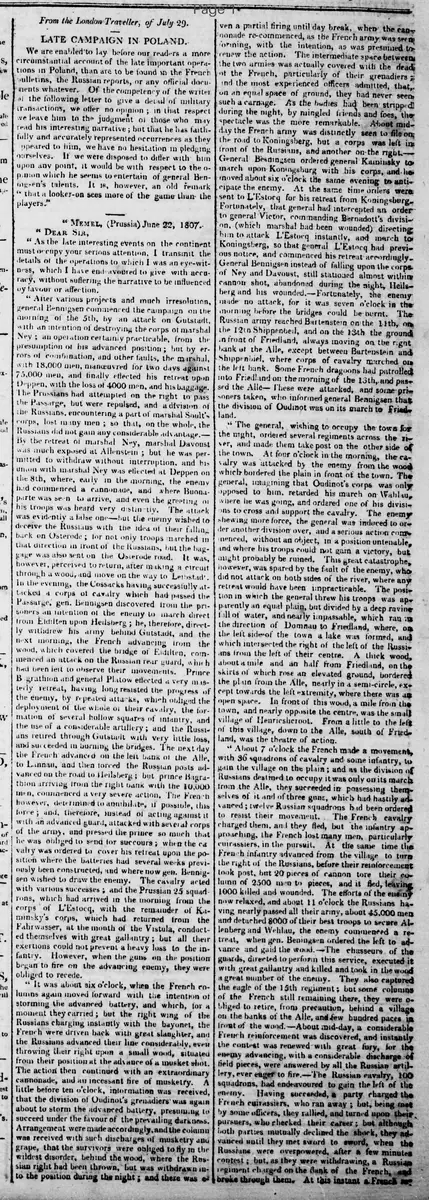
LATE CAMPAIGN IN POLAND.
We are enabled to lay before our readers a more circumstantial account of the late important operations in Poland, than are to be found in the French bulletins, the Russian reports, or any official documents whatever. Of the competency of the writer of the following letter to give a detail of military transactions, we offer no opinion; in that respect we leave him to the judgment of those who may read his interesting narrative; but that he has faithfully and accurately represented occurrences as they appeared to him, we have no hesitation in pledging ourselves. If we were disposed to differ with him upon any point, it would be with respect to the opinion which he seems to entertain of general Bennigsen's talents. It is, however, an old remark 'that a looker-on sees more of the game than the players.'
'Memel, (Prussia) June 22, 1807.
'DEAR SIR,
'As the late interesting events on the continent must occupy your serious attention, I transmit the details of the operations to which I was an eye-witness, which I have endeavoured to give with accuracy, without suffering the narrative to be influenced by favour or affection.
'After various projects and much irresolution, general Bennigsen commenced the campaign on the morning of the 5th, by an attack on Gutstadt, with an intention of destroying the corps of marshal Ney; an operation certainly practicable, from the presumption of his advanced position; but by errors of combination, and other faults, the marshal, with 18,000 men, manoeuvred for two days against 75,000 men, and finally effected his retreat upon Deppen, with the loss of 4000 men, and his baggage. The Prussians had attempted on the right to pass the Passarge, but were repulsed, and a division of the Russians, encountering a part of marshal Soult's corps, lost many men; so that, on the whole, the Russians did not gain any considerable advantage.—
By the retreat of marshal Ney, marshal Davoust was much exposed at Allenstein; but he was permitted to withdraw without interruption, and his union with marshal Ney was effected at Deppen on the 8th, where, early in the morning, the enemy had commenced a cannonade, and where Buonaparte was seen to arrive, and even the greeting of his troops was heard very distinctly. The attack was evidently a false one—but the enemy wished to deceive the Russians with the idea of their falling back on Osterode; for not only troops marched in that direction in front of the Russians, but the baggage was also sent on the Osterode road. It was, however, perceived to return, after making a circuit through a wood, and move on the way to Leibstadt. In the evening, the Cossacks having successfully attacked a corps of cavalry which had passed the Passarge, gen. Bennigsen discovered from the prisoners an intention of the enemy to march direct from Eylau upon Heilsberg; he, therefore, directly withdrew his army behind Gutstadt, and the next morning, the French advancing from the wood, which covered the bridge of Eylau, commenced an attack on the Russian rear guard, which had been left to observe their movements. Prince Bagration and general Platow effected a very masterly retreat, having long resisted the progress of the enemy, by repeated attacks, which obliged the deployment of the whole of their cavalry, the formation of several hollow squares of infantry, and the use of a considerable artillery; and the Russians retired through Gutstadt with very little loss, and succeeded in burning the bridges. The next day the French advanced on the left bank of the Alle. to Lannau, and then forced the Russian posts advanced on the road to Heilsberg; but prince Bagration arriving from the right bank with the 10,000 men, commenced a very severe action. The French however, determined to annihilate, if possible, this force; and, therefore, instead of acting against it with an advanced guard, attacked with several corps of the army, and pressed the prince so much that he was obliged to send for succours; when the cavalry was ordered to cover his retreat upon the position where the batteries had several weeks previously been constructed, and where now gen. Bennigsen wished to draw the enemy. The cavalry acted with various successes; and the Prussian 25 squadrons, which had arrived in the morning from the corps of L'Estocq, with the remainder of Kaminsky's corps, which had returned from the Fahrwasser, at the mouth of the Vistula, conducted themselves with great gallantry; but all their exertions could not prevent a heavy loss to the infantry. However, when the guns on the position began to fire on the advancing enemy, they were obliged to recede.
'It was about six o'clock, when the French columns again moved forward with the intention of storming the advanced battery, and which, for a moment they carried; but the right wing of the Russians charging instantly with the bayonet, the French were driven back with great slaughter, and the Russians advanced their line considerably, even throwing their right upon a small wood, situated from their position at the advance of a musket shot. The action then continued with an extraordinary cannonade, and an incessant fire of musketry. A little before ten o'clock, information was received that the division of Oudinot's grenadiers was again about to storm the advanced battery, presuming to succeed under the favour of the prevailing darkness. Arrangements were made accordingly, and the column was received with such discharges of musketry and grape, that the survivors were obliged to fly in the wildest disorder, behind the wood, where the Russian right had been thrown, but was withdrawn into the position during the night; and there was even a partial firing until day break, when the cannonade re-commenced, as the French army was seen forming, with the intention, as was presumed to renew the action. The intermediate space between the two armies was actually covered with the dead of the French, particularly of their grenadiers; and the most experienced officers admitted, that, on an equal space of ground, they had never seen such a carnage. As the bodies had been stripped during the night, by mingled friends and foes, the spectacle was the more remarkable. About mid-day the French army was distinctly seen to file on the road to Konigsberg, but a corps was left in front of the Russians, and another on the right.— General Bennigsen ordered general Kaminsky to march upon Konigsberg with his corps, and he moved about six o'clock the same evening to anticipate the enemy. At the same time orders were sent to L'Estocq for his retreat from Konigsberg— Fortunately, that general had intercepted an order to general Victor, commanding Bernadotte's division, (which marshal had been wounded) directing him to attack L'Estocq instantly, and march to Konigsberg, so that general L'Estocq had previous notice, and commenced his retreat accordingly. General Bennigsen instead of falling upon the corps of Ney and Davoust, still stationed almost within cannon shot, abandoned during the night, Heilsberg and his wounded.—Fortunately, the enemy made no attack, for it was seven o'clock in the morning before the bridges could be burnt. The Russian army reached Bartenstein on the 11th, on the 12th Spandau, and on the 13th the ground in front of Friedland, always moving on the right bank of the Alle, except between Bartenstein and Spandau, where corps of cavalry marched on the left bank. Some French dragoons had patrolled into Friedland on the morning of the 13th, and passed the Alle— These were attacked, and some prisoners taken, who informed general Bennigsen that the division of Oudinot was on its march to Friedland.
' The general, wishing to occupy the town for the night, ordered several regiments across the river, and made them take post on the other side of the town. At four o'clock in the morning, the cavalry was attacked by the enemy from the wood which bordered the plain in front of the town. The general, imagining that Oudinot's corps was only opposed to him, retarded his march on Tilsit, where he was going, and ordered one of his divisions to cross and support the cavalry. The enemy shewing more force, the general was induced to order another division over, and a serious action commenced, without an object, in a position untenable and where his troops could not gain a victory, but might probably be ruined. This great catastrophe, however, was spared by the fault of the enemy, who did not attack on both sides of the river, where any retreat would have been impracticable. The position in which the general threw his troops was apparently an equal plain, but divided by a deep ravine full of water, and nearly impassable, which ran in the direction of Domnau to Friedland, where, on the left side of the town a lake was formed, and which intersected the right of the left of the Russians from the left of their centre. A thick wood, about a mile and a half from Friedland, on the skirts of which rose an elevated ground, bordered the plain from the Alle, nearly in a semi-circle, except towards the left extremity, where there was an open space. In front of this wood, a mile from the town, and nearly opposite the centre, was the small village of Posthenen. From a little to the left of this village, down to the Alle, south of Friedland, was the theatre of action.
' About 7 o'clock the French made a movement with 36 squadrons of cavalry and some infantry, to gain the village on the plain; and as the division of Russians destined to occupy it was only on its march from the Alle, they succeeded in possessing themselves of it and of three guns, which had hastily advanced; twelve Russian squadrons had been ordered to resist their movement. .. The French cavalry charged them, and they fled, but the infantry approaching, the French lost many men, particularly cuirassiers, in the pursuit. At the same time the French infantry advanced from the village to turn the right of the Russians, before their reinforcement took post, but 20 pieces of cannon tore their column of 2500 men to pieces, and it fled, leaving 1000 killed and wounded. The efforts of the enemy now relaxed, and about 11 o'clock the Russians having nearly passed all their army, about 45,000 men and detached 8000 of their best troops to secure Allenberg and Wehlau, the enemy commenced a retreat, when gen. Bennigsen ordered the left to advance and gain the wood.—The chasseurs of the guards, directed to perform this service, executed it with great gallantry and killed and took in the wood a great number of the enemy. They also captured the eagle of the 15th regiment: but some columns of the French still remaining there, they were obliged to retire, from precaution, behind a village on the banks of the Alle, and a few hundred paces in front of the wood.—About mid-day, a considerable French reinforcement was discovered, and instantly the contest was renewed—with great fury, for the enemy advancing, with a considerable discharge of field pieces, were answered by all the Russian artillery, ever eager to fire.—The Russian cavalry, 100 squadrons, had endeavoured to gain the left of the enemy. Having succeeded, a party charged the French cuirassiers, who ran away; but, being met by some officers, they rallied, and turned upon their pursuers, who checked their career; but although both parties mutually declined the shock, they advanced until they met sword to sword, when the Russians, were overpowered, after a few minutes contest; but, as they were withdrawing, a Russian regiment charged on the flank of the French, and broke through them. At this instant a French...
Cavalry charged in the same manner the successful Russians, and a melée ensued, which terminated in the total rout of the French cavalry, and the ground was strewed with their men and horses. Above 3 waggon loads of cuirassiers were also collected from the killed and wounded lying in this part of the field.
The enemy being discomfited here, covered the front of their position with tirailleurs, and played from a numerous artillery upon the Russian army, which was exposed to every musket ball, but stood erect as if disdaining their fire, while the French supporting lines lay down in order to be covered with high grass; and whilst their main columns were sheltered in the wood from any kind of danger.
Never was there a more gallant bravery displayed than that of the Russians in the tremendous storm of bullets which they endured until six o'clock in the evening, with a fortitude and patience that equals whatever has been known in the history of the world of human courage, under the influence of discipline. Their heroism was the more extraordinary as they had been for 12 days making the most painful marches, with scarcely any repose or food; and for many hours before and during the battle, they had not eaten a morsel of any kind, and yet not a murmur was heard, nor did any man shrink from his post. About three o'clock Buonaparte arrived with his whole army from Prussian Eylau, and reposed his troops until 6 o'clock, when the cavalry mounted, and his infantry began to advance. Gen. Benningsen had known of the proposed attack about half an hour before, but he had not a regiment in reserve. He diverted, indeed, his line to be rendered more compact, but the loss of 12,000 men had made great intervals. A few moments before the attack commenced, he had ordered his cavalry to form behind his centre, as the enemy had withdrawn all their tirailleurs to distract; but there was no time for execution of this order, nor for himself to mount on horseback, before the enemy's battery of 40 pieces of gun thundered on the guards stationed on the left; several columns of immense depth rushed, the principal one directing itself along the. The regiment of chasseur guards and the squadron of militia which were considerably advanced gave way at the approach of the enemy. The guards impatient under the cannon shot, which plunged through their ranks, moved forward, but not with regularity or compact order, and were driven back upon the town, where for some time they maintained themselves, and until the fugitives of the chasseurs and militia had passed the bridges, when they also retired, and an order was given for the destruction of the pontoons and the conflagration of the town bridge, which was executed effectually. The town also was set on fire, in a quarter where the Russians who were dangerously wounded were deposited; so that they have perished in the flames which raged for several hours. The centre had repulsed the attack made on it; but when the enemy gained its flank, retreat was necessary; but so difficult was it, that there was little prospect of effecting it. At this moment the horse-guards and two other regiments charged the columns pressing them, and routed one so completely, that the Russian infantry gained the town, and were preparing to pass the bridge, when the flames shewed them its fate and their probable destruction. At this critical conjuncture, however, a ford was accidentally discovered, but the river was breast deep, with very steep banks. The infantry, nevertheless, not only passed in safety, but the artillery ventured the passage, and ascended the opposite bank. The remaining ammunition was then destroyed, but in no considerable quantity, as the firing had been so great during the day, that little remained; and this indeed may be justly stated as one of the causes which occasioned the defeat; for many guns had been withdrawn, and the Russian line was no longer covered by an adequate artillery, when the enemy's batteries, previous to the attack, commenced their fire. The right wing, consisting chiefly of cavalry also retired by the same ford, and saved their artillery. Gen. Benningsen rallied the troops of the left wing, at a wood, about a mile distant, on the Wehlau road, which prevented the pursuit of the enemy, and gave time for the guns and baggage to gain Allenberg, from which place the army marched to Wehlau, where the Pregel river was passed on a single bridge, and in presence of the enemy, who detached 4000 men as a corps of observation, rather than offence, as they moved on the left bank of the Alle, but kept post within cannon-shot of the bridge. It is generally said, that Buonaparte was with this detachment. The whole of the army passed without any interruption or loss on the 17th; the bridge was burnt, and the troops moved to Pepelke, where the corps of L'Estocq and Kaminskoy joined the main army, after having effected their junction at Peterswalde, entered Konigsberg, evacuated that town, with an immense equipage, crossed the Dnieper at Tilsit, and all this with comparatively small loss, the principal of which was by desertion.
On the 18th, the army collected and marched to Tilsit, and there again crossed the river on a single bridge, and where the protection of a rear guard was very difficult. The whole of the baggage, about 600 guns, &c. having gained the right bank of the Memel, the bridge was burnt, and the enemy almost instantly entered the town, where there was some partial firing of musquetry from the sentinels, which ceased by agreement.
Thus terminated a campaign, which is one of the most memorable and sanguinary in modern history, and as remarkable for its short duration as its conduct. The result of the battle of Friedland has been of great political importance; but I much doubt whether a battle, under such circumstances, if ever a similar one was fought could be gained by so few military advantages to the conqueror; he did not capture one standard, not twenty pieces of cannon, including those dismounted, although above 400 pieces were with the army; and in the subsequent retreat of 120 miles, over two single bridges, he did not take a man or a gun by any attack. A few stragglers, perhaps, might have been picked up by his patroles; but he lost an eagle of the 15th regiment; and it may be fairly stated, notwithstanding his great superiority of force, that had not his opponent abandoned the common precautions for resistance, his last attack would have been defeated; and had the 8000 men, detached in the morning, been but present, a splendid success would have been certain; but it would have been acquired by the courage of the soldiers, and not the merit of the General.
* Melée is a French military term, to express the hurry and confusion of battle; corresponds with the English expression of thick of the fight.
26
It cannot escape your observation, that general Benningsen suffered the French army to be reinforced by the besieging force of Dantzick, before he made his movement, so long meditated; that he retired, when the enemy offered him battle, between the Passarge and the Alle: that after his success at Heilsberg he again refused battle, suffering the enemy to defile before him on his right, and abandon his position, when, with a very superior force, he might have thrown himself upon Ney and Davoust's corps, who remained within cannon shot of his batteries, on very disadvantageous ground; that by forced marches he reached Friedland, but suffered himself to be diverted from his plan, to engage in the most unmilitary position, where he exposed the army entrusted to him to annihilation, and when his force was weakened by the detachment of above 12,000 men, and many marauders, as is always the case on a retreat of the Russian armies: that he fled to Tilsit with the greatest precipitation, and without adopting common arrangements for the preservation of the remains of his army, and the safety of L'Estocq's corps. These are facts with which part of those who were present are acquainted. That Buonaparte should have allowed L'Estocq and Kaminsky to unite, and gain Konigsberg, was a military fault; but that he should have suffered the quiet retreat of the Russians over the Memel, is a very mysterious circumstance, if his losses were not very great, for he must well know the disorder of a Russian retreat, so much encumbered by artillery and baggage; and he is also acquainted, that to defile such a column over single bridges, is an impracticable measure, without heavy loss, where there was not even a tete du pont.
General Bennigsen has greatly exaggerated his own losses, for reasons sufficiently evident, as he was of that party who wished to force the emperor to make peace: but I do not believe that in the battle of Friedland he had more than 16,000 men killed and wounded. At Heilsberg, he might have 5000, and 3000 at the passage of the Alle. There were certainly many absentees, as must happen when an army is so ill provided for, as the Russian army has been with food, and on retrograde movements, so hostile to the principle of the Russian soldiers, but the greatest part of these will reach L'Estocq's corps.
It is impossible to know exactly the present state of the Russian force, but I believe it may be estimated at 80,000 effective men, exclusive of the two new divisions, L'Estocq's corps, the Cossacks, Bashkirs, &c. The French opened the campaign with 160,000 men, including every description of force between the Oder and the Alle. Their loss has been considerable on various points, particularly at Heilsberg, where the French officers admit 12,000 of their best troops were killed and wounded; and calculate that since the 4th of June 30,000 men are deficient in the army.
I do not presume to offer my opinion on the political discussion now pending; but of this I am certain, that if the emperor can have fortitude enough to resist the pacifick faction which assails him, he has sense enough to know what conduct he ought to adopt for the maintenance of his honour, and the dignity of his empire, so essential for its safety, and the world will willingly submit to whatever privation such a system of action might demand; for he is ignorant of the state of the enemy, who regard with horror a winter campaign, in whose inhospitable regions, teeming with urn, or whom they can attribute no bloodless victories; but if gen. Benningsen should retain the command, then no hopes remain for the restoration of the affairs of the allies.
I remain, sir.
P. S. Lord Hutchinson brought us away after the passage of the Memel and we here await events.
What sub-type of article is it?
What keywords are associated?
What entities or persons were involved?
Where did it happen?
Foreign News Details
Primary Location
Poland
Event Date
5th To 18th June 1807
Key Persons
Outcome
russian losses: ~16,000 killed/wounded at friedland, 5,000 at heilsberg, 3,000 at alle passage; french losses: 12,000 at heilsberg, ~30,000 overall since june 4; russians retreat to tilsit and memel, french victory at friedland leading to political importance and potential peace.
Event Details
Eyewitness account of Russian campaign under Bennigsen against French forces: failed attack on Ney at Gutstadt (June 5), Ney-Davout union at Deppen (June 8), Russian retreat from Eylau to Heilsberg with Bagration's rearguard action, battle at Heilsberg with Russian success but heavy losses, retreat to Friedland (June 13-14), battle of Friedland resulting in Russian defeat and retreat across rivers to Tilsit and Memel (June 17-18), campaign ends with French strategic victory despite minimal captures.