Thank you for visiting SNEWPapers!
Sign up free
The Virginia Gazette
Richmond, Williamsburg, Richmond County, Virginia
What is this article about?
New York citizens, alarmed by potential compliance with the British billeting act through payment of troop debts, held a large public meeting on January 17 at the Liberty Pole, passing resolutions to boycott soldiers and treat armed ones at night as enemies, amid reports of soldiers cutting down the pole.
Merged-components note: Continuation of the New York assembly and public resolutions story across page break.
Clippings
1 of 2
OCR Quality
Full Text
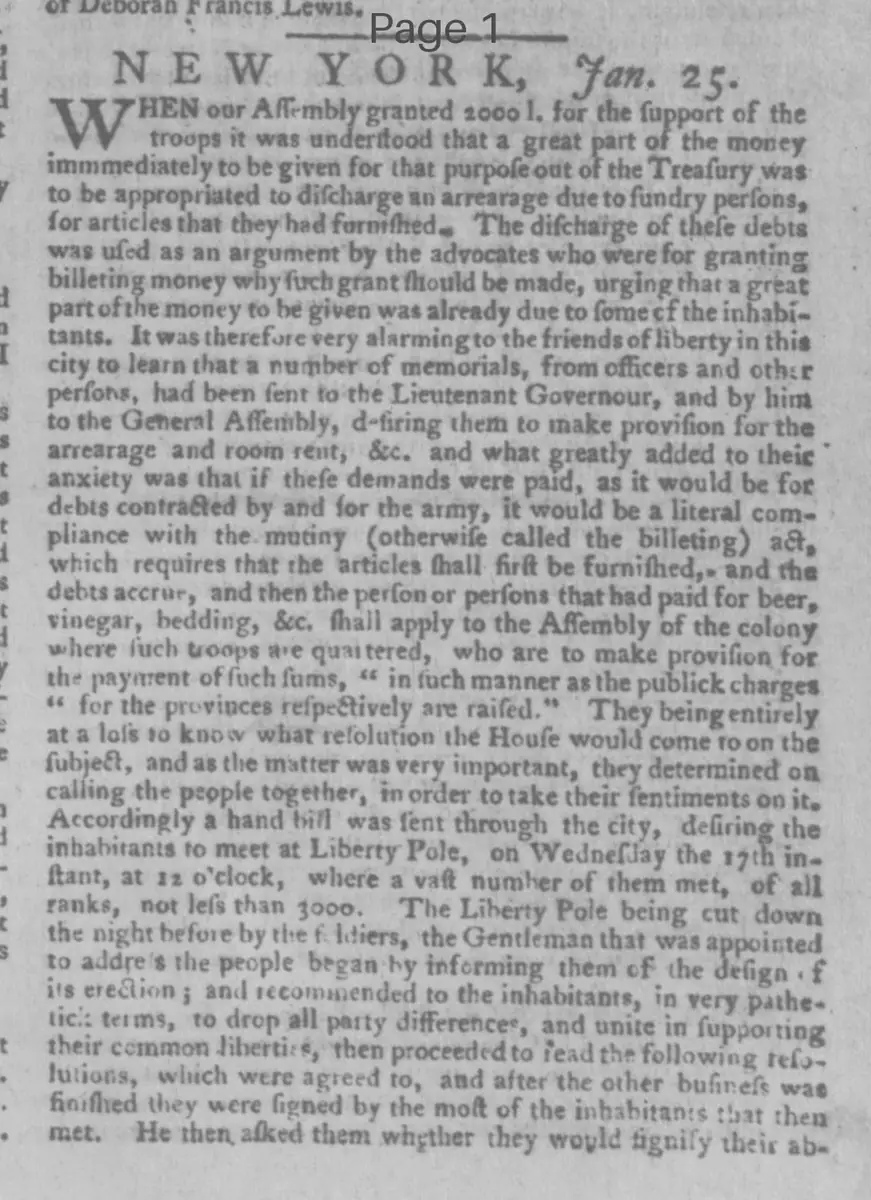
When our Assembly granted 2000 l. for the support of the troops it was understood that a great part of the money immediately to be given for that purpose out of the Treasury was to be appropriated to discharge an arrearage due to sundry persons, for articles that they had furnished. The discharge of these debts was used as an argument by the advocates who were for granting billeting money why such grant should be made, urging that a great part of the money to be given was already due to some of the inhabitants. It was therefore very alarming to the friends of liberty in this city to learn that a number of memorials, from officers and other persons, had been sent to the Lieutenant Governour, and by him to the General Assembly, desiring them to make provision for the arrearage and room rent, &c. and what greatly added to their anxiety was that if these demands were paid, as it would be for debts contracted by and for the army, it would be a literal compliance with the mutiny (otherwise called the billeting) act, which requires that the articles shall first be furnished, and the debts accrue, and then the person or persons that had paid for beer, vinegar, bedding, &c. shall apply to the Assembly of the colony where such troops are quartered, who are to make provision for the payment of such sums, "in such manner as the publick charges for the provinces respectively are raised." They being entirely at a loss to know what resolution the House would come to on the subject, and as the matter was very important, they determined on calling the people together, in order to take their sentiments on it. Accordingly a hand bill was sent through the city, desiring the inhabitants to meet at Liberty Pole, on Wednesday the 17th instant, at 12 o'clock, where a vast number of them met, of all ranks, not less than 3000. The Liberty Pole being cut down the night before by the soldiers, the Gentleman that was appointed to address the people began by informing them of the design of its erection; and recommended to the inhabitants, in very pathetic terms, to drop all party difference, and unite in supporting their common liberty, then proceeded to read the following resolutions, which were agreed to, and after the other business was finished they were signed by the most of the inhabitants that then met. He then asked them whether they would signify their approbation of their abhorrence to a compliance with the mutiny or billeting act, which they did universally, by holding up their hands, and loud huzzas; upon which he proposed to them to appoint a committee that should call the people together, as occasion may require, which they accordingly did.
It is very alarming at this important crisis, notwithstanding the humane and benevolent treatment that the troops quartered in this city have received from the colony, and this city in particular (although we have great ground to suspect they are not stationed here to protect us) that they should be so ungrateful and insulting to the citizens as to make several attempts to blow up and cut down the Liberty Pole, which has been erected as a memorial of freedom. This base conduct is an incontestable proof that they are not only enemies to the peace and good order of this city, but that they manifest a temper devoted to destroy the least monument raised to show the laudable spirit of liberty that prevails among the inhabitants; and as the same diabolical spirit will naturally dispose them to use their utmost endeavours to enslave us, they must be considered by all men, who are actuated by a free spirit of liberty, as enemies, mortal enemies, to all that is dear and valuable to Englishmen: Impressed by these considerations, we
RESOLVE, that we will not employ any soldier, on any terms whatsoever, but that we will treat them with all that abhorrence and contempt which the enemies of our happy constitution deserve; and whereas many of them have repeatedly travelled the streets of this city, in the night, with arms, with which they have attempted to take the lives of many of the citizens, and notwithstanding made their escape, and thereby eluded the laws, and passed with impunity, therefore that the inhabitants may not for the future be insulted, and put in peril of their lives,
RESOLVED, that if any soldier shall be found in the night, having arms (except sentinels and orderly sergeants) or out of barracks after the roll is called, such as are found even without arms, and behave in an insulting manner, shall be treated as enemies to the peace of this city; and we do hereby solemnly engage, to and with each other, that we will, to the utmost of our power, strictly adhere to the above resolutions, and if possible bring the transgressors of them to condign punishment.
What sub-type of article is it?
What keywords are associated?
What entities or persons were involved?
Where did it happen?
Domestic News Details
Primary Location
New York
Event Date
Wednesday The 17th Instant
Key Persons
Outcome
resolutions passed and signed by most attendees; committee appointed to call future meetings; universal approbation shown by raised hands and huzzas.
Event Details
Citizens met at Liberty Pole after it was cut down by soldiers; addressed by a gentleman who urged unity for liberty; resolutions read and agreed to against complying with billeting act and employing soldiers; vow to treat armed or insulting soldiers at night as enemies.