Thank you for visiting SNEWPapers!
Sign up free
Daily National Intelligencer
Washington, District Of Columbia
What is this article about?
Topographical memoir from an army officer's journal dated October 15, 1815, describing Castine, Maine's history, geography, military fortifications like Fort George, strategic importance to British and Americans, shipping tonnage, and the 1814 British occupation and evacuation.
Clipping
OCR Quality
Full Text
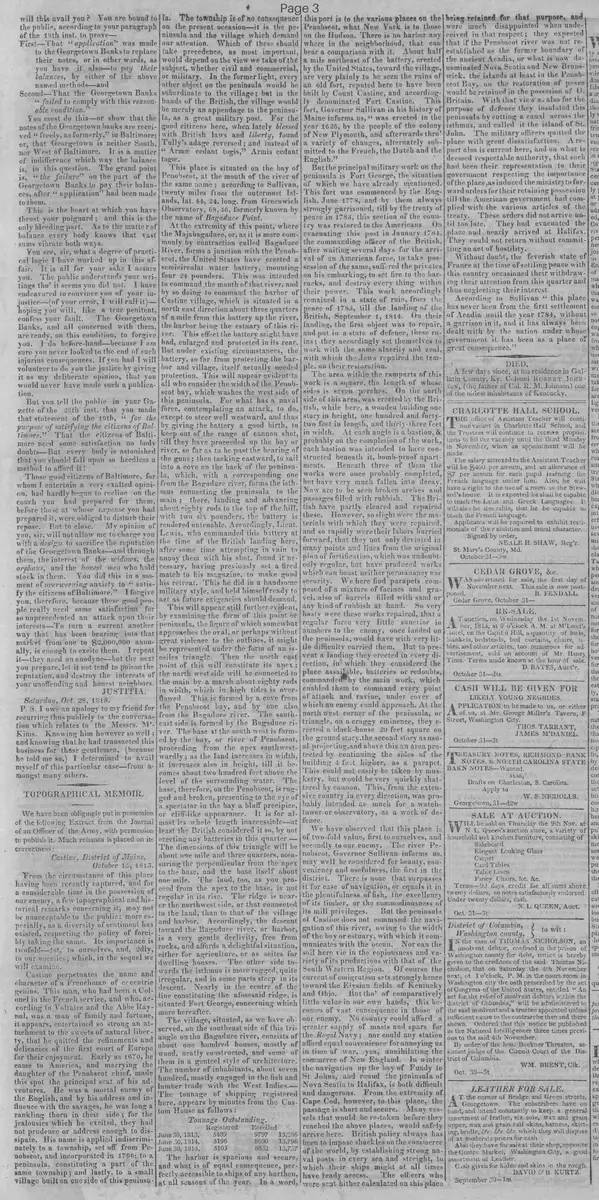
We have been obligingly put in possession of the following Extract from the Journal of an Officer of the Army, with permission to publish it. Much reliance is placed on its correctness:
Castine, District of Maine, October 15, 1815.
From the circumstance of this place having been recently captured, and for a considerable time in the possession of our enemy, a few topographical and historical remarks concerning it, may not be unacceptable to the public: more especially, as a diversity of sentiment has existed, respecting the policy of forcibly taking the same. Its importance is twofold—1st, to ourselves, and, 2dly, to our enemies; which, in the sequel we will examine.
Castine perpetuates the name and character of a Frenchman of eccentric genius. This man, who had been a Colonel in the French service, and who, according to Voltaire and the Abbe Raynal, was a man of family and fortune, it appears, entertained so strong an attachment to the sweets of natural liberty, that he quitted the refinements and delicacies of the first court of Europe for their enjoyment. Early as 1670, he came to America, and marrying the daughter of the Penobscot chief, made this spot the principal seat of his adventures. He was a mortal enemy of the English, and by his address and influence with the savages, he was long a rankling thorn in their side; for the jealousies which he excited, they had not prudence or address enough to dissipate. His name is applied indiscriminately to a township, set off from Penobscot, and incorporated in 1796; to a peninsula, constituting a part of the same township; and lastly, to a small village built on one side of this peninsula.
The township is of no consequence on the present occasion—it is the peninsula and the village which demand our attention. Which of these should take precedence, as most important, would depend on the view we take of the subject, whether civil and commercial, or military. In the former light, every other object on the peninsula would be subordinate to the village; but in the hands of the British, the village would be merely an appendage to the peninsula, as a great military post. For the good citizens here, when lately blessed with British laws and liberty, found Tully's adage reversed: and instead of "Arma cedant togis," Armis cedant toga.
This place is situated on the bay of Penobscot, at the mouth of the river of the same name; according to Sullivan, twenty miles from the outermost Islands, lat. 44, 24, long. from Greenwich Observatory, 68, 46, formerly known by the name of Bagaduce Point.
At the extremity of this point, where the Majabagaduce, or, as it is more commonly by contraction called Bagaduce River, forms a junction with the Penobscot, the United States have erected a semicircular water battery, mounting four 24 pounders. This was intended to command the mouth of that river. and by so doing to command the harbor of Castine village, which is situated in a north east direction about three quarters of a mile from this battery up the river, the harbor being the estuary of this river. This effect the battery might have had, enlarged and protected in its rear. But under existing circumstances, the battery, so far from protecting the harbor and village, itself actually needed protection. This will appear evident to all who consider the width of the Penobscot bay, which washes the west side of this peninsula. For what has a naval force, contemplating an attack, to do, except to steer well westward, and thus by giving the battery a good berth, to keep out of the range of cannon shot, till they have proceeded up the bay or river, so far as to be past the bearing of the guns; then tacking eastward, to sail into a cove on the back of the peninsula, which, with a corresponding one from the Bagaduce river, forms the isthmus connecting the peninsula to the main; there, landing and advancing about eighty rods to the top of the hill, with two six pounders. the battery is rendered untenable. Accordingly, Lieut. Lewis, who commanded this battery at the time of the British landing here, after some time attempting in vain to annoy them with his shot, found it necessary, having previously set a fired match to his magazine. to make good his retreat. This he did in a handsome military style, and held himself ready to act as future exigencies should demand.
This will appear still further evident, by examining the form of this point or peninsula, the figure of which somewhat approaches the oval, or perhaps without great violence to the outlines, it might be represented under the form of an isosceles triangle. Then the north east point of this will constitute its apex: the north west side will be connected to the main by a marsh about eighty rods in width, which in high tides is over-flowed. This is formed by a cove from the Penobscot bay. and by one also from the Bagaduce river. The south-east side is formed by the Bagaduce river. The base at the south west is formed by the bay, or river of Penobscot. proceeding from the apex southwestwardly; as the land increases in width, it increases also in height, till it becomes about two hundred feet above the level of the surrounding water. The base, therefore, on the Penobscot, is rugged and broken, presenting to the eye of a spectator in the bay a bluff precipice, or cliff-like appearance. It is for almost its whole length inaccessible—at least the British considered it so, by not erecting any batteries in this quarter.—The dimensions of this triangle will be about one mile and three quarters, measuring the perpendicular from the apex to the base, and the base itself about one mile. The land, too, as you proceed from the apex to the base, is not regular in its rise. The ridge is nearer the northwest side. or that connected to the land, than to that of the village and harbor. Accordingly, the descent toward the Bagaduce river, or harbor. is a very gentle declivity, free from rocks, and affords a delightful situation, either for agriculture, or as sites for dwelling houses. The other side towards the isthmus is more rugged, quite irregular, and in some parts steep in its descent. Nearly in the centre of the line constituting the aforesaid ridge, is situated Fort George, concerning which more hereafter.
The village, situated, as we have observed, on the southeast side of this triangle on the Bagaduce river, consists of about one hundred houses, mostly of wood, neatly constructed, and some of them in a genteel style of architecture. The number of inhabitants, about seven hundred, mostly engaged in the fish and lumber trade with the West Indies.—The tonnage of shipping registered here, appears by minutes from the Custom House as follows:
Tonnage Outstanding.
Registered Enrolled
June 30, 1813, 5489 9797 15,286
June 30, 1814, 5196 8600 13,796
June 30, 1815, 5105 8632 13,737
The harbor is spacious and secure, and what is of equal consequence, perfectly accessible to ships of any burthen, at all seasons of the year. In a word, this port is to the various places on the Penobscot, what New York is to those on the Hudson. There is no harbor any where in the neighborhood, that can bear a comparison with it. About half a mile northeast of the battery, erected by the United States, toward the village. are very plainly to be seen the ruins of an old fort, reputed here to have been built by Count Castine, and accordingly denominated Fort Castine. This fort, Governor Sullivan in his history of Maine informs us, "was erected in the year 1620, by the people of the colony of New Plymouth, and afterwards thro' a variety of changes, alternately submitted to the French, the Dutch and the English."
But the principal military work on the peninsula is Fort George, the situation of which we have already mentioned. This fort was commenced by the English, June 1779, and by them always strongly garrisoned, till by the treaty of peace in 1783, this section of the country was restored to the Americans On evacuating this post in January 1784. the commanding officer of the British, after waiting several days for the arrival of an American force. to take possession of the same, suffered the privates on his embarking, to set fire to the barracks, and destroy every thing within their power. This work accordingly remained in a state of ruin, from the peace of 1783, till the landing of the British, September 1, 1814. On their landing, the first object was to repair. and put in a state of defence, these ruins; they accordingly set themselves to work with the same alacrity and zeal, with which the Jews repaired the temple, on their restoration.
The area within the ramparts of this work is a square, the length of whose sides is seven perches. On the north side of this area, was erected by the British, while here, a wooden building one story in height, one hundred and forty-two feet in length, and thirty-three feet in width. At each angle is a bastion. & probably on the completion of the work. each bastion was intended to have constructed beneath it. bomb-proof apartments. Beneath three of them the works were once probably completed. but have very much fallen into decay. Now are to be seen broken arches and passages filled with rubbish. The British have partly cleared and repaired these. However, so slight were the materials with which they were repaired. and so rapidly were their labors hurried forward, that they not only deviated in many points and lines from the original plan of fortification, which was undoubtedly regular, but have produced works which can boast neither permanency nor security. We here find parapets composed of a mixture of fascines and gravel, also of barrels filled with sand or any kind of rubbish at hand. So very hasty were these works repaired, that a regular force very little superior in numbers to the enemy, once landed on the peninsula, would have with very little difficulty carried them. But to prevent a landing they erected in every direction, in which they considered the place assailable, batteries or redoubts. commanded by the main work, which enabled them to command every point of attack and ravine. under cover of which an enemy could approach. At the north west corner of the peninsula, or triangle, on a craggy eminence, they erected a block-house 20 feet square on the ground story,the second story as usual projecting,and above this an area protected by continuing the sides of the building 4 feet higher, as a parapet. This could not easily be taken by musketry, but would be very quickly shattered by cannon. This, from the extensive country in every direction, was probably intended as much for a watch-tower or observatory, as a work of defence.
We have observed that this place is of two-fold value. first to ourselves. and secondly to our enemy. The river Penobscot, Governor Sullivan informs us. may well be considered for beauty, convenience and usefulness, the first in the district. There is none that surpasses it for ease of navigation, or equals it in the plentifulness of fish, the excellency of its timber, or the commodiousness of its mill privileges. But the peninsula of Castine does not command the navigation of this river, owing to the width of the bay or estuary, with which it communicates with the ocean. Nor can the soil here vie in the copiousness and variety of its productions with that of the South Western Region. Of course the current of emigration sets strongly hence toward the Elysian fields of Kentucky and Ohio. But tho' of comparatively little value in our own hands, this becomes of vast consequence in those of our enemy. No country could afford a greater supply of masts and spars for the Royal Navy; nor could any station afford equal convenience for annoying us in time of war, yea, annihilating the commerce of New England. In winter the navigation up the bay of Fundy to St Johns, and round the peninsula of Nova Scotia to Halifax, is both difficult and dangerous. From the extremity of Cape Cod, however, to this place, the passage is short and secure. Many vessels that would be re-taken before they reached the above places, would safely arrive here. British policy always has been to impose shackles on the commerce of the world, by establishing strong naval posts in every sea and streight, to which their ships might at all times have ready access. The officers who were sent hither calculated on this place being retained for that purpose, and were much disappointed when undeceived in that respect; they expected that if the Penobscot river was not re-established as the former boundary of the ancient Acadia, or what is now denominated Nova Scotia and New Brunswick. the islands at least in the Penobscot Bay, on the restoration of peace would be retained in the possession of G. Britain. With that view as also for the purpose of defence they insulated this peninsula by cutting a canal across the isthmus, and called it the island of St. John. The military officers quitted the place with great dissatisfaction. A report also is current here, and on what is deemed respectable authority, that such had been their representation to their government respecting the importance of the place,as induced the ministry to forward orders for their retaining possession till the American government had complied with the various articles of the treaty. These orders did not arrive until too late. They had evacuated the place and nearly arrived at Halifax. They could not return without committing an act of hostility.
Without doubt, the feverish state of France at the time of settling peace with this country occasioned their withdrawing their attention from this quarter and thus neglecting their interest.
According to Sullivan "this place has never been from the first settlement of Acadia until the year 1784, without a garrison in it, and it has always been dealt with by the nation under whose government it has been as a place of great consequence."
What sub-type of article is it?
What keywords are associated?
What entities or persons were involved?
Where did it happen?
Domestic News Details
Primary Location
Castine, District Of Maine
Event Date
October 15, 1815
Key Persons
Outcome
british occupied castine from september 1, 1814, repaired fortifications, but evacuated in 1815 per treaty; no casualties mentioned; strategic value analyzed as greater to british for naval purposes.
Event Details
Detailed topographical and historical description of Castine peninsula, village, harbor, and fortifications including Fort George and a U.S. battery; recounts British landing, repairs, and evacuation; discusses strategic military and commercial importance.