Thank you for visiting SNEWPapers!
Sign up free
Editorial
December 25, 1787
The New York Journal, And Daily Patriotic Register
New York, New York County, New York
What is this article about?
Federalist No. 27 by Publius argues that the proposed U.S. Constitution will not need military force to enforce laws, as better federal administration, broader elections, and familiarity with federal authority will foster public confidence and obedience, unlike weaker state governments or loose confederacies.
Clipping
OCR Quality
98%
Excellent
Full Text
For the Daily Patriotic Register.
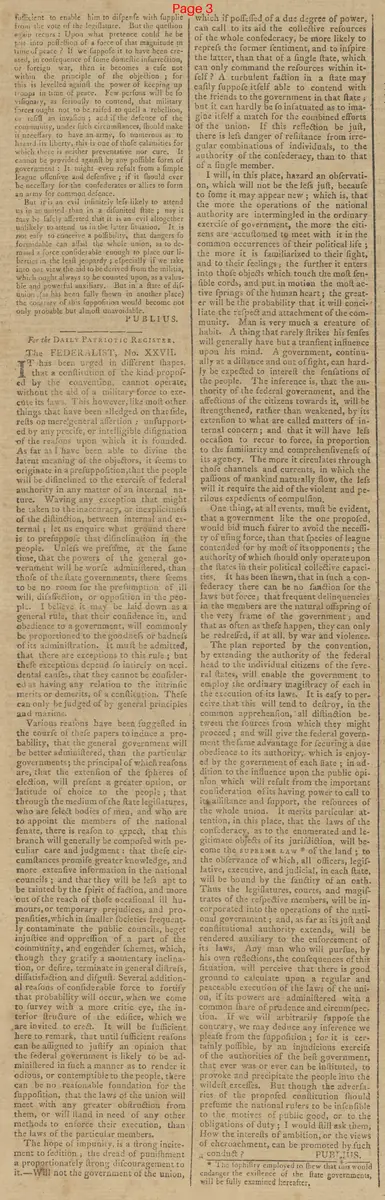
The FEDERALIST. No. XXVII.
It has been urged, in different shapes, that a constitution of the kind proposed by the convention, cannot operate, without the aid of a military force to execute its laws. This however, like most other things that have been alleged on that side, rests on mere general assertion; unsupported by any precise, or intelligible designation of the reasons upon which it is founded. As far as I have been able to divine the latent meaning of the objectors, it seems to originate in a presupposition, that the people will be disinclined to the exercise of federal authority in any matter of an internal nature. Waving any exception that might be taken to the inaccuracy, or inexplicitness of the distinction, between internal and external: let us enquire what ground there is to presuppose that disinclination in the people. Unless we presume, at the same time, that the powers of the general government will be worse administered, than those of the state governments, there seems to be no room for the presumption of ill will, disaffection, or opposition in the people. I believe it may be laid down as a general rule, that their confidence in, and obedience to a government, will commonly be proportioned to the goodness or badness of its administration. It must be admitted, that there are exceptions to this rule; but these exceptions depend so entirely on accidental causes, that they cannot be considered as having any relation to the intrinsic merits or demerits, of a constitution. These can only be judged of by general principles and maxims.
Various reasons have been suggested in the course of these papers to induce a probability, that the general government will be better administered, than the particular governments; the principal of which reasons are, that the extension of the spheres of election, will present a greater option, or latitude of choice to the people; that through the medium of the state legislatures, who are elect bodies of men, and who are to appoint the members of the national senate, there is reason to expect, that this branch will generally be composed with peculiar care and judgment: that these circumstances promise greater knowledge, and more extensive information in the national councils; and that they will be less apt to be tainted by the spirit of faction, and more out of the reach of those occasional ill humours, or temporary prejudices, and propensities, which in smaller societies frequently contaminate the public councils, beget injustice and oppression of a part of the community, and engender schemes, which, though they gratify a momentary inclination, or desire, terminate in general dissatisfaction and disgust. Several additional reasons of considerable force, to fortify that probability, will occur, when we come to survey with a more critical eye, the interior structure of the edifice, which we are invited to erect. It will be sufficient here to remark, that until sufficient reasons can be assigned to justify an opinion that the federal government is likely to be administered in such a manner as to render it odious, or contemptible to the people, there can be no reasonable foundation for the supposition, that the laws of the union will meet with any greater obstruction from them, or will stand in need of any other methods to enforce their execution, than the laws of the particular members.
The hope of impunity, is a strong incitement to sedition; the dread of punishment a proportionately strong discouragement to it. Will not the government of the union, which if possessed of a due degree of power, can call to its aid the collective resources of the whole confederacy, be more likely to repress the former sentiment, and to inspire the latter, than that of a single state, which can only command the resources within itself? A turbulent faction in a state may easily suppose itself able to contend with the friends to the government in that state; but it can hardly be so infatuated as to imagine itself a match for the combined efforts of the union. If this reflection be just, there is less danger of resistance from irregular combinations of individuals, to the authority of the confederacy, than to that of a single member.
I will, in this place, hazard an observation, which will not be the less just, because to some it may appear new; which is, that the more the operations of the national authority are intermingled in the ordinary exercise of government, the more the citizens are accustomed to meet with it in the common occurrences of their political life; the more it is familiarized to their sight, and to their feelings; the further it enters into those objects which touch the most sensible cords, and put in motion the most active springs of the human heart; the greater will be the probability that it will conciliate the respect and attachment of the community. Man is very much a creature of habit. A thing that rarely strikes his senses will generally have but a transient influence upon his mind. A government, continually at a distance and out of sight, can hardly be expected to interest the sensations of the people. The inference is, that the authority of the federal government, and the affections of the citizens towards it, will be strengthened, rather than weakened, by its extension to what are called matters of internal concern; and that it will have less occasion to recur to force, in proportion to the familiarity and comprehensiveness of its agency. The more it circulates through those channels and currents, in which the passions of mankind naturally flow, the less will it require the aid of the violent and perilous expedients of compulsion.
One thing, at all events, must be evident, that a government like the one proposed, would bid much fairer to avoid the necessity of using force, than that species of league contended for by most of its opponents; the authority of which should only operate upon the states in their political collective capacities. It has been shewn, that in such a confederacy there can be no sanction for the laws but force; that frequent delinquencies in the members are the natural offspring of the very frame of the government; and that as often as these happen, they can only be redressed, if at all, by war and violence.
The plan reported by the convention, by extending the authority of the federal head to the individual citizens of the several states, will enable the government to employ the ordinary magistracy of each, in the execution of its laws. It is easy to perceive that this will tend to destroy, in the common apprehension, all distinction between the sources from which they might proceed; and will give the federal government the same advantage for securing a due obedience to its authority, which is enjoyed by the government of each state; in addition to the influence upon the public opinion which will result from the important consideration of its having power to call to its assistance and support, the resources of the whole union. It merits particular attention, in this place, that the laws of the confederacy, as to the enumerated and legitimate objects of its jurisdiction, will become the SUPREME LAW of the land; to the observance of which, all officers, legislative, executive, and judicial, in each state, will be bound by the sanctity of an oath. Thus the legislatures, courts, and magistrates of the respective members, will be incorporated into the operations of the national government; and, as far as its just and constitutional authority extends, will be rendered auxiliary to the enforcement of its laws.
Any man who will pursue, by his own reflections, the consequences of this situation, will perceive that there is good ground to calculate upon a regular and peaceable execution of the laws of the union, if its powers are administered with a common share of prudence and circumspection. If we will arbitrarily suppose the contrary, we may deduce any inferences we please from the supposition: for it is certain that it is possible, by an injudicious exercise of the authorities of the best government that ever was, or ever can be instituted, to provoke and precipitate the people into the wildest excesses. But though the adversaries of the proposed constitution should presume the national rulers to be insensible to the motives of public good, or to the obligations of duty; I would still ask them, How the interests of ambition, or the views of encroachment, can be promoted by such a conduct?
PUBLIUS.
* The sophistry employed to shew that this would endanger the existence of the state governments, will be fully examined hereafter.
The FEDERALIST. No. XXVII.
It has been urged, in different shapes, that a constitution of the kind proposed by the convention, cannot operate, without the aid of a military force to execute its laws. This however, like most other things that have been alleged on that side, rests on mere general assertion; unsupported by any precise, or intelligible designation of the reasons upon which it is founded. As far as I have been able to divine the latent meaning of the objectors, it seems to originate in a presupposition, that the people will be disinclined to the exercise of federal authority in any matter of an internal nature. Waving any exception that might be taken to the inaccuracy, or inexplicitness of the distinction, between internal and external: let us enquire what ground there is to presuppose that disinclination in the people. Unless we presume, at the same time, that the powers of the general government will be worse administered, than those of the state governments, there seems to be no room for the presumption of ill will, disaffection, or opposition in the people. I believe it may be laid down as a general rule, that their confidence in, and obedience to a government, will commonly be proportioned to the goodness or badness of its administration. It must be admitted, that there are exceptions to this rule; but these exceptions depend so entirely on accidental causes, that they cannot be considered as having any relation to the intrinsic merits or demerits, of a constitution. These can only be judged of by general principles and maxims.
Various reasons have been suggested in the course of these papers to induce a probability, that the general government will be better administered, than the particular governments; the principal of which reasons are, that the extension of the spheres of election, will present a greater option, or latitude of choice to the people; that through the medium of the state legislatures, who are elect bodies of men, and who are to appoint the members of the national senate, there is reason to expect, that this branch will generally be composed with peculiar care and judgment: that these circumstances promise greater knowledge, and more extensive information in the national councils; and that they will be less apt to be tainted by the spirit of faction, and more out of the reach of those occasional ill humours, or temporary prejudices, and propensities, which in smaller societies frequently contaminate the public councils, beget injustice and oppression of a part of the community, and engender schemes, which, though they gratify a momentary inclination, or desire, terminate in general dissatisfaction and disgust. Several additional reasons of considerable force, to fortify that probability, will occur, when we come to survey with a more critical eye, the interior structure of the edifice, which we are invited to erect. It will be sufficient here to remark, that until sufficient reasons can be assigned to justify an opinion that the federal government is likely to be administered in such a manner as to render it odious, or contemptible to the people, there can be no reasonable foundation for the supposition, that the laws of the union will meet with any greater obstruction from them, or will stand in need of any other methods to enforce their execution, than the laws of the particular members.
The hope of impunity, is a strong incitement to sedition; the dread of punishment a proportionately strong discouragement to it. Will not the government of the union, which if possessed of a due degree of power, can call to its aid the collective resources of the whole confederacy, be more likely to repress the former sentiment, and to inspire the latter, than that of a single state, which can only command the resources within itself? A turbulent faction in a state may easily suppose itself able to contend with the friends to the government in that state; but it can hardly be so infatuated as to imagine itself a match for the combined efforts of the union. If this reflection be just, there is less danger of resistance from irregular combinations of individuals, to the authority of the confederacy, than to that of a single member.
I will, in this place, hazard an observation, which will not be the less just, because to some it may appear new; which is, that the more the operations of the national authority are intermingled in the ordinary exercise of government, the more the citizens are accustomed to meet with it in the common occurrences of their political life; the more it is familiarized to their sight, and to their feelings; the further it enters into those objects which touch the most sensible cords, and put in motion the most active springs of the human heart; the greater will be the probability that it will conciliate the respect and attachment of the community. Man is very much a creature of habit. A thing that rarely strikes his senses will generally have but a transient influence upon his mind. A government, continually at a distance and out of sight, can hardly be expected to interest the sensations of the people. The inference is, that the authority of the federal government, and the affections of the citizens towards it, will be strengthened, rather than weakened, by its extension to what are called matters of internal concern; and that it will have less occasion to recur to force, in proportion to the familiarity and comprehensiveness of its agency. The more it circulates through those channels and currents, in which the passions of mankind naturally flow, the less will it require the aid of the violent and perilous expedients of compulsion.
One thing, at all events, must be evident, that a government like the one proposed, would bid much fairer to avoid the necessity of using force, than that species of league contended for by most of its opponents; the authority of which should only operate upon the states in their political collective capacities. It has been shewn, that in such a confederacy there can be no sanction for the laws but force; that frequent delinquencies in the members are the natural offspring of the very frame of the government; and that as often as these happen, they can only be redressed, if at all, by war and violence.
The plan reported by the convention, by extending the authority of the federal head to the individual citizens of the several states, will enable the government to employ the ordinary magistracy of each, in the execution of its laws. It is easy to perceive that this will tend to destroy, in the common apprehension, all distinction between the sources from which they might proceed; and will give the federal government the same advantage for securing a due obedience to its authority, which is enjoyed by the government of each state; in addition to the influence upon the public opinion which will result from the important consideration of its having power to call to its assistance and support, the resources of the whole union. It merits particular attention, in this place, that the laws of the confederacy, as to the enumerated and legitimate objects of its jurisdiction, will become the SUPREME LAW of the land; to the observance of which, all officers, legislative, executive, and judicial, in each state, will be bound by the sanctity of an oath. Thus the legislatures, courts, and magistrates of the respective members, will be incorporated into the operations of the national government; and, as far as its just and constitutional authority extends, will be rendered auxiliary to the enforcement of its laws.
Any man who will pursue, by his own reflections, the consequences of this situation, will perceive that there is good ground to calculate upon a regular and peaceable execution of the laws of the union, if its powers are administered with a common share of prudence and circumspection. If we will arbitrarily suppose the contrary, we may deduce any inferences we please from the supposition: for it is certain that it is possible, by an injudicious exercise of the authorities of the best government that ever was, or ever can be instituted, to provoke and precipitate the people into the wildest excesses. But though the adversaries of the proposed constitution should presume the national rulers to be insensible to the motives of public good, or to the obligations of duty; I would still ask them, How the interests of ambition, or the views of encroachment, can be promoted by such a conduct?
PUBLIUS.
* The sophistry employed to shew that this would endanger the existence of the state governments, will be fully examined hereafter.
What sub-type of article is it?
Constitutional
What keywords are associated?
Federalist Papers
Constitution Ratification
Federal Authority
Government Administration
Military Force
Public Obedience
What entities or persons were involved?
Publius
The Convention
Federal Government
State Governments
Editorial Details
Primary Topic
Defense Of Federal Authority Without Need For Military Enforcement
Stance / Tone
Supportive Of The Proposed Constitution
Key Figures
Publius
The Convention
Federal Government
State Governments
Key Arguments
Objections To The Constitution Rest On Unsupported Assertions About Needing Military Force.
Public Confidence In Government Depends On Its Administration Quality.
Federal Government Likely Better Administered Due To Larger Election Spheres And Less Factionalism.
Familiarity With Federal Authority Will Foster Respect And Reduce Need For Force.
Proposed Constitution Avoids Force By Extending Authority To Individuals Via State Magistracy.
Confederacy Model Requires Force For Enforcement, Unlike The Proposed Plan.