Thank you for visiting SNEWPapers!
Sign up free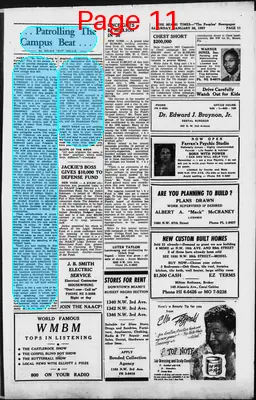
Story
January 26, 1957
The Miami Times
Miami, Dade County, Florida
What is this article about?
Part II of a series advising high school seniors on entering college, covering challenges like meeting new people, handling sudden freedom, adapting to new studies, and developing critical thinking skills.
Clipping
OCR Quality
98%
Excellent
Full Text
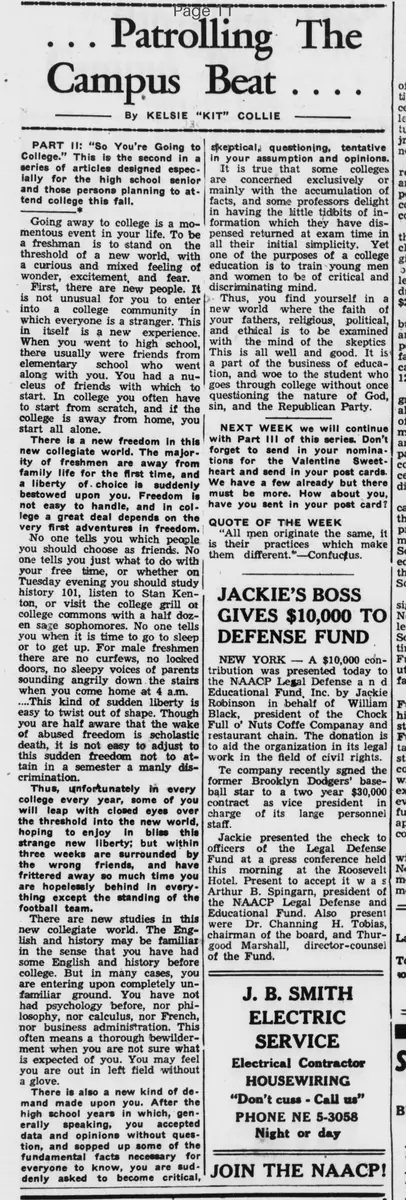
Patrolling The Campus Beat
By KELSIE "KIT" COLLIE
PART II: "So You're Going to College." This is the second in a series of articles designed especially for the high school senior and those persons planning to attend college this fall.
Going away to college is a momentous event in your life. To be a freshman is to stand on the threshold of a new world, with a curious and mixed feeling of wonder, excitement, and fear.
First, there are new people. It is not unusual for you to enter into a college community in which everyone is a stranger. This in itself is a new experience.
When you went to high school, there usually were friends from elementary school who went along with you. You had a nucleus of friends with which to start. In college you often have to start from scratch, and if the college is away from home, you start all alone.
There is a new freedom in this new collegiate world. The majority of freshmen are away from family life for the first time, and a liberty of choice is suddenly bestowed upon you. Freedom is not easy to handle, and in college a great deal depends on the very first adventures in freedom.
No one tells you which people you should choose as friends. No one tells you just what to do with your free time, or whether on Tuesday evening you should study history 101, listen to Stan Kenton, or visit the college grill or college commons with a half dozen sage sophomores. No one tells you when it is time to go to sleep or to get up. For male freshmen there are no curfews, no locked doors, no sleepy voices of parents sounding angrily down the stairs when you come home at 4 a.m.
This kind of sudden liberty is easy to twist out of shape. Though you are half aware that the wake of abused freedom is scholastic death, it is not easy to adjust to this sudden freedom not to attain in a semester a manly discrimination.
Thus, unfortunately in every college every year, some of you will leap with closed eyes over the threshold into the new world, hoping to enjoy in bliss this strange new liberty; but within three weeks are surrounded by the wrong friends, and have frittered away so much time you are hopelessly behind in everything except the standing of the football team.
There are new studies in this new collegiate world. The English and history may be familiar in the sense that you have had some English and history before college. But in many cases, you are entering upon completely unfamiliar ground. You have not had psychology before, nor philosophy, nor calculus, nor French, nor business administration. This often means a thorough bewilderment when you are not sure what is expected of you. You may feel you are out in left field without a glove.
There is also a new kind of demand made upon you. After the high school years in which, generally speaking, you accepted data and opinions without question, and sopped up some of the fundamental facts necessary for everyone to know, you are suddenly asked to become critical, skeptical, questioning, tentative in your assumption and opinions.
It is true that some colleges are concerned exclusively or mainly with the accumulation of facts, and some professors delight in having the little tidbits of information which they have dispensed returned at exam time in all their initial simplicity. Yet one of the purposes of a college education is to train young men and women to be of critical and discriminating mind.
Thus, you find yourself in a new world where the faith of your fathers, religious, political, and ethical is to be examined with the mind of the skeptics. This is all well and good. It is a part of the business of education, and woe to the student who goes through college without once questioning the nature of God, sin, and the Republican Party.
NEXT WEEK we will continue with Part III of this series. Don't forget to send in your nominations for the Valentine Sweetheart and send in your post cards. We have a few already but there must be more. How about you, have you sent in your post card?
By KELSIE "KIT" COLLIE
PART II: "So You're Going to College." This is the second in a series of articles designed especially for the high school senior and those persons planning to attend college this fall.
Going away to college is a momentous event in your life. To be a freshman is to stand on the threshold of a new world, with a curious and mixed feeling of wonder, excitement, and fear.
First, there are new people. It is not unusual for you to enter into a college community in which everyone is a stranger. This in itself is a new experience.
When you went to high school, there usually were friends from elementary school who went along with you. You had a nucleus of friends with which to start. In college you often have to start from scratch, and if the college is away from home, you start all alone.
There is a new freedom in this new collegiate world. The majority of freshmen are away from family life for the first time, and a liberty of choice is suddenly bestowed upon you. Freedom is not easy to handle, and in college a great deal depends on the very first adventures in freedom.
No one tells you which people you should choose as friends. No one tells you just what to do with your free time, or whether on Tuesday evening you should study history 101, listen to Stan Kenton, or visit the college grill or college commons with a half dozen sage sophomores. No one tells you when it is time to go to sleep or to get up. For male freshmen there are no curfews, no locked doors, no sleepy voices of parents sounding angrily down the stairs when you come home at 4 a.m.
This kind of sudden liberty is easy to twist out of shape. Though you are half aware that the wake of abused freedom is scholastic death, it is not easy to adjust to this sudden freedom not to attain in a semester a manly discrimination.
Thus, unfortunately in every college every year, some of you will leap with closed eyes over the threshold into the new world, hoping to enjoy in bliss this strange new liberty; but within three weeks are surrounded by the wrong friends, and have frittered away so much time you are hopelessly behind in everything except the standing of the football team.
There are new studies in this new collegiate world. The English and history may be familiar in the sense that you have had some English and history before college. But in many cases, you are entering upon completely unfamiliar ground. You have not had psychology before, nor philosophy, nor calculus, nor French, nor business administration. This often means a thorough bewilderment when you are not sure what is expected of you. You may feel you are out in left field without a glove.
There is also a new kind of demand made upon you. After the high school years in which, generally speaking, you accepted data and opinions without question, and sopped up some of the fundamental facts necessary for everyone to know, you are suddenly asked to become critical, skeptical, questioning, tentative in your assumption and opinions.
It is true that some colleges are concerned exclusively or mainly with the accumulation of facts, and some professors delight in having the little tidbits of information which they have dispensed returned at exam time in all their initial simplicity. Yet one of the purposes of a college education is to train young men and women to be of critical and discriminating mind.
Thus, you find yourself in a new world where the faith of your fathers, religious, political, and ethical is to be examined with the mind of the skeptics. This is all well and good. It is a part of the business of education, and woe to the student who goes through college without once questioning the nature of God, sin, and the Republican Party.
NEXT WEEK we will continue with Part III of this series. Don't forget to send in your nominations for the Valentine Sweetheart and send in your post cards. We have a few already but there must be more. How about you, have you sent in your post card?
What sub-type of article is it?
Advice Column
Educational Guide
What themes does it cover?
Moral Virtue
Social Manners
What keywords are associated?
College Freshman
New Freedom
Academic Adjustment
Critical Thinking
Social Integration
What entities or persons were involved?
Kelsie "Kit" Collie
Where did it happen?
College Campus
Story Details
Key Persons
Kelsie "Kit" Collie
Location
College Campus
Story Details
Advises freshmen on navigating new social environments, managing freedom to avoid academic failure, adapting to unfamiliar subjects, and embracing critical thinking in college life.